Storage
Garage Gym Shelving: Capacity, Depth and What Fits
Shelf ratings quote hundreds of pounds, but small gym gear usually runs out of depth first. Measure your biggest item, add a little clearance, then check the load label.
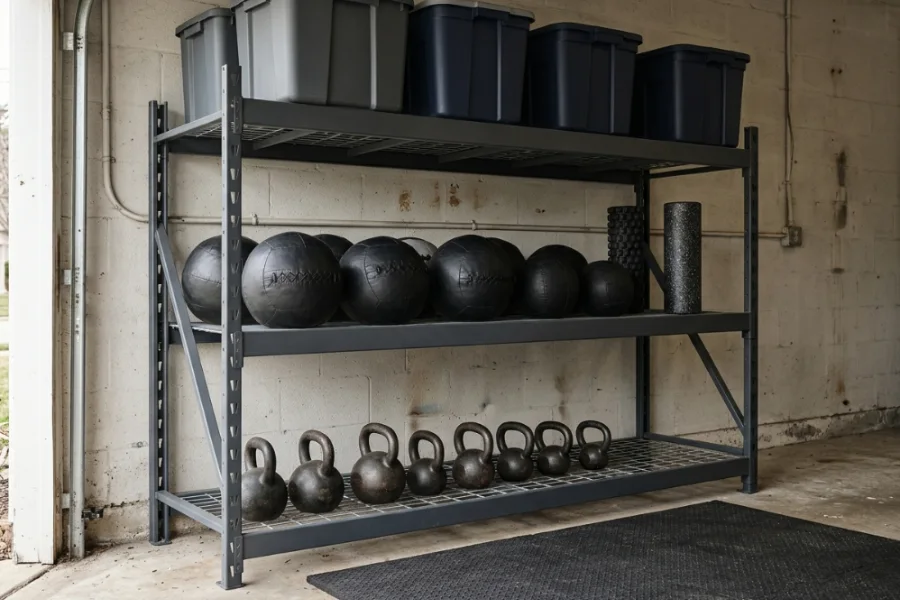
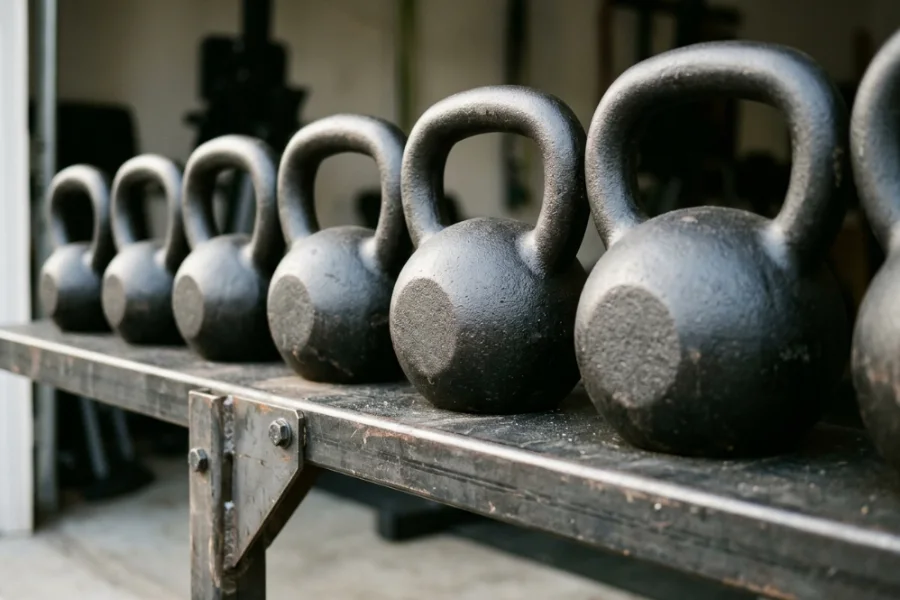
The garage wall is empty, the kettlebells sit in a pile, and two wall balls roll into the corner. Garage gym shelving looks like the quick fix.
Listings quote ratings of hundreds of pounds per shelf. That number rarely decides what fits. A 14 inch wall ball and a 17.7 inch plate run out of shelf depth first. Count your gear first with how much wall and floor your gear needs.
Below I work through depth arithmetic, load labels, anchoring and damp concrete. Every figure is my own planning math, not a test and not engineering advice. The standard behind it is on how these guides are evaluated.
How deep should shelves be for gym gear?
Choose a shelf at least as deep as your largest item, plus an inch or two of margin, my rule of thumb. A 14 inch wall ball overhangs a 12 inch shelf, and a plate lying flat overhangs a 16 inch one. Kettlebells fit almost any depth.
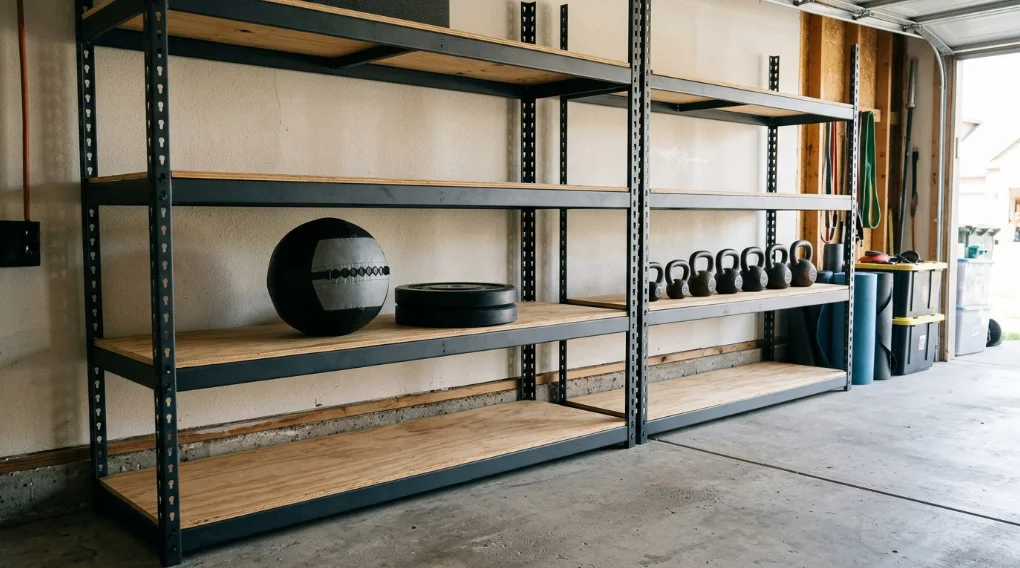
Garage units are commonly sold 12 to 24 inches deep. Most 45 lb plates are about 17.7 inches (450 mm) across, though cast iron ones can vary. Maker pages list a 20 lb soft wall ball at 14 inches.
| Shelf depth | 45 lb plate lying flat | 14 inch wall ball |
|---|---|---|
| 12 in | Overhangs 5.7 in | Overhangs 2 in |
| 16 in | Overhangs 1.7 in | 2 in spare |
| 18 in | 0.3 in spare | 4 in spare |
| 24 in | 6.3 in spare | 10 in spare |
Kettlebells are the easy case. One maker lists a 50 lb bell at 6.9 inches front to back, 8.3 wide and 10.6 tall, so width and height limit it, not depth.
A flat plate pushed back on a 16 inch shelf keeps its center over the deck, but one knock can push it off. On edge, it needs 17.7 inches of height and something to stop it rolling. Pegs suit plates better, as storing bumper plates by peg length and floor space shows.
Depth costs floor too. A 24 inch shelf takes two feet of the bay, so if a car shares it, read garage gym storage with a car inside first.
What does a shelf load rating really mean?
A load rating is the maker’s limit for weight spread evenly across one shelf. It is not a limit for a pile in one spot. Check whether the number is per shelf or for the whole unit, then keep the load on each shelf and on the whole unit under the matching figure.
Labels differ. A listing of 1,000 lb for a four-shelf unit may be a whole-unit figure, which divides to about 250 lb per shelf. Some makers print both numbers, and the unit figure can be lower than the shelf figures added up. Some also cut the rating when wheels are fitted.
Even spread matters for dense gear. Ten 45 lb plates lying flat weigh 450 lb and touch at most about 243 square inches (the circle, minus the bore). Take a made-up 48 by 18 inch shelf rated 600 lb. Its deck is 864 square inches, so an even spread is 0.69 lb per square inch. The plate stack presses at about 1.85 lb per square inch, roughly 2.7 times harder, while the total stays under 600.
The label cannot tell you if the deck tolerates that, so ask the maker. Or move plates to a rack built for them, as the comparison of plate trees and wall-mounted plate storage explains.
What fits on one 48 by 18 inch shelf?
A 48 by 18 inch shelf holds less than its width suggests. My example set of four kettlebells and two wall balls needs about 64 inches of row length, or about 21 inches of depth in two rows. One shelf cannot hold both, so plan one shelf per gear type.
| Gear | Space each | Row length | Weight |
|---|---|---|---|
| 4 kettlebells (20, 30, 40, 50 lb) | 7.5 to 8.3 in wide | 35 in | 140 lb |
| 2 wall balls (20 lb each) | 14 in wide | 29 in | 40 lb |
| Both in one row | Not applicable | 64 in | 180 lb |
Row lengths include a 1 inch gap between items, my own assumption, and bell sizes come from one maker’s table. The four bells are 7.5 + 7.9 + 7.9 + 8.3 = 31.6 inches wide, or about 35 with three gaps. Two balls are 14 + 14 + 1 = 29. Together they overrun the shelf by 16 inches. Two rows need about 6.9 + 14 = 21 inches of depth, 3 more than the shelf has.
So the garage gym shelving plan is two shelves, bells low and balls above. Compare 140 lb with the per-shelf label, and 180 lb plus bins with the unit label. Dumbbells are a separate job, and dumbbell storage for small spaces covers racks and trays.
Do freestanding gym shelves need anchoring?
Yes, whenever the maker’s instructions say so, and I would treat it as the default for any tall unit holding heavy gear. Tipping starts when the combined weight’s center moves past the edge of the base. Heavy items low, even loading and a wall anchor all reduce that risk. The maker’s manual governs.
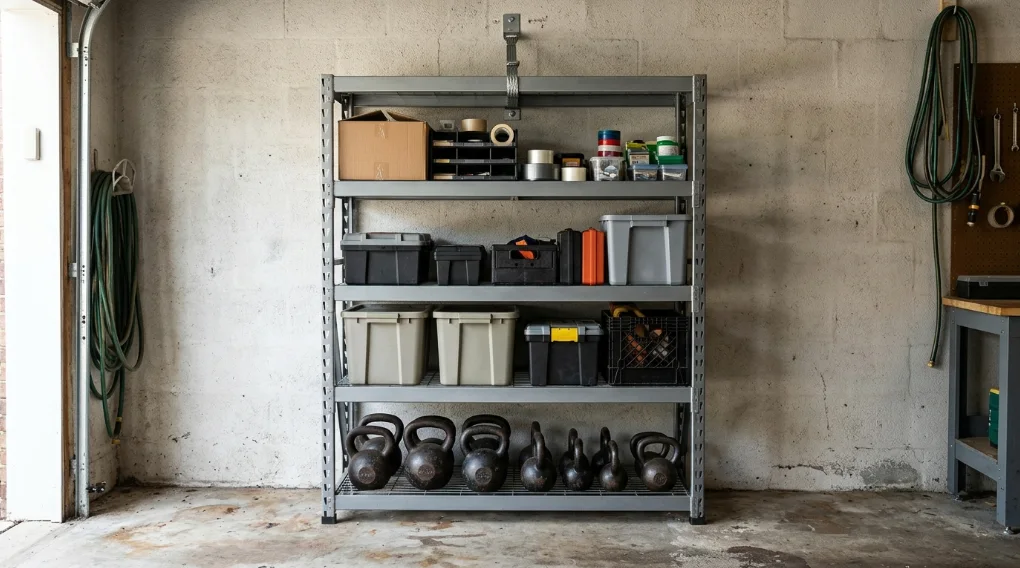
One common size is 72 inches tall on an 18 inch deep base, four times taller than deep. Heavy gear high up lifts the center of gravity. A knock from the side, or a pull on an upper shelf, can then tip the unit.
Put the kettlebells on the bottom shelf and the light bins on top. Spread each load evenly instead of piling one corner. Then fasten the unit to the wall framing as the manual describes. Studs, anchor choice and weight limits are in gym storage studs, anchors and weight limits.
If you are unsure what sits behind the wall, such as wiring or pipes, ask a qualified contractor before you drill.
How does a damp garage change shelf choice?
In a damp garage, shelving helps only if it keeps gear off the slab and the gear goes on dry. Concrete can hold moisture, and steel can rust where its coating chips. If rust keeps returning, fix the air before you replace the shelf.
The guide to why gym equipment rusts in a garage explains the cause. Treat a chipped coating as an early warning. Orange spots on shelf edges or gear within a season usually point to the room, not the unit.
Put straps, bands and rollers away dry. A damp strap left on a bare steel shelf can turn a small coating chip into a rust patch.
Next, decide whether the air needs treating. The guide to whether you need a dehumidifier for a garage gym helps you make that call.
FAQ
Should garage gym shelves have wheels?
Usually not for heavy gear. Some makers publish a lower rating once wheels are fitted, and a rolling base is harder to anchor. If you must move the unit, use the wheeled rating on the label.
How far apart should garage shelves be?
Set each gap at the tallest item plus about 2 inches, my own rule. A 50 lb kettlebell is 10.6 inches tall at one maker, so about 13 works, and a 14 inch ball needs about 16. Typical garage spacing runs 12 to 18 inches.
Is metal, wire or plastic shelving better in a garage gym?
Steel suits heavy, low shelves, and plastic suits light gear in a damp corner. Plastic will not rust, while coated steel or wire can rust once the coating chips or wears. Humidity affects all three, so see garage gym climate control and what to fix first.
Is freestanding or wall-mounted shelving better for a small garage?
Neither wins outright. Freestanding keeps heavy gear low and puts little load on the wall, but tall units need anchoring. Wall-mounted frees the floor and loads its fasteners. If a lease bans drilling, see renter-friendly home gym storage with no drilling.
Final thought
Measure your largest item, add an inch or two, then check the weight against both the shelf label and the unit label. Anchor the unit the way its manual says. The Storage topic holds the next question, such as plates or barbells.
For the wider plan, return to the Guides hub.
How we wrote this guide
I wrote this guide as planning arithmetic, and I have not tested any shelving unit, kettlebell, plate or garage. Plate, ball and kettlebell sizes come from maker specification tables and vary by maker, so use your own measurements. Load ratings, anchoring and wall fasteners belong to the maker and a qualified contractor. Specs checked November 2026.
Which shelf size suits your garage wall?
Send me your wall width, shelf depth and the gear you own, and I will help you check the footprint.
Write to me