Storage
Home Gym Storage: How Much Wall and Floor Your Gear Needs
Count each piece of gear three ways: floor footprint, wall run and vertical reach. The 87 inch bar and the 17.7 inch plate set the limits, so measure those first.
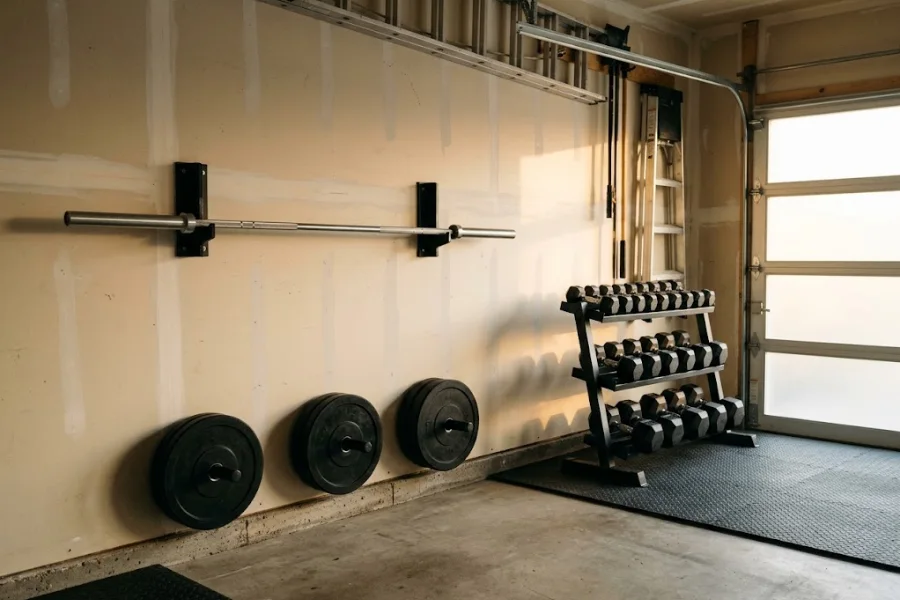
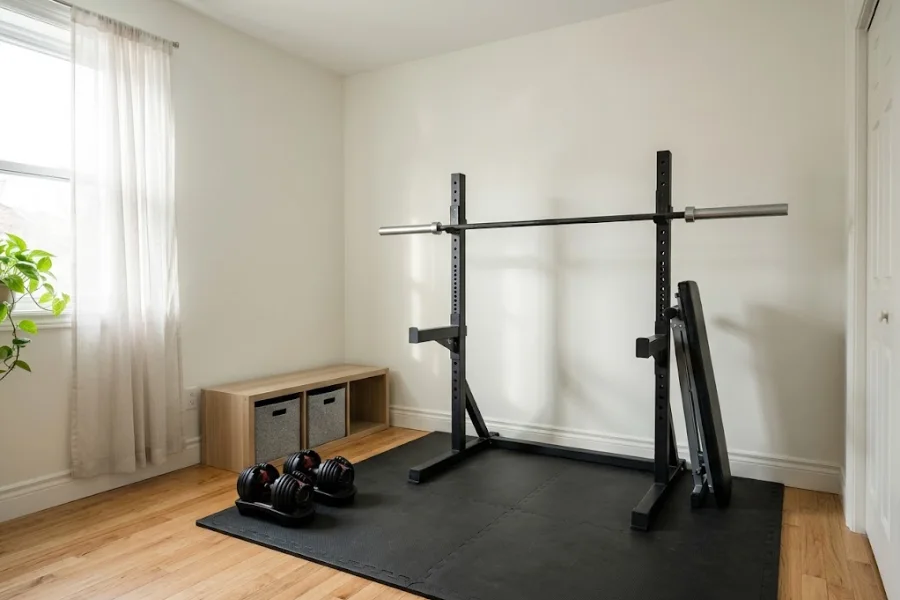
You have a garage corner, a spare room or a basement wall, a rack in place or on order, and plates leaning where they should not. Home gym storage gets easier when you count: every item spends floor footprint, wall run or vertical reach.
Two items usually set the plan. A men’s Olympic bar is about 87 inches long, and a 45 lb plate is about 17.7 inches across. Measure those against your wall and ceiling first, then add the smaller gear.
This guide counts space, not strength. Walls, anchors and floors need a qualified pro, and each gear type has its own guide in the Storage category.
How do you count what your gear needs?
Give every item three numbers: floor footprint in square feet, wall run in inches, and vertical reach in inches. Most items spend one of the three heavily and the others barely. A bar on a wall bracket spends wall run. A dumbbell rack spends floor. A bar stood upright spends height.
Footprint is length times width in inches, divided by 144 to give square feet. Whatever you park on the floor also stands on your flooring, and the flooring thickness guide covers which mat fits heavy gear.
Wall run is the unbroken stretch of wall one item needs, so count only clear wall. A 10 ft wall with a 3 ft doorway leaves 84 inches, which is about 3 inches short of a bar.
Vertical reach is the height an item needs as stored, from floor to its top edge. Measure the room the same way, and check your numbers with the ceiling-height tool on the home page.
Keep one line per item on a sheet: name, footprint, wall run, height. Add each column, and the total that runs out first shows itself.
Which gear dimensions set the limits?
Three sizes do most of the work. A men’s Olympic bar is about 87 inches long, a 45 lb plate is about 17.7 inches across, and a bar sleeve loads about 16 inches per side. These set the wall run, the plate row and the deepest plate stack.
| Size | What it decides |
|---|---|
| Men’s Olympic bar, about 87 in (2,200 mm) | Wall run if flat, or height if upright; see vertical vs horizontal barbell storage |
| 45 lb plate, about 17.7 in (450 mm) across | Width of each wall peg and height of each plate row |
| Loadable sleeve, about 16 in (415 mm) per side | Most plate depth one side of a bar holds, a yardstick for peg length |
| US wall studs, typically 16 in apart | Where wall storage can bolt, so wall run alone is not enough |
Treat these as typical. Some iron plates run a little larger or smaller, bar lengths vary by maker, and some walls are framed wider than 16 inches. Check your own gear’s listed size and find your own studs.
One result matters for tight rooms. At 84 inches, a 7 ft ceiling is about 3 inches shorter than the bar, so the bar cannot stand upright there. At 96 inches, an 8 ft ceiling leaves roughly 9 inches before any holder. The 7 foot ceiling guide covers what does fit.
What does a worked example look like?
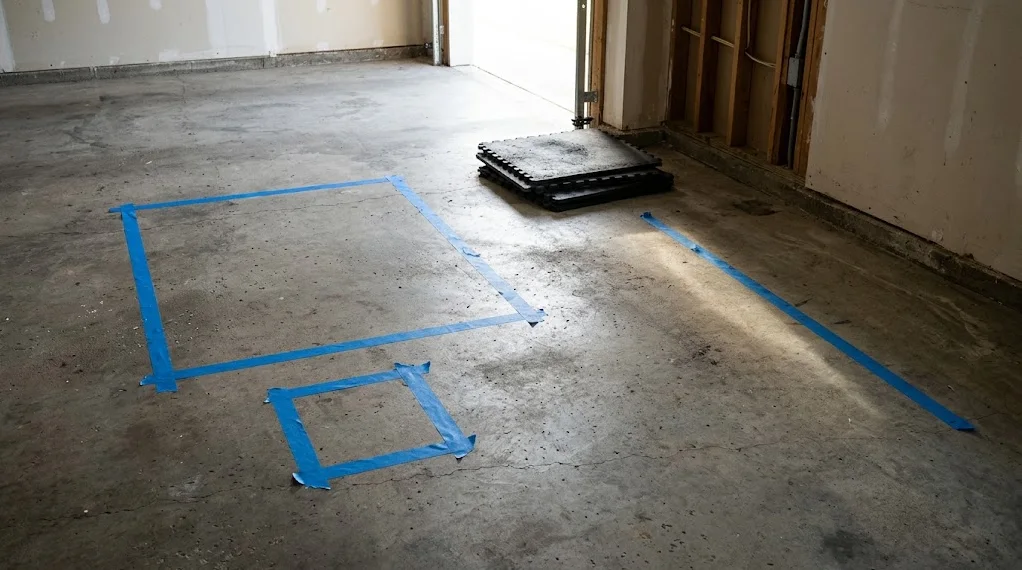
Add every item’s wall run, floor footprint and height, then compare each total with what the room offers. In the example below, a bar and six plates need 122.4 inches of wall side by side, but only 120 are free. Mounting the plates under the bar fixes it.
The numbers are made-up round figures to show the method, not specs: a 10 ft clear wall (120 inches), an 8 ft ceiling, one Olympic bar, six 45 lb plates, a 48 by 20 inch dumbbell rack and a 52 by 24 inch bench.
- Bar stored flat: 87 inches of wall run.
- Six plates on two pegs, three each: 2 x 17.7 = 35.4 inches. Check peg length and plate count.
- Side by side: 87 + 35.4 = 122.4 inches against 120 free, so it fails by 2.4.
- Pegs mounted under the bar share its 87 inches, so the wall passes.
- Floor: 48 x 20 + 52 x 24 = 2,208 square inches, about 15.3 square feet, for a dumbbell rack and bench.
- Add 20 percent for future gear (my planning margin, not a standard): 104 inches of wall, 18.4 square feet.
Check weight before you drill. Three 45 lb plates is 135 lb on each peg. Whether your wall can carry that depends on studs and anchors, so read the studs, anchors and weight limits guide and ask a qualified pro if unsure.
Wall or floor: where should each item go?
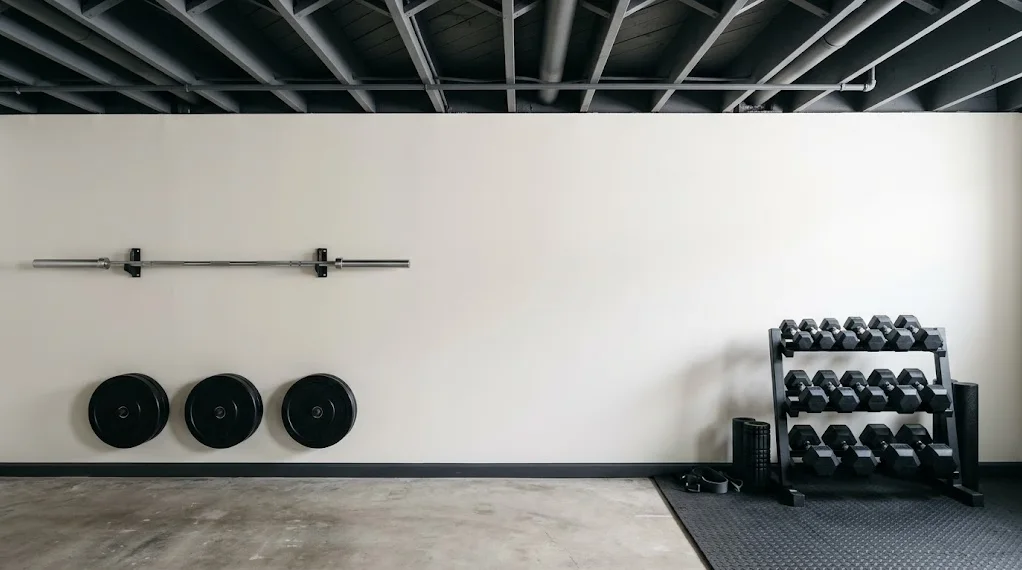
In home gym storage, neither wall nor floor wins in general. Wall storage saves floor but needs a clear run and solid framing. Floor storage needs no drilling but spends footprint. Pick by whichever total from your count is tighter, and keep the heaviest items lowest.
| Gear | Usual home | Suits | Wrong when |
|---|---|---|---|
| Plates | Wall pegs or floor tree | Pegs: a spare wall with studs. Tree: an open corner and no drilling | Pegs: the wall is short. Tree: the floor is your lifting zone |
| Dumbbells | Floor rack | Heavy and compact, so low storage avoids a long drop | The floor is your tightest total |
| Bench | Against a wall, flat or upright | A spare wall edge | Door swing or a low ceiling blocks the upright position |
When two options both fit, take the one that keeps weight low and leaves your lifting zone clear.
Which room limits change the plan?
Three limits change the plan most: a car sharing the garage, a lease that bans drilling, and obstacles that hang below the ceiling. Each one removes a storage type. Cross that type off your list, then redo the count before you buy anything.
A parked car comes first. It takes the middle of the floor and can block wall you counted, so measure free wall and floor with the car in place. See garage gym storage with a car inside.
A rental changes the rules. If you cannot drill, most wall run drops out of the count and floor footprint carries more of the load. Renter-friendly no-drill storage covers what still works.
Low obstacles remove height. Garage door tracks, springs and openers hang below the ceiling, so take height from the lowest one. Upright storage works only if the bar clears all of them, and the minimum ceiling height guide explains how to measure.
FAQ
How much space do you need between gym equipment?
Plan on about 3 feet (36 inches) of clear floor in front of wall storage and between racks. That is my planning rule, not a code. It lets you lift a plate off a peg without turning sideways.
Where do bands, collars and small gear go?
On shelves or in bins. These items are light but easy to lose, so a labelled bin keeps them off the floor. Shelf depth and capacity are covered in the garage gym shelving guide.
Will stored gym equipment rust in a garage?
It can. Bare steel rusts where moisture sits on it, and a damp garage supplies plenty. Keep stored gear dry and airy, then read why gym equipment rusts in a garage and how to stop it.
How much floor space should stay open in a home gym?
Keep your lifting zone free of storage and fit storage around its edges. No standard sets a minimum, so I size the zone from the bar: about 87 inches long, plus room to load plates at both ends.
How do you organize a garage gym?
Sort by weight and use: heavy items low, daily gear near the lifting zone, small items in labelled bins, and one clear floor lane. Then run the three-total count in this guide before you buy racks or shelves.
Final thought
Count the bar and the 45 lb plate first, add the rest, and compare three totals with your room: floor, wall and height. The one that runs out first tells you what to skip and what to store another way.
Next, open the guide for your tightest limit, or browse all home gym planning guides.
How we wrote this guide
I wrote this guide from standard sizes and my own arithmetic. The bar, plate and stud figures are typical values checked in November 2026, and makers vary, so check your own gear’s listed size. The worked example uses made-up round numbers to show the method. I have not tested any product, wall or storage system. For anchors, framing and weight limits, ask a qualified pro.
Want a second look at your numbers?
Send me your wall lengths, ceiling height and gear list, and I will point you to the guide that fits your tightest limit.
Write to me