Storage
Garage Gym With a Car: Storage That Clears the Doors
Garage width, minus the car, minus about 36 inches for the driver door, is the wall depth you can spend. Do that sum first, then pick storage that fits what is left.
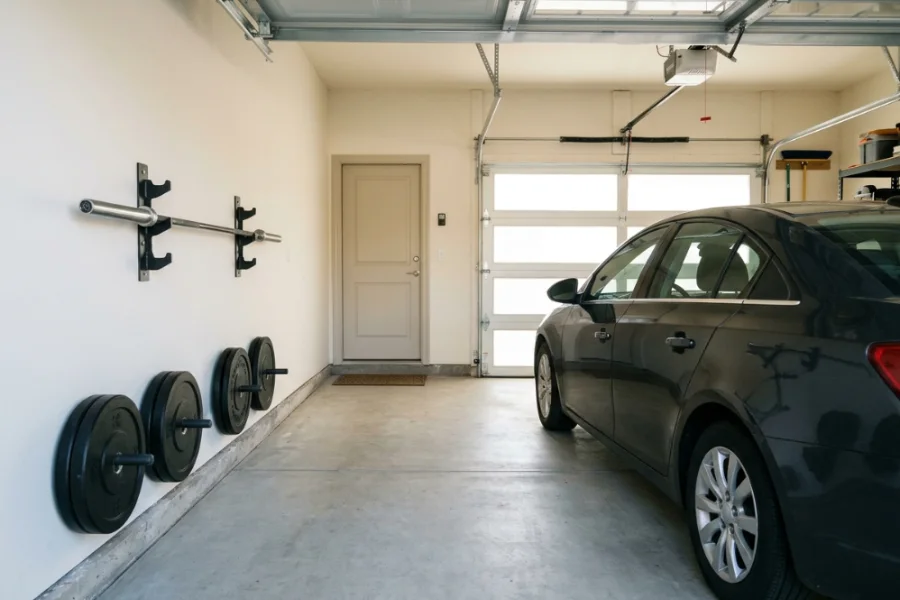
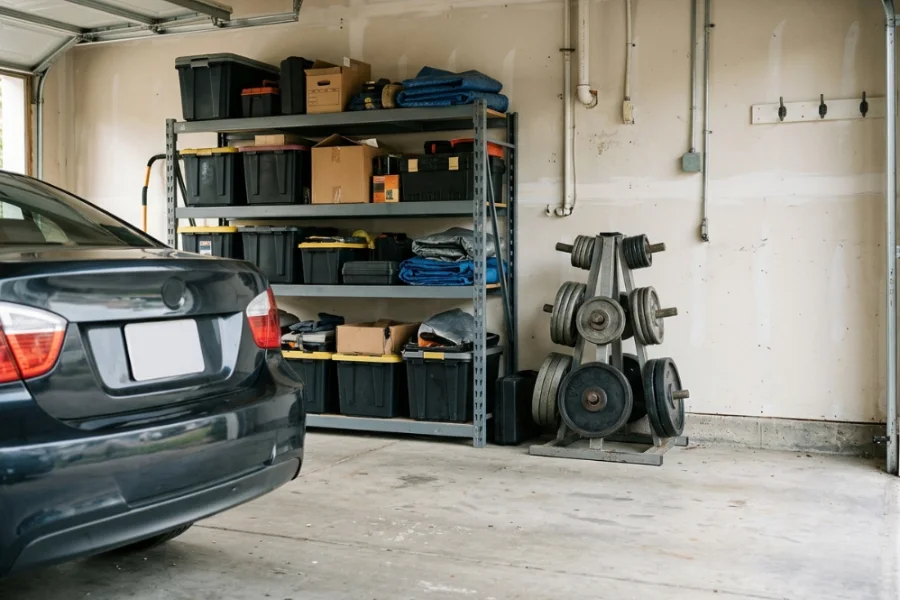
A plate that juts 12 inches off the wall looks fine until the driver door swings into it. Planning a garage gym with a car inside starts with one subtraction: garage width, minus car width, minus the door opening. The answer is the wall depth you can spend.
That figure swings by about 36 inches depending on whether the passenger door opens, and it applies only beside the doors. For the wider picture, read how much wall and floor your gear needs.
Wiring, gas lines and ceiling loads belong with a licensed pro. The rest are planning sums from typical sizes, not tests; see how guides here are checked.
How much wall depth can you spend?
The wall depth you can spend is garage width, minus car width, minus the door opening, minus about 6 inches of margin. With a 6 ft car and a 36 inch door opening, a 12 ft bay leaves about 30 inches on the passenger wall, but only if that door stays shut. Open both doors and it leaves nothing.
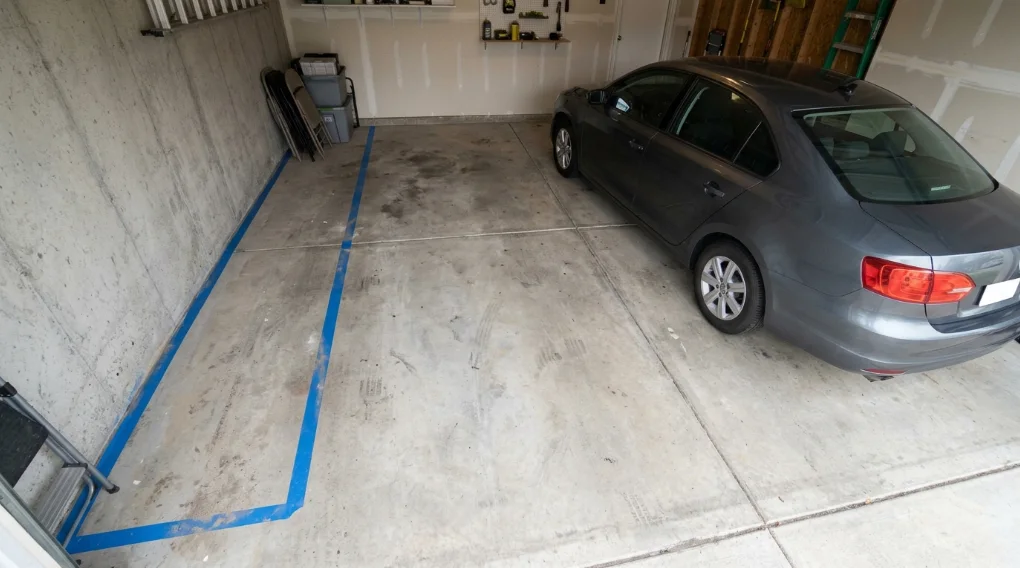
Typical cars run about 14 to 17 ft long and 5.5 to 6.5 ft wide; SUVs reach about 7 ft wide. A door needs roughly 30 to 40 inches to open, so I use 36. Sources differ on mirrors, so measure your car.
Written out for a 12 ft bay: 144 inches, minus 72 for the car, minus 36 for the driver door, minus 6 for margin, leaves 30. That is why the common “3 ft around the car” advice leaves nothing in a one-car garage: two 36 inch gaps plus the car fill all 144 inches.
| One-car bay width | Spare after a 72 in car | Both front doors open | Driver door only |
|---|---|---|---|
| 12 ft | 72 in | 0 in | 30 in |
| 14 ft | 96 in | 18 in | 54 in |
| 16 ft | 120 in | 42 in | 78 in |
The last two columns show depth on the passenger-side wall. Use the driver-only column only if you mostly drive alone. For depth against load, see garage gym shelving: capacity, depth and what fits.
Where does the free depth actually sit?
Only the stretch of wall beside the doors loses depth to door swing. Beside the hood and the trunk, a wall keeps the full gap minus your margin. At the end wall, depth is garage depth minus car length minus a 36 inch walk space.
Take a 12 ft bay with the car centered. Each side gap is 36 inches. Beside the doors that gap is spoken for, but beside the hood it leaves 30 inches, enough for a common 24 inch deep base cabinet.
Now the length. A 16 ft car in a 20 ft deep garage leaves 48 inches, or 12 after the walk space. A 24 ft deep garage leaves 96, or 60. A deeper garage buys end-wall depth, and a wider one buys side depth.
A standard Olympic bar is about 7 ft long, so it fits along a 12 ft end wall; vertical or horizontal barbell storage trades wall length for height.
If you back in, a liftgate or trunk opens toward the end wall, so keep its swing clear.
Plates add weight and depth together, so compare a plate tree with wall-mounted plate storage for that wall.
Which storage types clear a parked car?
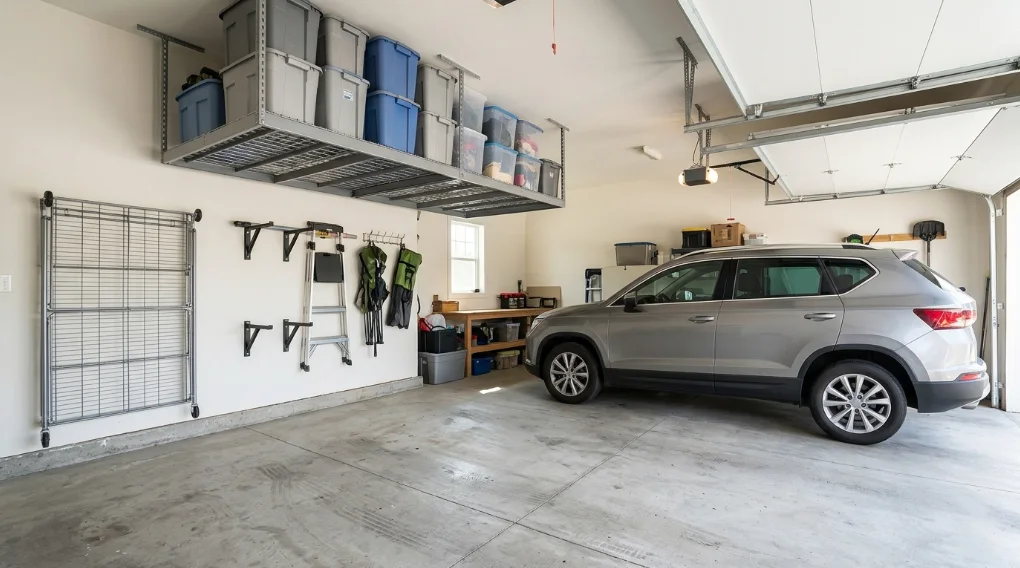
Match the type to the zone. Wall-hung gear suits the hood zone or end wall, overhead racks suit light gear you use rarely, and wheeled or fold-away racks suit a bay that must be empty by evening. Each fails somewhere, as the table shows.
| Option | Why it works | Suits | Wrong when |
|---|---|---|---|
| Wall-hung racks and hooks | Costs only what sticks out | The hood zone or end wall | The wall sits in the door zone |
| Overhead ceiling racks | Costs no wall or floor | Light, bulky, rarely used gear | Joists or the maker’s rating are unconfirmed |
| Wheeled or fold-away racks | Takes floor only in use | Tight bays needing a clear floor | You have nowhere to park them |
Wall mounts have their own limits, so read studs, anchors and weight limits before drilling. A bench is the item that most often wanders into the door zone, so fold it flat or wheel it away.
Ceiling-mounted loads need a pro. Makers rate racks assuming correct fastening into joists, and I cannot judge your framing. Open the liftgate and the garage door fully before judging clearance. A ceiling rack also takes headroom, so run the ceiling check on the home page for any tall gear beneath it.
What should stay clear of the car and gear?
Keep the walking path, the service areas and the car’s wet or hot parts apart from your gear. That means a route to the house door, access to the breaker panel and any gas appliance, and a gap between steel and wet tires. Wiring and gas questions go to a licensed professional.
For the route, general path guidance lists 24 inches as the working minimum for one person and 30 to 36 inches for a secondary path. I plan 36 inches when carrying anything.
Does a parked car make gear rust faster?
It can add moisture. A wet car, melting snow and damp tires put water in the air, and bare steel such as sleeves, plates and rack posts shows it first. A just-parked car’s exhaust and brakes are hot too, so keep foam and rubber gear off the car body. For the moisture side, see why gym equipment rusts in a garage.
What must you never block?
Never block the house door, a side exit, the breaker panel or a gas appliance. US model code asks for a clear space in front of a panel, commonly 36 inches deep and 30 inches wide; confirm locally with an electrician.
How do you test the layout before buying?
In a garage gym with a car inside, mark the layout on the floor with tape and cardboard first. Park as usual, open each door the way you really use it, and measure. Your measured door opening replaces my 36 inch assumption.
- Park as usual and tape the tire positions.
- Open each door you use and tape the floor under its outer edge.
- Measure from the car body to that tape: your door opening.
- Measure from the tape to the wall, then subtract 6 inches.
- Mark where the doors start and end along the wall: your door zone.
- Set a cardboard box at the gear’s depth and open the door again.
If the box blocks the door, move that gear to the hood zone or end wall, or go overhead or wheeled.
Repeat on the end wall, then browse the storage category for each type of gear.
FAQ
Is a two-car garage big enough for a gym and a car?
Usually yes. In a 20 ft wide garage, one 6 ft car plus a 36 inch driver-door gap leaves about 10.5 ft for gear beside it. If the passenger door must open too, about 7.5 ft.
Can you park a car on garage gym flooring?
Only if the maker rates that exact product for vehicles. Rubber gym flooring usually is not, while some PVC tiles and coatings are. Compare garage gym flooring types, and ask the maker, before the car touches it.
Is it safe to work out next to a parked car?
Yes, with the engine off. Never run the engine inside the garage, even briefly or with the door open, because exhaust gas can build up. Pull the car out to warm it up.
How much space does a garage door need overhead?
Often 10 inches above the opening for extension springs and 12 for torsion springs, and an opener needs more. Your door’s manual gives the exact figure; the ceiling height guide lists typical headroom.
Do SUVs and pickups leave less room for storage?
Yes. In a 14 ft bay, a 7 ft wide SUV with a 40 inch door opening leaves about 38 inches on the far wall, with the passenger door shut. With both doors open, nothing.
Final thought
Do the subtraction with your own car and your measured door gap. Put deep gear on the end wall, shallow gear beside the doors and light, rarely used gear overhead. Park the same way every time, because the table assumes it.
For the next storage question, open the Guides hub and pick the gear you plan to store.
How we wrote this guide
I wrote this guide from typical garage and car sizes I checked in November 2026, plus my own arithmetic, which is shown above. I have not tested any product or measured your garage. Doors, tracks and ceilings vary, so measure yours. Ask a licensed electrician, gas fitter or installer about wiring, gas appliances and ceiling-mounted loads.
What fits beside your car?
Send me your garage width, your car’s width and the door gap you measured, and I will help you work out the depth you can spend.
Write to me