Storage
Dumbbell Storage for Small Spaces: Racks, Trays and Floor Load
A 5 to 50 lb set of ten pairs weighs 550 lb before the rack. Pick the rack shape by footprint, then check the weight your floor has to carry.
Ten pairs of dumbbells sit on the carpet in a spare-room corner, and you want them off the floor. Two checks decide the answer, in this order: footprint, then weight.
For dumbbell storage for small spaces, a vertical rack saves the most floor area, a horizontal rack stays low, and a tray for one adjustable pair saves the most weight. A 5 to 50 lb set of ten pairs weighs 550 lb before the rack.
That weight is why this guide covers the floor as well as the footprint. It is planning arithmetic, not a structural check. For the whole-gym picture, see how much wall and floor your gear needs.
Which rack shape fits a small corner?
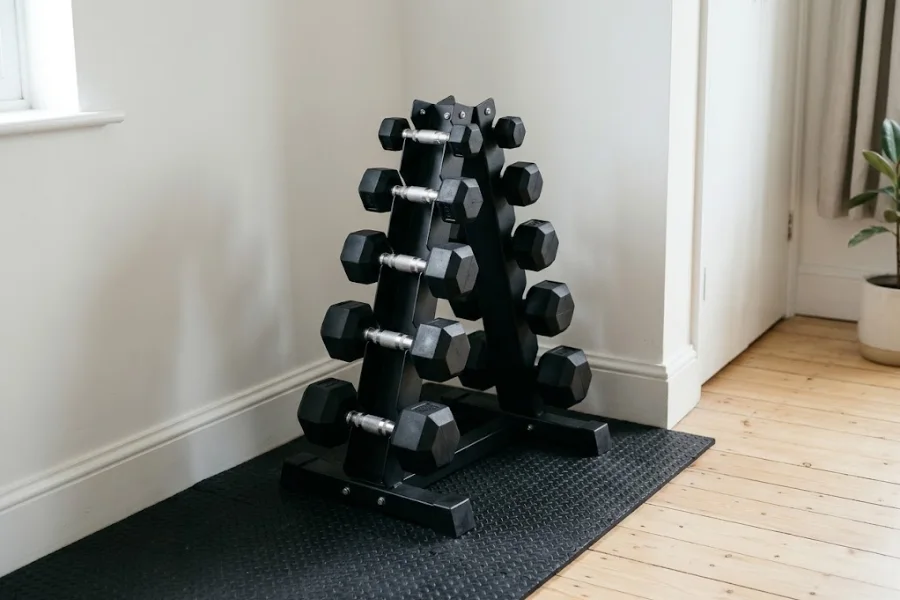
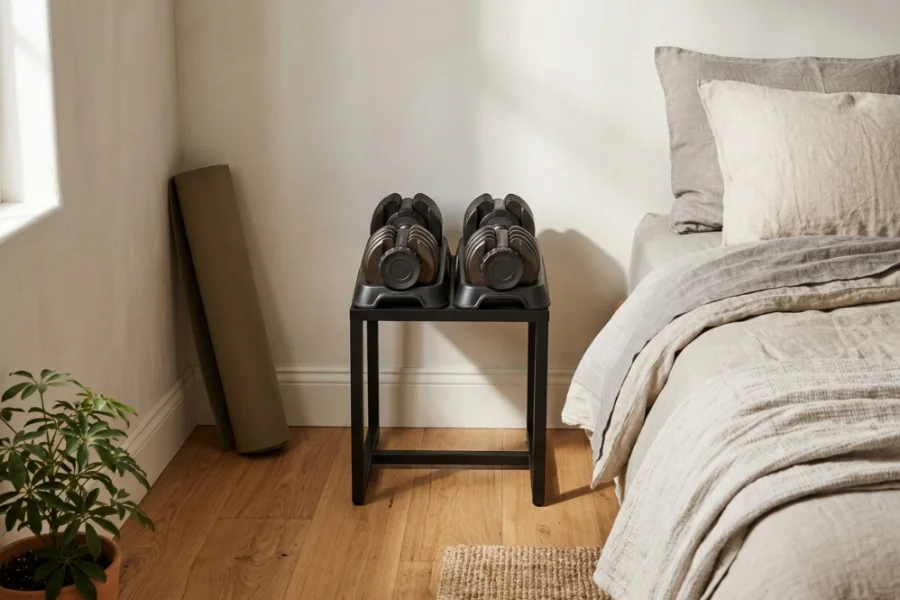
Pick the rack by the corner you have. Horizontal tiered racks run low and long, vertical or A-frame racks stand narrow and tall, and a tray or stand for adjustable dumbbells takes the least floor. These are typical ranges from maker listings I read in November 2026. Check your exact model.
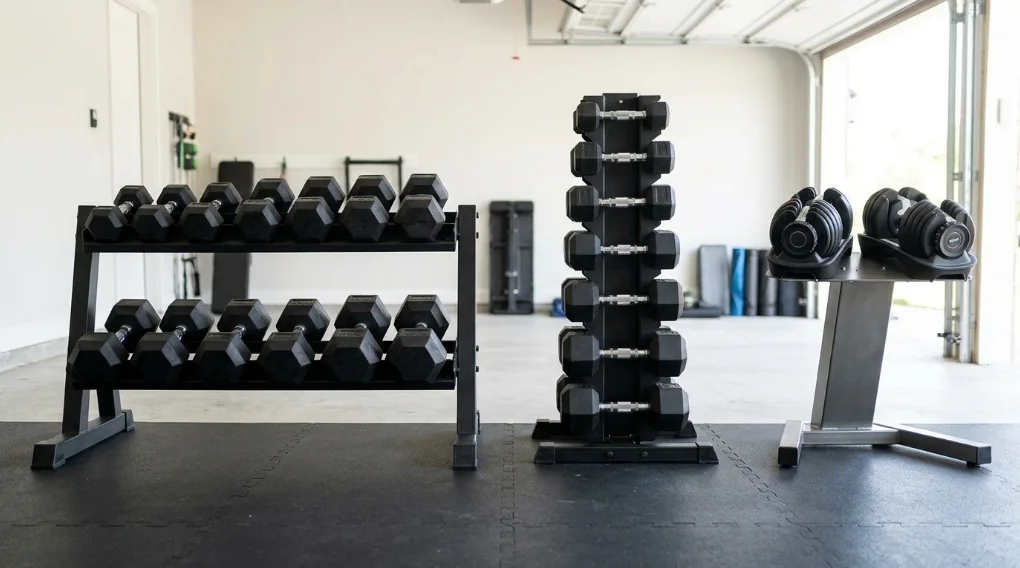
| Shape | Typical footprint | Typical height | Typical capacity |
|---|---|---|---|
| Horizontal tiered rack | 37 to 50 in long, 20 to 26 in deep | 30 to 33 in | 3 to 12 pairs |
| Vertical or A-frame rack | 20 to 24 in by 20 to 31 in | About 62 in | About 10 pairs |
| Tray or stand for adjustables | 19 by 21 in (one listing) | 29 in (same listing) | One adjustable pair |
Choose horizontal when wall length is spare and you want a low top shelf. Choose vertical when floor area is tight and wall height is spare. Skip vertical under a sloped ceiling or window ledge, since it needs about 62 in of clear height. Skip horizontal where the free wall is shorter than the rack. Leave a clear step in front of any rack so you can lift a pair out.
Hamilton Home Fitness lists vertical and horizontal dumbbell racks among its weight storage racks.
Racks that bolt to the wall are a separate question, because studs and anchors set their limit. I cover wall-mounted storage, studs and weight limits in its own guide.
How much weight does a full set add?
A full 5 to 50 lb set in 5 lb steps has ten pairs and weighs 550 lb: 2 x (5 + 10 + … + 50) = 2 x 275. Racks add roughly 50 to 105 lb in the listings I checked. One rack with a full set puts about 600 to 655 lb in a single corner.
Use three steps for any layout.
- Add every pair: 550 lb for the full set.
- Add the rack or stand weight from the maker’s listing.
- Divide by footprint: length x depth in inches, divided by 144, gives square feet.
Same set, three shapes. A 49.5 x 26.25 in horizontal rack (65 lb) covers 9.0 sq ft, so 615 lb is about 68 lb per sq ft. A 23 x 20 in vertical rack (50 lb) covers 3.2 sq ft, so 600 lb is about 188 lb per sq ft. One adjustable pair at 50 lb each is 100 lb. With a 48 lb stand on 2.8 sq ft, that is about 148 lb, or 53 lb per sq ft.
The vertical rack saves the most floor area and loads each square foot hardest. The tray cuts the total from about 600 lb to about 150 lb.
Plates in the same corner raise the total fast. Plate tree versus wall-mounted plate storage compares two ways to hold them.
Can your floor carry the rack?
Nobody can answer that from a rack listing, and I cannot either. Code floor figures are averages over a whole room, so a rack’s pounds per square foot is a way to compare layouts, not a pass mark. A structural pro has to judge your floor, its joists (the framing beams under it) and your corner.
US houses and townhouses built to the model residential code (the IRC) are designed for at least 40 psf, pounds per square foot, in living areas and 30 psf in sleeping rooms. Apartment buildings follow a different code, and local rules vary. I am a guide author, not an engineer, so read how guides here are evaluated before relying on my arithmetic.
Those figures are design minimums for people, furniture and everything else, not weight limits. Do not set 188 lb per sq ft beside 40 psf and read a verdict into it. Compare 188 with 68 and 53 instead. That shows which layout loads the floor hardest.
What should you tell a pro?
Bring numbers, not photos, so the answer is about your floor.
- Total pounds in the corner, including plates or a bench
- Rack footprint in inches and where it will stand
- Floor level, and what sits below it
- Joist size, spacing and direction, if known
- Any bounce you already feel in that room
How do you protect the floor under a rack?
Put a firm mat or rigid board under the feet. It spreads the load locally, which limits dents and scratches, but it does not change the total pounds on the joists. Rubber-coated hex heads are typically gentler on floors than bare iron or chrome.
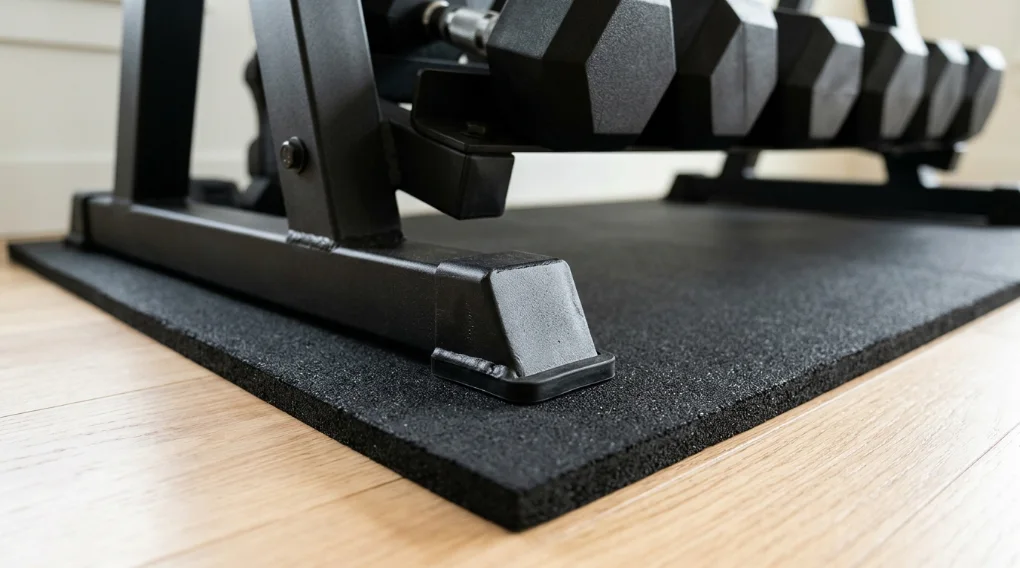
On carpet, rack feet press small patches of pile. Home gym flooring over carpet: what works and when to remove it compares the options.
| Problem | What to do |
|---|---|
| Dents in carpet or vinyl | Set the feet on a firm mat or rigid board. |
| Scratches on hard floors | Use a mat under the rack and wipe grit off the heads. |
| Rust on damp concrete | Lift pairs off the slab and read why garage gym equipment rusts. |
| Marks from moving the rack | Unload it first. A set plus rack can weigh 600 lb or more. |
Which setup suits which room?
Match the setup to the floor first and the room second. An upstairs bedroom corner suits one adjustable pair on a stand, because it carries the least weight. A spare room can take a vertical rack. A garage corner can take either shape, but depth beside the car decides.
Upstairs bedroom corner. A stand cuts the load to about 150 lb. It is the wrong choice if you already own ten fixed pairs. Renters can start with no-drill home gym storage options.
Spare room. A vertical rack frees the most floor for ten fixed pairs, but it is the wrong choice under a sloped ceiling. A concrete slab on the ground is a different question from a framed floor, so ask a pro which you have. A bench shares the room too: see how to store a weight bench in a small space.
Garage corner. Measure from the wall to where the car door opens, then compare that with the rack depths above. A rack that stops the door opening fully is the wrong choice. See garage gym storage with a car inside for clearance.
FAQ
How do you store dumbbells without a rack?
Line them up on a rubber mat along a wall, heaviest pairs nearest the wall. Hex heads stay put, while round heads can roll. A low shelf works for light pairs if its rating covers the load; see garage gym shelving capacity and depth.
Are dumbbell racks universal?
No. Each rack lists a weight range and often a head shape, such as hex, so a rack rated for 5 to 50 lb pairs may not take heavier ones. Match your heaviest pair, pair count and shelf width to the listing.
Can you store dumbbells under a bed?
Only a few light pairs, and only if they clear the frame. Measure the gap with rails and legs in place. A full set weighs hundreds of pounds, so a floor-standing rack or tray suits it better.
Can you put kettlebells on a dumbbell rack?
Sometimes. Flat-shelf racks often take kettlebells, but angled or cradle-style slots may not. Check the maker’s listing for kettlebell support, then add each kettlebell’s weight to your corner total before you load the rack.
Are dumbbell racks worth it?
Yes, once you own several fixed pairs, because a rack frees the floor and keeps pairs sorted. It adds 50 to 105 lb of its own, and one adjustable pair needs only a tray; compare equipment for small spaces.
Final thought
Dumbbell storage for small spaces comes down to footprint first, then total pounds. A tray holds one adjustable pair for about 150 lb, while a full 5 to 50 lb set on a vertical rack reaches about 600 lb in about 3 sq ft. Upstairs, show a pro those numbers before you commit.
Next, browse the Guides hub for the rest of your storage plan.
How we wrote this guide
I wrote this guide from maker listings I read in November 2026 and from my own arithmetic, which is shown above. I have not tested any rack, tray or dumbbell. Sizes are typical ranges from a handful of listings, and the 40 and 30 psf figures are US model-code design minimums, not limits for your floor. I am not an engineer, so ask a structural pro before you load an upstairs floor.
Does your corner have room for the rack?
Write to me with the corner’s width and depth, the floor level and the weight of your set, and I will point you to the right guide.
Write to me