Storage
Wall Mounted Gym Storage: Studs, Anchors and Weight Limits
A wall rack holds what its maker rates, and only when the screws reach solid framing. Here is how to find studs, read a rating and spot when to call a professional.
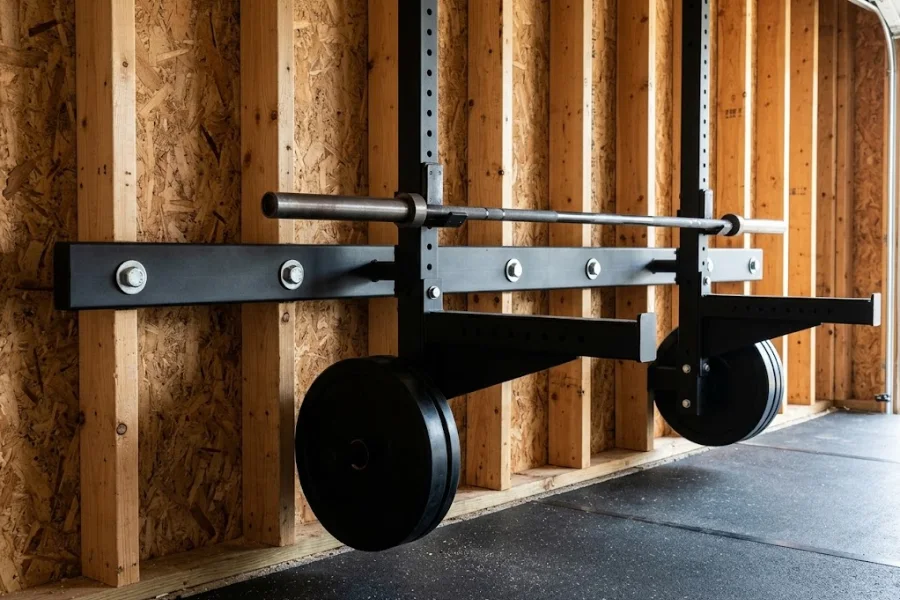
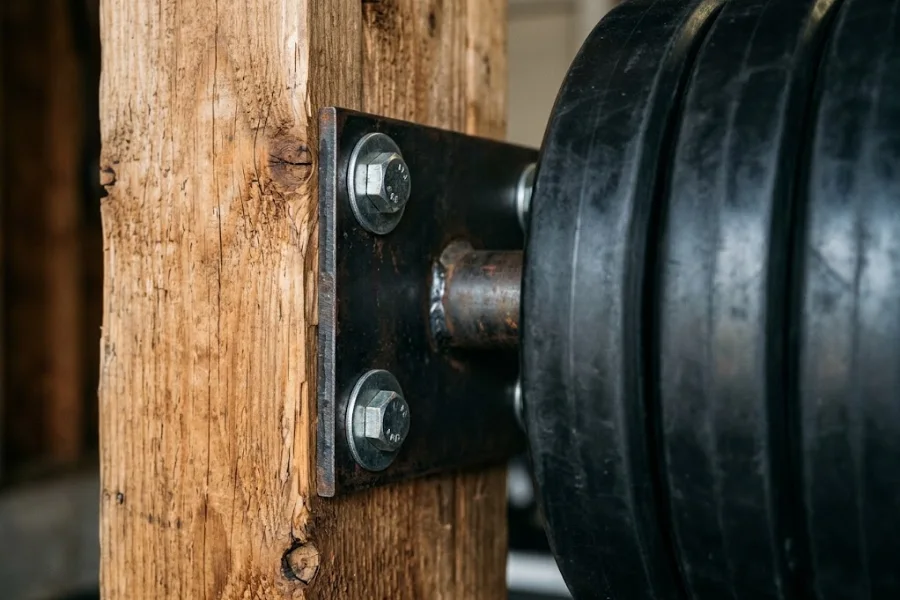
Say a rack lists 800 lb, your garage wall is drywall over studs, and you own 360 lb of plates. Will the wall hold them? That depends on two things: the screws must reach solid framing, and the load must stay inside the maker’s rating.
Wall mounted gym storage hangs on studs, the vertical boards behind the drywall. This guide shows how to find them, match a rack to your spacing, read a weight rating and split a load. The math is my own planning illustration, not an engineering rating; how guides here are evaluated explains the checks.
If the framing is unknown, shared or masonry, ask a contractor or structural engineer before drilling. Sizing your gear first? See how much wall and floor your gear needs.
Does drywall hold anything on its own?
No. Drywall is a brittle gypsum sheet, commonly 1/2 to 5/8 inch thick in US homes, made to cover a wall rather than carry weight. Plate pegs, bar holders and heavy shelves need screws that pass through it into wood framing, so the studs take the load.
The target is small. A common 2×4 stud is 1.5 inches wide, so a screw more than 3/4 inch off center misses it. In wood framing, the screw itself is the anchor. Drywall anchors, the plugs and toggles that grip hollow walls, suit light items. For plates or bars, I would not rely on them unless the rack’s manual gives a drywall-only method with a rating.
Depth matters too. Bundled screws, often lag screws, assume a standard wall covering. Moving from 1/2 to 5/8 inch drywall costs 1/8 inch of bite into the stud, and foam board costs its own thickness. Ask the maker for longer screws. If you are insulating the garage first, ask the builder about solid blocking between studs before the wall closes.
How do you find studs behind drywall?
Use an electronic stud finder, mark both edges of each stud and take the midpoint as its center. Confirm with a second clue, then measure across several studs. In the US, wood studs are commonly 16 inches apart center to center, written 16 inches on center.
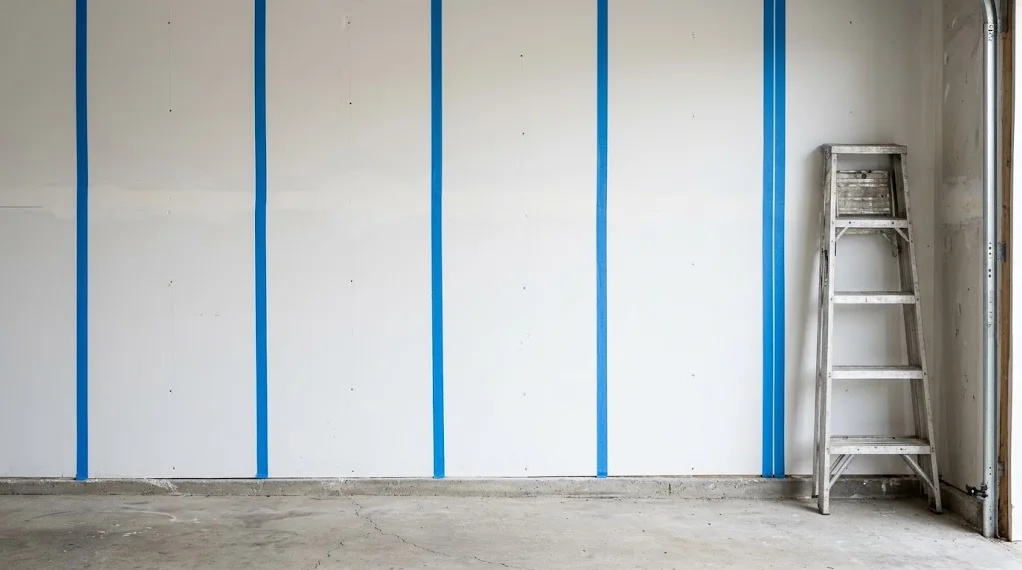
- Choose the wall stretch, clear of doors and windows.
- Scan across it and mark both edges of each stud.
- Mark each midpoint and measure center to center.
- Check the marks against outlet boxes, which often sit on a stud edge.
- Confirm the spacing repeats across at least three studs.
Do not assume 16. Garage exterior walls can be 24 inches on center, engineered framing sometimes uses 19.2, and older homes can vary from stud to stud. Measure the wall you have.
If a car shares the garage, the usable wall shrinks. See garage gym storage with a car inside.
Will a rack’s holes match your studs?
Only if the mounting holes fall on stud centers. A rack with holes 16 inches apart suits studs 16 inches on center, but on 24 inch framing only one hole reaches a stud. Measure your spacing before you order, not after the box arrives.
The arithmetic is simple. Assume the first mount is centered on a stud and the framing is regular:
| Holes apart | Studs 16 in apart | Studs 24 in apart |
|---|---|---|
| 16 in | Lands | Misses |
| 24 in | Misses | Lands |
| 32 in | Lands | Misses |
| 48 in | Lands | Lands |
Some makers sell slotted or adjustable brackets. Another route is a backer board, a horizontal wood board fixed across studs. Ask the maker whether the rating still applies on a board, and have a pro size it, because the board and its screws join the load path.
If matching studs sounds like too much work, compare a plate tree with wall-mounted plate storage.
Hamilton Home Fitness lists folding squat racks, pull-up rigs and half-bay setups that anchor into wall studs on its wall mount rigs page.
How do you read a weight rating?
Treat a rating as a promise tied to one installation: the stated studs, the stated fasteners and a still load. Find out whether the number is per peg or for the whole unit, how many studs it assumes and which wall it was written for. If the page is silent, ask the maker.
Ratings come in different shapes. Of eight maker pages and install notes I read in November 2026, two gave a per-peg figure plus a total, two gave one total only, three gave no number and one said the rack was not weight bearing. Stud assumptions differed too: one unit mounts to a single stud, another’s holes suit studs 16 inches apart, and two add a floor leg or anchor to share the load.
Before you trust any number, get four answers from the manual:
- Is the figure per peg or for the whole unit?
- How many studs, and what spacing, does it assume?
- Which fasteners and wall types does it cover?
- Does it cover a dropped plate, a moving load, or only still weight?
None of the eight mentioned moving loads. Peg length also decides how many plates fit, so see how to store bumper plates for peg length and plate count.
How do you split a load across mounts?
Add up everything that will hang, divide by the number of pegs, then check the heaviest peg rather than the average. Repeat the division for the screws holding the unit. This is a planning illustration of why loads are shared, not an engineering rating.
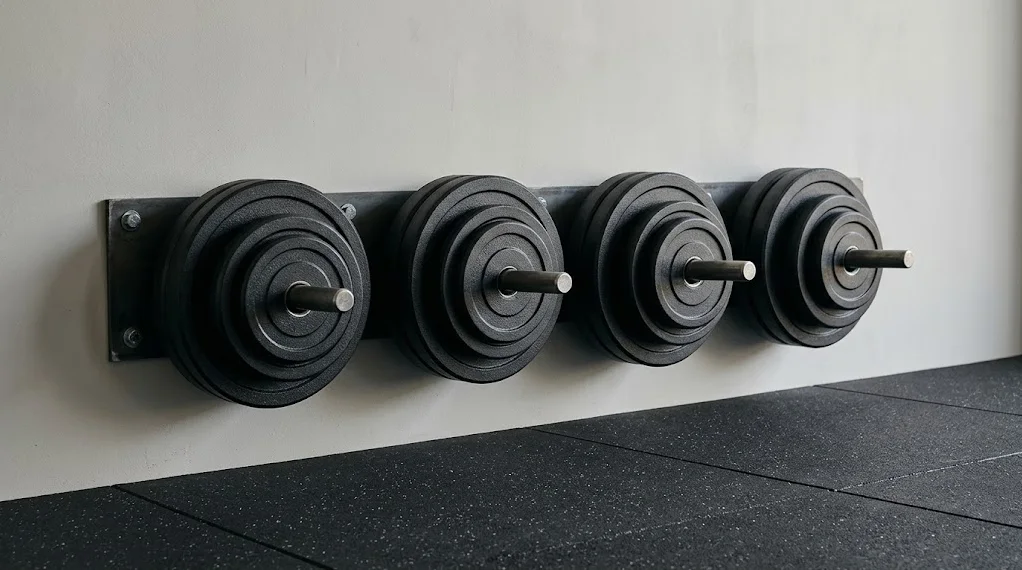
Take a four-peg unit holding six 45 lb plates, two 25 lb plates and four 10 lb plates, with the six 45s on two pegs:
| Check | Arithmetic | Result |
|---|---|---|
| Total load | 270 + 50 + 40 | 360 lb |
| Average per peg | 360 / 4 | 90 lb |
| Heaviest peg | 3 x 45 | 135 lb |
| Per screw (4, shared evenly) | 360 / 4 | 90 lb |
Even sharing never happens. Pegs hold weight out from the wall, so the upper screws are pulled outward as well as down, and screws usually hold better against a downward load than against being pulled out. A plate dropped onto a peg adds a jolt on top.
Dumbbells are the load I would try to keep off the wall. A floor rack carries them straight to the floor; see dumbbell storage for small spaces.
If your total sits near the rating, I would not plan on the last pound. Add a second unit or ask a pro. That is my judgment, not a code.
Count any bars in the total too. Vertical and horizontal barbell storage compares the two layouts.
When should a pro check the wall?
Before you drill, call a licensed contractor or structural engineer whenever you cannot confirm what is behind the wall or what it carries. No guide, including this one, can judge your framing from a distance. Treat each situation below as a stop sign.
- You cannot confirm the framing, or the wood looks damp, soft or damaged.
- The wall may be load bearing, or your load exceeds the rating.
- The wall is concrete, block or brick and the manual has no masonry hardware.
- The wall is shared, as in a condo, townhouse or duplex.
- You are unsure what wiring or pipes run behind it.
- You plan a backer board or blocking.
If the wall is not yours, no-drill options exist. Renter-friendly home gym storage covers them.
FAQ
How much weight can a wall stud hold?
There is no honest single number. It depends on the wood, the screw’s size and depth, the load direction and the stud’s condition. Use the maker’s rated total for your installation, and ask a pro for anything heavier.
Are wall mounted racks safe?
They can be, when screws reach framing exactly as the manual shows and the load stays under the rating. Change either condition and the rating stops applying, so a new wall or heavier load is a new question.
Can wall mounted storage go on metal studs?
Only with the hardware the maker specifies for steel framing. Steel studs are thin, and screws made for wood can strip out. If the manual says nothing about steel, ask the maker or a contractor first.
How much weight can a wall mounted shelf hold?
Whatever the maker rates for that shelf, installed into studs as the manual shows. Capacity also shifts with shelf depth, so check the figure for your size in garage gym shelving capacity and depth.
Final thought
Wall mounted gym storage works only when three things line up: screws in confirmed framing, a rating that matches your real load and a wall you have verified. The storage guides cover the rest of your layout.
Measure your stud spacing first, then check any rack’s holes and rating against it. More planning help lives in the Guides hub.
How we wrote this guide
I wrote this guide from maker install notes and product pages I read in November 2026, plus common US framing practice. The load examples are my own arithmetic, and I have not tested any rack or wall. Maker manuals and local building rules come first, and the framing sizes here are US. For framing, load-bearing or masonry questions, ask a licensed contractor or structural engineer.
Not sure your wall can take the rack?
Send me your wall type, measured stud spacing and the gear you plan to hang, and I will point you to the guide that fits.
Write to me