Storage
How to Store Bumper Plates: Peg Length, Plate Count and Floor Space
Most bumper plates are about 17.7 inches across, but thickness changes with weight and maker. Divide your peg length by your plates’ real thickness to find how many fit.
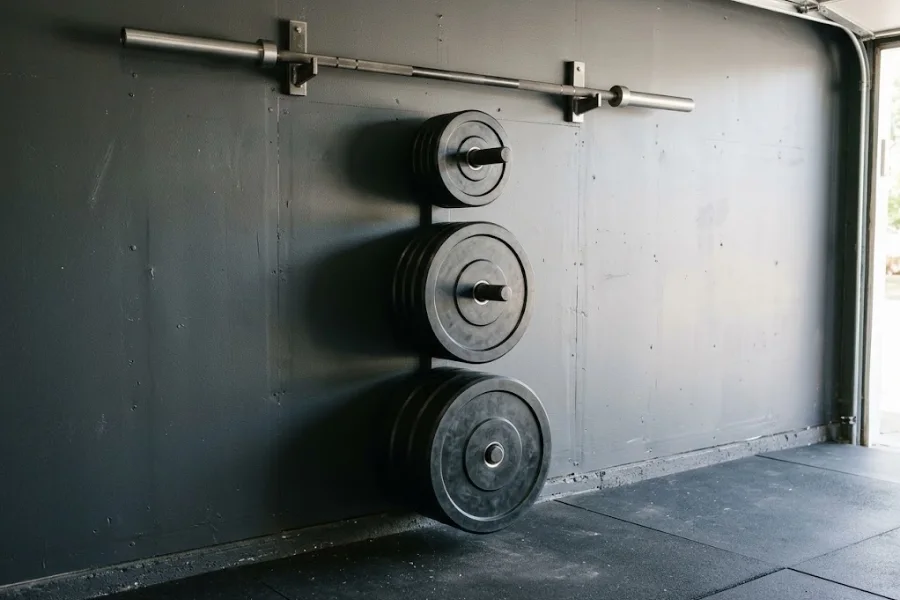
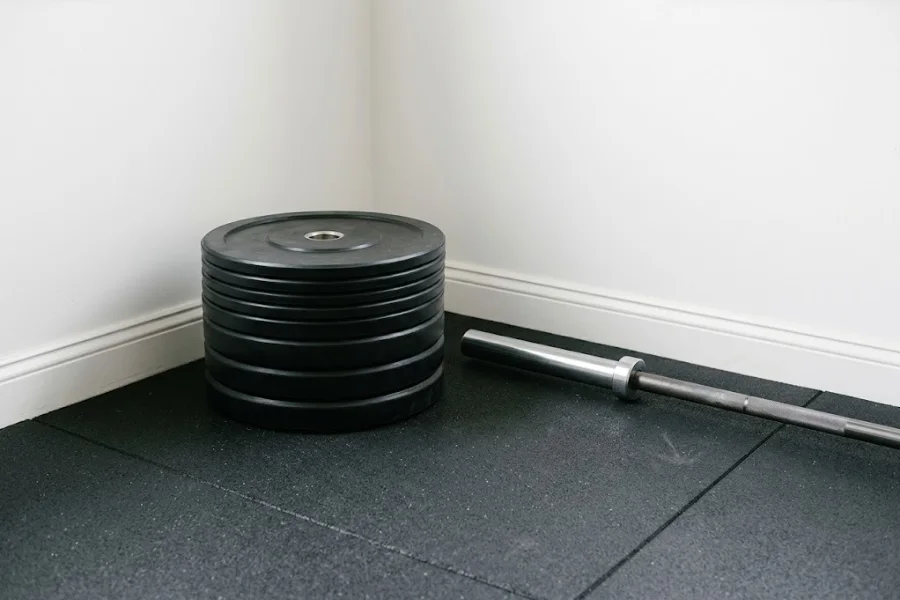
A 260 lb bumper set is ten plates, and each one needs a place to sit. Peg length divided by plate thickness tells you how many fit on a peg.
Diameter is not the catch, since most bumper plates are about 17.7 inches across. Thickness is. Published specs I checked for a 45 lb training plate run from 2.8 to 3.5 inches, so one peg holds different counts for different plates.
This guide shows how to store bumper plates by the numbers. It is planning arithmetic from published specs, not a test. For the whole room, start with how much wall and floor your gear needs.
How many bumper plates fit on one peg?
Subtract about 1 inch from the peg length, divide by one plate’s thickness, and round down. A 16 inch peg holds five 45 lb plates that are 2.8 inches thick, but only four that are 3.5 inches thick. Thickness, not diameter, sets the count.
Diameter is the standardized part. Competition plates are 450 mm (17.7 in), and most training bumpers land close to it, though some 10 lb plates run smaller. Thickness is not standardized. One maker lists a 20 kg competition plate (44.1 lb) at 2.15 inches, against 2.8 to 3.5 for a 45 lb training plate.
| Peg length | 45 lb plates, 2.8 in thick | 45 lb plates, 3.5 in thick |
|---|---|---|
| 12 in | 3 | 3 |
| 16 in | 5 | 4 |
| 20 in | 6 | 5 |
| 24 in | 8 | 6 |
The 1 inch allowance is my planning habit, not a standard. It keeps the last plate off the peg tip. Many rack listings quote total pounds rather than plate counts, so this sum is yours to do.
Hanging pegs or buying a tree is a separate call, compared in plate tree vs wall-mounted plate storage. The peg math stays the same.
Hamilton Home Fitness lists bumper plates in virgin rubber, urethane, hi-temp, crumb rubber and competition types.
How thick is a whole 260 lb set?
Add up every plate’s thickness. One example set of ten plates stacks to about 21.4 inches, the peg length or flat-pile height the kit needs. A 370 lb set adds two 55 lb plates, which my estimate puts near 30 inches in total.
These thicknesses are one maker’s published specs. How guides here are evaluated explains where specs come from and why the math is shown.
- Count the plates: two each of 10, 15, 25, 35 and 45 lb, ten plates and 260 lb.
- Look up thickness: 1, 1 5/16, 2 1/8, 2 3/4 and 3 1/2 inches.
- Double each for the pair: 2, 2 5/8, 4 1/4, 5 1/2 and 7 inches.
- Add the pairs: 21 3/8 inches, about 21.4, for all ten plates.
- Split by weight, add 1 inch each: the 45s and 35s need 13.5 inches, the rest 9.9, so a 14 and a 10 inch peg.
These 45s sit at the thick end; 2.8 inch 45s would shrink that pair from 7 to 5.6 inches. For the 370 lb set I scaled the 45 lb plate: 3.5 × 55 ÷ 45 is about 4.3 inches each, so the pair adds 8.6 inches. Check your real 55 lb figure.
You can also stack bumper plates flat on the floor, heaviest at the bottom. The same 21.4 inches becomes the pile height, and a pile needs no drilling, which suits no-drill storage for renters.
How much wall and floor does the set need?
Plan on 18 inches per plate, the 17.7 inch diameter rounded up. Two pegs in one column need about 18 inches of wall width and 36 inches of height. A flat floor pile covers about 18 inches square, or 2.2 square feet. Pegs also reach out from the wall by their full length.
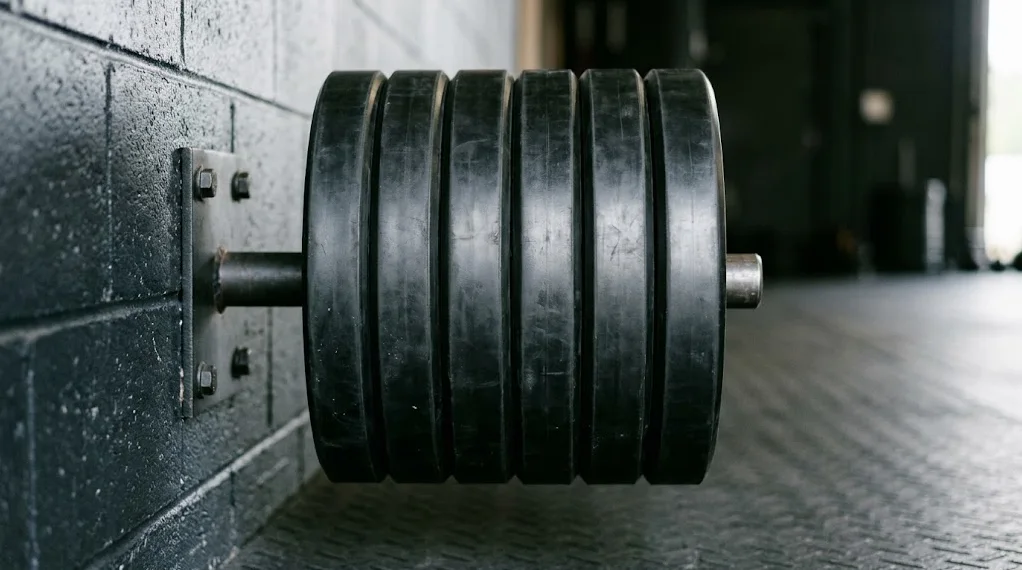
For the example set, the 14 and 10 inch pegs stick out 14 inches at most. Leave your own standing room on top of that. A barbell hung beside them takes its own wall width, and vertical vs horizontal barbell storage compares the two layouts.
A post stacker trades wall for floor. One I checked has a 24 by 24 inch base (4 square feet) and a 35.5 inch post listed for 10 to 14 plates of about 45 lb. Working back, that implies plates about 2.5 to 3.5 inches thick: 35.5 ÷ 14 and 35.5 ÷ 10.
A wall that holds 260 to 370 lb of plates is a structural job. I cannot judge your wall, so check the studs and the mount’s rating, and ask a qualified pro if you are unsure.
Can bumper plates sit on the floor?
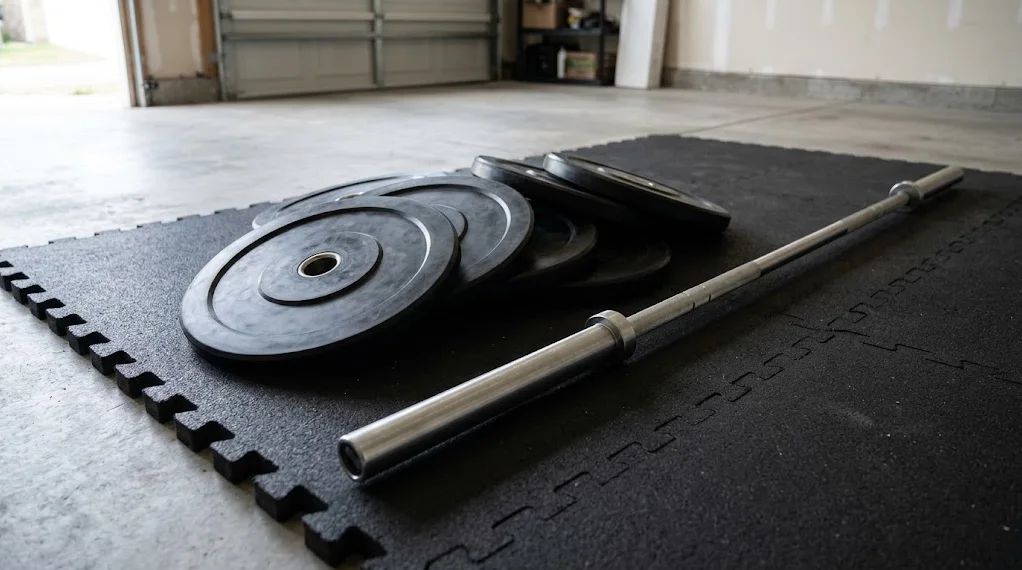
Yes. Bumper plates are rubber and made to hit the floor, so a flat pile on a mat is fine. Trouble comes from how they sit: on edge on soft flooring, leaning on drywall, or flat on damp concrete.
| Surface | What can go wrong | What I would do |
|---|---|---|
| Bare concrete | Damp under the pile; inserts can rust | Raise the pile on a board or mat |
| Foam tile | Plate rims dent soft foam | Lay plates flat, not on edge |
| Carpet | Pile compresses under weight | Flat pile on a board |
| Finished wood | Rubber can react with some finishes | Add a barrier; follow the floor maker |
A flat plate rests on its whole face, about 250 square inches. On edge, it presses on a thin strip of rim. How thick garage gym flooring should be explains why foam suits bodyweight work, not loaded gear.
Garage slabs pass water vapor upward, and a flat pile can trap that damp against the rubber. Testing the slab and choosing a vapor barrier is covered separately.
Why not lean plates against drywall?
Because a leaning plate stays up on floor friction alone, and the wall only catches the top. If the base slides, it falls, and the rim can scuff paint or dent soft drywall. The drywall, damp-concrete and foam points are my reasoning, not tests.
What should you check before buying pegs?
Check plate thickness first, peg length second and footprint third. Most storage mistakes are off by a few inches, not a few pounds. These six checks need only a spec sheet and a tape measure, and they come before you buy pegs or drill a single hole.
- Read each plate’s thickness on the maker’s spec sheet, not just its weight.
- Ask whether the listed peg length is measured from the wall face.
- Subtract 1 inch per peg, then divide by thickness.
- Load the 45s first so the heaviest plates sit nearest the wall.
- Tape the pegs’ footprint on the wall and floor before drilling.
- Keep steel inserts dry; see why garage gear rusts and how to stop it.
FAQ
Can you leave bumper plates outside?
Avoid it if you can. Moisture can rust the steel inserts, and direct sun or fast hot-cold swings can shorten rubber life. A dry garage is usually fine, and garage gym climate control covers what to fix first.
Why are bumper plates so thick?
Rubber is far less dense than steel, so the same weight takes more volume. Dense competition plates come out thinner than softer training plates, which is why your set can differ from a friend’s. Trust your own spec sheet.
How much weight can a wall-mounted plate peg hold?
Only as much as the lower of the peg’s rating and the wall fixing’s rating. A 260 to 370 lb set is a heavy load, so see studs, anchors and weight limits before you drill.
Where do bumper plates go when a car fills the garage?
On a wall or corner the car never reaches. Pegs add only their length to the floor, and an 18 inch pile adds 2.2 square feet. Measure with the car doors open, then see garage gym storage with a car.
Final thought
To decide how to store bumper plates, work in this order: your plates’ real thickness, peg length minus an inch, then the wall and floor footprint. Tape that footprint out, and check it against door swing and walking room before you buy or drill.
Then check the wall itself, and browse the rest of the room in the Guides hub.
How we wrote this guide
I wrote this guide from published plate dimensions and my own arithmetic, which I show so you can check it. I have not tested any plate, peg or rack, and the thickness examples are published specs, not measurements I took. Specs differ by maker and change, so use your plates’ own sheet, and ask a pro about walls and anchors. Specs checked November 2026.
Not sure your wall or floor fits the set?
Send me your plate list and the wall or floor space you have, and I will help you check the peg length and footprint.
Write to me