Cooling
Garage Gym Air Conditioning: Which Type Fits Your Space?
A bare two-car garage needs about four times the cooling of an insulated one, and a swamp cooler needs dry air.
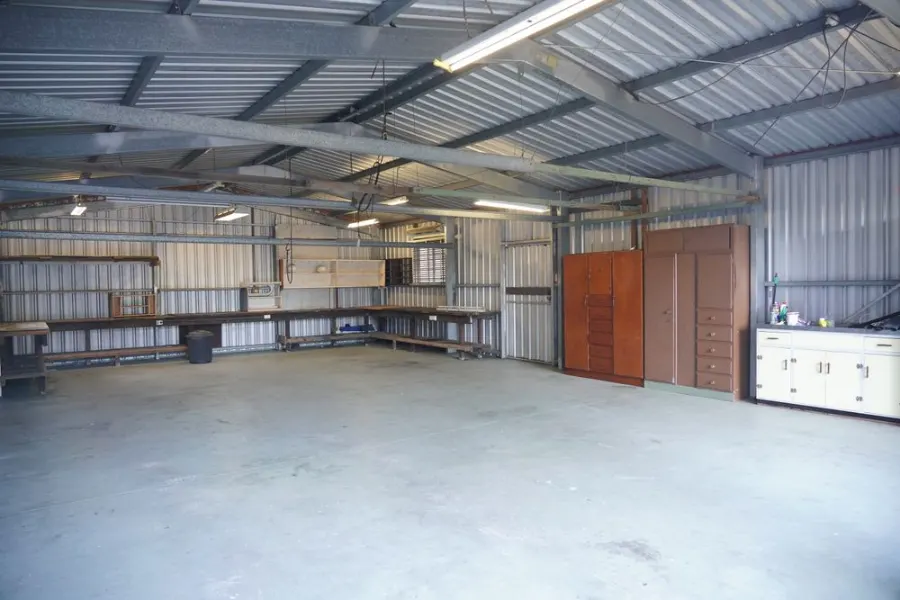
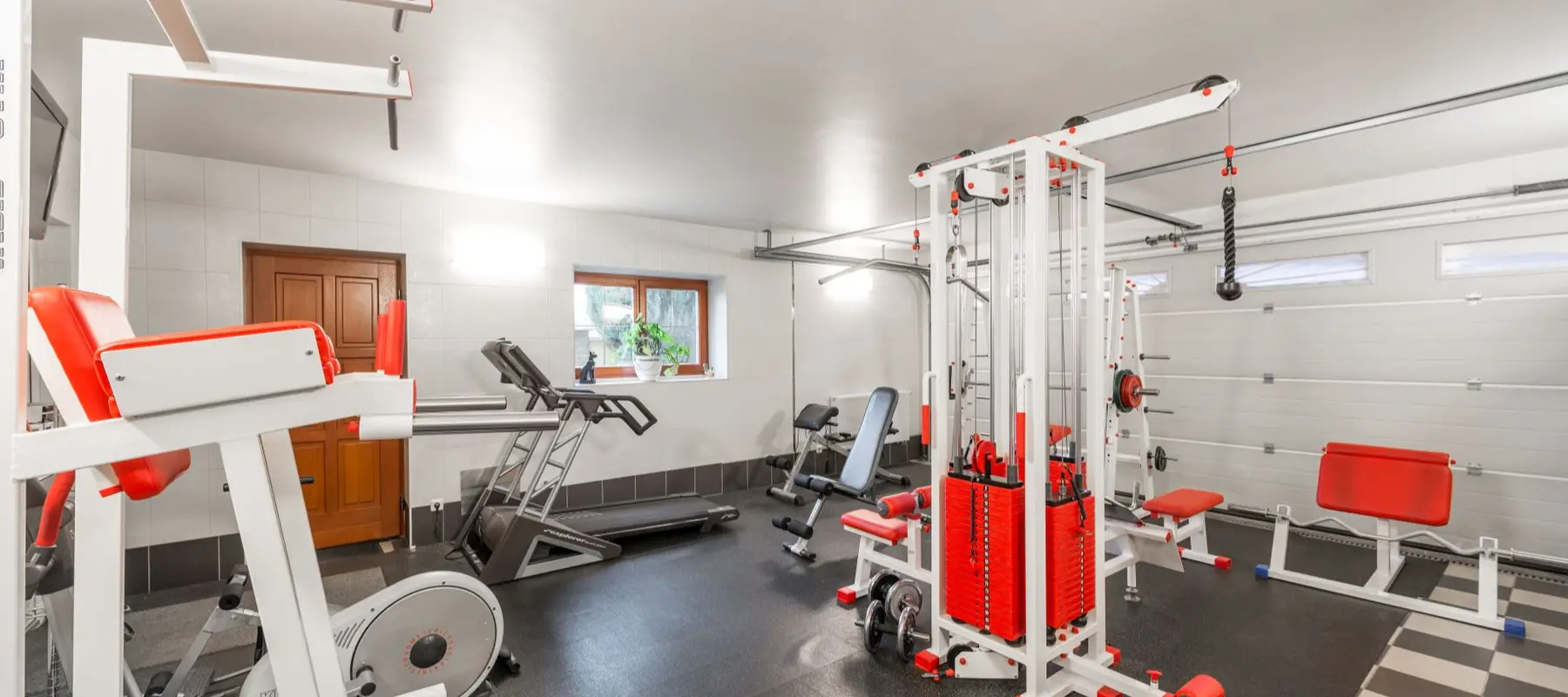
Garage gym air conditioning is not one product. A window unit needs a window, a portable unit needs a way to vent its hose, a mini split needs a wall and a budget, and an evaporative cooler needs dry air. The shell decides too: a bare two-car garage needs about four times the cooling of an insulated one.
Every figure is my own calculation, not a test; how we evaluate guides explains the method.
Wiring and wall cuts need a licensed electrician or contractor, and the manual outranks this page. More cooling and heating help sits in the Climate guides.
Which cooling type fits which garage?
Four cooling types can work in a garage gym, and the garage decides which one fits. Size and insulation set how much cooling you need. Wall openings and power set what you can install. Find your garage in the table, then read the last column first.
| Type | Garage size | Insulation | Power | Wrong choice when |
|---|---|---|---|---|
| Window unit | One- or two-car | Insulated | Usually 120 V; large units 240 V | No window or framed wall opening |
| Portable unit | One-car; two-car is a stretch | Insulated and sealed | Usually a 120 V plug | The hose cannot reach outdoors, or the garage is bare |
| Mini split | One- or two-car | Either; bare needs about four times the capacity | Own breaker; electrician | You rent, or cool only a few weeks a year |
| Evaporative cooler | Any, if air can flow through | Not needed; a sealed shell defeats it | Fan and pump on a plug | Humidity tops about 27% on a 95°F day |
The size and insulation cells are my judgment, not a test. Window, portable and evaporative units only cool, so for winter heat weigh propane against electric garage heaters or choose a heat-pump mini split.
Does a garage need insulation for AC?
No, an air conditioner will run in a bare garage, but the garage then needs about four times the cooling of an insulated one. That means a bigger unit, longer run times and a bigger power bill. Insulate the garage gym first and the same garage needs far less.
My own planning estimate, not a test. BTU/h means heat removed per hour. A one-car garage (12 × 20 ft, 8 ft walls) needs 4,179 BTU/h insulated and 17,518 bare. The sums use the same model as the mini split sizing guide. Inputs are 75°F inside, 95°F outside, a 25°F sun allowance on the ceiling and door, 1,000 BTU/h per trainer plus 1,000 for gear, and 10% extra. Windows and humidity are not counted.
What size AC for a two-car garage?
Size from the load, not the floor area: buy a unit whose labeled cooling capacity is at or above it. A 20 × 20 ft two-car garage needs 6,271 BTU/h insulated and 26,786 bare. The bare figure is beyond what most window and portable units list; that is my judgment, not a checked spec. If the unit must also heat, compare the winter load in the BTU guide and size to the larger.
Portable or window unit for a garage?
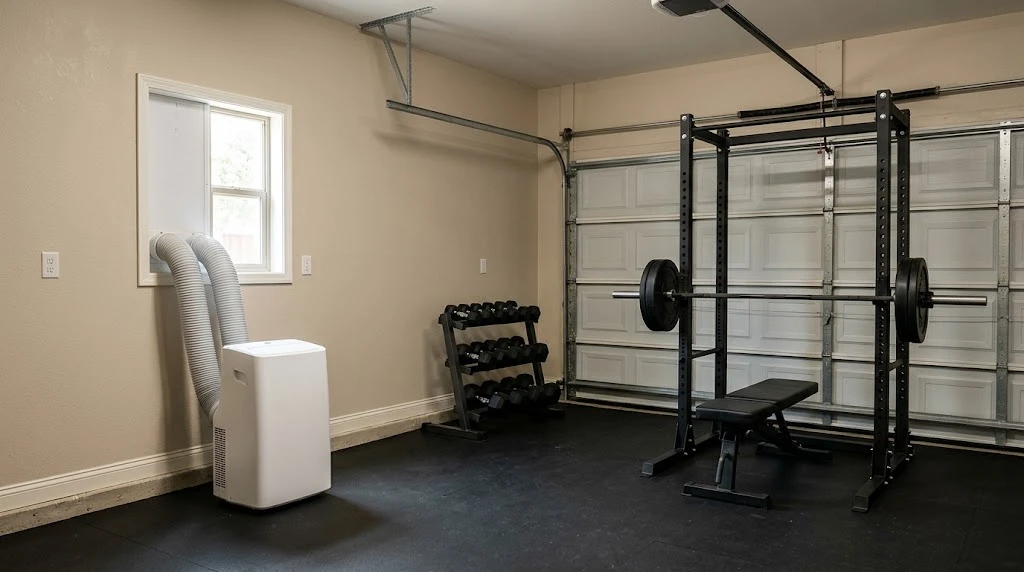
A portable unit works in a garage if its hose reaches outdoors and its label capacity covers the load. A window unit suits a garage with a window or framed wall opening: it sends heat straight outside, while a portable unit stands anywhere but loses some cooling to its hose.
Single hose or dual hose?
Dual hose is usually the better fit for a garage. A single-hose unit blows room air outside, so outside air leaks in. At an assumed 100 cubic feet a minute (a planning value, not a spec), that replaces the two-car garage’s air 1.9 extra times an hour. It adds 2,376 BTU/h, 38% on top of the insulated 6,271. A dual-hose unit draws its heat-carrying air from outdoors, so it avoids most of that.
Window unit in a garage with no window
Not as shipped: a window unit needs a window or framed wall opening, hot side outdoors. Cutting an opening is construction, so ask your building department, especially about a wall shared with the house. Leave the garage door uncut, because cutting it can upset its balance. With no window, your options are:
- Portable unit, vented through a panel in a door or wall
- Mini split, which needs only a small hole for its lines
- Framed opening and sleeve, built by a pro
Is a swamp cooler good for a garage gym?
Only in dry air. An evaporative cooler, also called a swamp cooler, chills air by evaporating water, so it cannot supply air colder than the wet-bulb temperature, the lowest a wet surface reaches in that air. In humid air that sits close to the outdoor temperature, and the cooler adds moisture.
My own calculation, from a dew-point formula and an assumed 80% effectiveness, meaning the cooler closes 80% of the gap to the wet-bulb. At 95°F and 15% humidity, the wet-bulb is 64°F and supply air is about 70°F. At 50% humidity, the wet-bulb is 79°F and supply air is about 82°F. To reach 75°F on a 95°F day, humidity must be below about 27%.
A cooler also works the opposite way from air conditioning: it needs air flowing through. Keep a door or window open, or humidity climbs and the cooling fades. The added water raises the risk covered in why gym equipment rusts in a garage.
In humid air, choose an air conditioner, which dries the air as it cools. For the moisture it leaves, see when a garage gym needs a dehumidifier.
Does a garage AC need its own circuit?
Often yes, but the label and the manual decide, and a licensed electrician should confirm. Many manuals call for an air conditioner on its own circuit, and a garage breaker may already carry lights, an opener or a freezer. Read the unit’s volts and amps before you buy, not after.
Voltage comes first. Smaller window and portable units usually plug into a standard 120-volt outlet. Larger window units and most mini splits use 240 volts, which needs a different outlet or a hardwired connection.
Volts times amps gives watts: a label reading 120 volts and 10 amps means 1,200 watts. Add that to everything else on the breaker. What else shares a garage circuit shows how to find those loads. Plug the unit straight into the wall unless the manual allows a cord.
FAQ
Can you air condition a garage gym?
Yes. A garage can be cooled when the unit’s capacity covers the heat coming in, its hot air leaves the garage and a circuit can carry the load, with the door shut. A bare shell and a small unit fail.
Is a mini split worth it for a garage gym?
Yes, if you own an insulated garage, train there for months each year and want heat too. No if you rent or cool a few weeks a year. The indoor unit hangs high on a wall, so check rack clearance and ceiling height.
What does it cost to air condition a garage?
Running cost is watts × hours ÷ 1,000 × your rate per kilowatt-hour. An assumed 1,000 watts for 6 hours a day over 30 days is 180 kilowatt-hours. Purchase and installation prices vary by region, so get written quotes.
Can a garage be too hot for an AC to cool?
Yes. Cooling stalls when heat coming in equals or beats what the unit removes, as with a small unit in a bare, sunny garage. Cut the load first, then size up, and read the manual’s outdoor temperature range.
Final thought
Garage gym air conditioning works when the type matches the shell: insulate first, then pick the unit your garage’s size, wall openings and power allow. If hot weeks are few, try the simpler route and learn to cool a garage gym without AC.
Check the label and manual before you buy or wire. More planning guides sit on the guides page.
How we wrote this guide
Every number comes from my own calculation. Cooling loads use the planning model behind the mini split guide, the evaporative figures a dew-point formula and an assumed 80% effectiveness, and the cost example an assumed 1,000 watts. I have not tested any air conditioner, cooler, garage or installer. Real loads change with sun, windows, door openings and humidity, and electrical and building rules vary by location.
Which cooling type fits your garage?
Send your garage size, insulation and coldest training day, and I will tell you which numbers to check.
Write to me