Layout
How to Hang a Gym Mirror on a Concrete Wall, Safely
Add up the glass weight, share it across the anchors under the bottom channel, and check that share against the anchor maker’s rating for your wall. Large panels go to a glass installer.
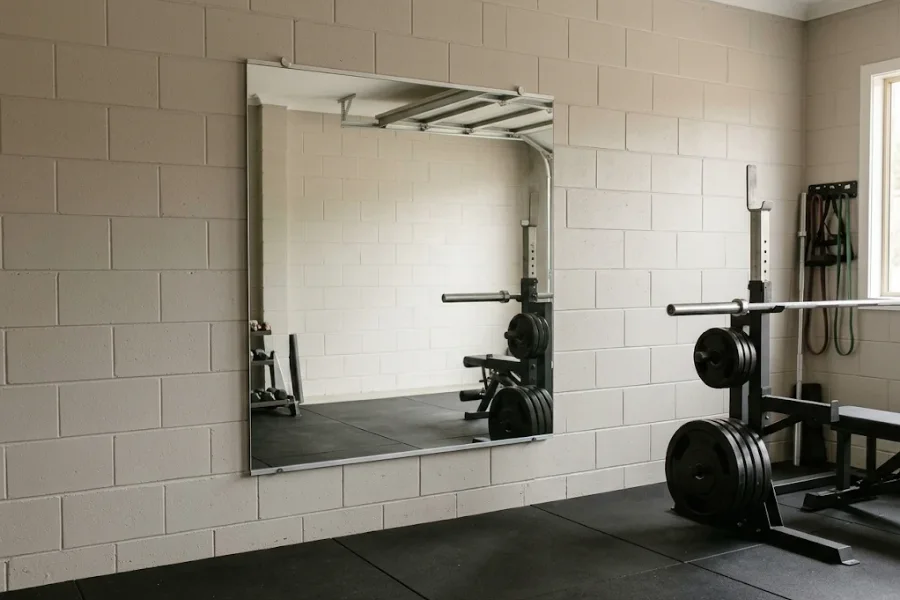
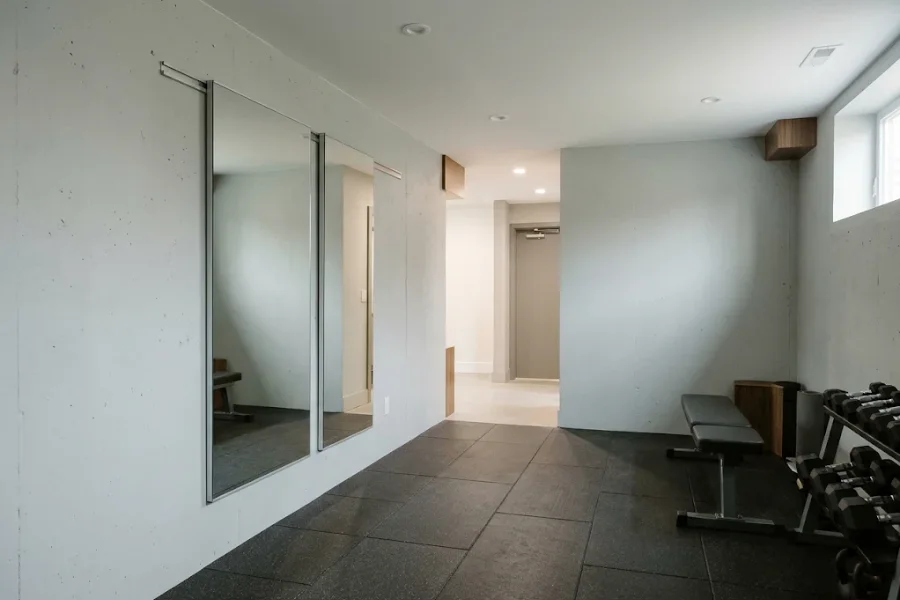
You have a concrete or block wall in a garage or basement gym, a large mirror on the way, and a fair worry about 80 pounds of glass.
How to hang gym mirror on concrete wall starts with one sum, not a drill bit: glass area times weight per square foot, shared across the anchors under the bottom channel.
I cannot rate your anchors or certify your wall. Those ratings come from the anchor and hardware makers, and large panels belong with a glass installer. To choose the size first, read how big a gym mirror should be.
How heavy is a gym mirror?
A 1/4 inch gym mirror is about 3.3 lb per square foot as glass, but the listed weights I found run nearer 3.9. A 48 by 72 inch panel is 24 square feet: about 79 lb of glass, and one retailer lists it at 93 lb. Use the supplier’s weight if listed; if not, plan on the higher rate.
Glass is about 158 lb per cubic foot, so the 1/4 inch sheets most listings give are 158 × 0.25 ÷ 12 = 3.3 lb per square foot. Metric 6 mm sheets run near 3.0 to 3.1.
| Panel (in) | Area | Glass only | Listed weight |
|---|---|---|---|
| 36 x 60 | 15 sq ft | 50 lb | none found |
| 48 x 72 | 24 sq ft | 79 lb | 93 lb |
| 48 x 84 | 28 sq ft | 92 lb | 109 lb |
The two listings that give a weight equal about 3.9 lb per square foot (93 ÷ 24 and 109 ÷ 28), roughly 18 percent above the glass-only sum. They do not say what the weight includes. I show every sum, as the page on how I check specs explains, but I have not weighed a mirror.
How do you hang a heavy gym mirror?
Rest the glass on a bottom channel fixed with masonry anchors, and let the top clips only hold it to the wall. The channel’s anchors carry the full weight, so divide the total by the anchors under it and check that share against the maker’s rating.
Take the 93 lb panel and four anchors, a count I chose. Shared evenly, that is 93 ÷ 4 = about 23 lb each. If a slightly unlevel channel leaves two anchors doing the work, it is 93 ÷ 2 = about 47 lb each.
That load pulls mainly down along the wall face, which anchor makers call shear. Tables list a failure load and a lower working load, commonly the failure load divided by a safety factor of 4. Read the working shear figure for your anchor, wall, hole depth and edge distance. No number here rates your wall.
That is dead weight only. Bumps add to it, so the studs, anchors and weight limits guide treats every rating as a promise tied to one installation.
Which anchors suit concrete, block and brick?
Use anchors the maker rates for your wall. Concrete screws and sleeve anchors suit solid concrete, block and brick; wedge anchors suit solid concrete only. Hollow block gives an anchor less to grip, so ratings run lower and rules run stricter.
| Wall | Watch for |
|---|---|
| Poured concrete | Rebar, edge distance |
| Hollow block | Thin face shell, mortar joints |
| Brick | Soft or crumbling brick |
A standard US 8 inch hollow block has a face shell at least 1-1/4 inch thick around open cells. One 3/16 inch concrete-screw table lists a pull-out failure load of 220 lb in light-weight block against 600 lb in 2000 psi concrete. Those are failure loads for one screw, not working loads for your wall.
Keep holes in the block face, not the mortar joints, and beyond the maker’s minimum edge distance (hole to nearest edge), since ratings drop closer in. If the bit hits rebar, the steel bars inside concrete, stop and move the hole about 2 inches. Never cut it.
How do you hang a gym mirror, step by step?
Fix a level bottom channel with rated anchors, lift the glass onto it with a helper, then add top clips snug, not tight. That is the usual channel-and-clip order for installing a gym mirror; your kit maker’s sheet outranks mine.
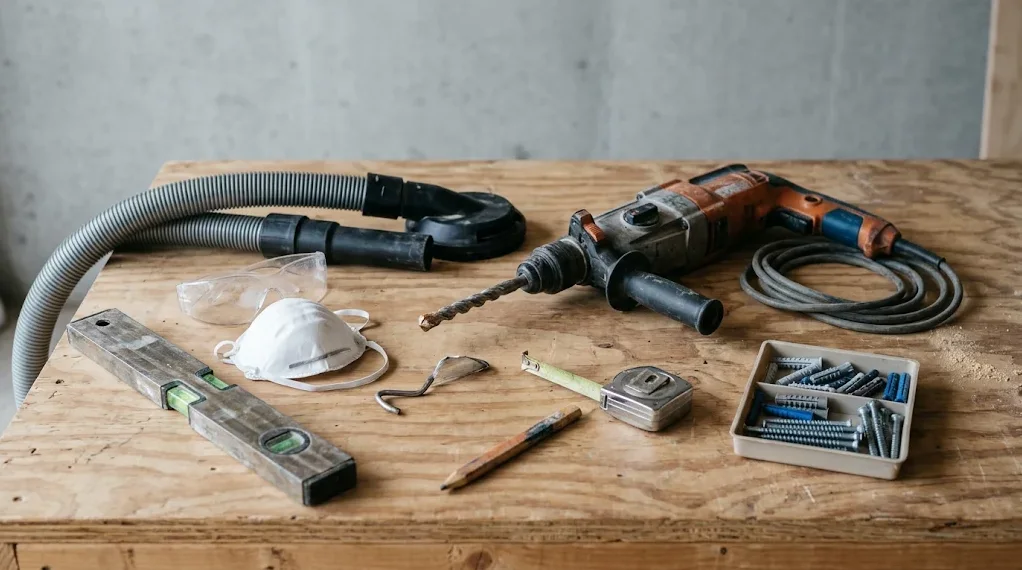
- Read the supplier’s weight, kit hardware list and anchor sheet; mark the mirror on your home gym floor plan.
- Mark a level line, then each anchor at the maker’s edge distance.
- Drill with dust control, clean each hole, set the anchors.
- Fix the channel, shimming until it sits level.
- With a helper, set the glass on the channel. Never lift it alone.
- Add clips gradually, leaving 1/8 to 1/4 inch between panels (one kit maker’s range).
Drilling concrete releases fine silica dust that harms lungs over time. Hold a shrouded vacuum at the bit, vacuum each hole instead of blowing it out, and ventilate a basement. Wear safety glasses, not everyday glasses, and a dust mask.
Stop before step 5 if the glass is large, the wall is hollow or damp, or no rating clearly covers your wall. Hire an installer.
Is your garage or basement wall ready?
Check three things before drilling a garage or basement wall: paint, flatness and damp. Glass cannot flex to fit a bump, and trapped moisture attacks the backing. Fix each first; the garage climate control order puts leaks and wet slabs ahead of everything.
Painted. Anchors pass through paint into the wall, but adhesive bonds only to the paint, and one mastic data sheet says never to install mirrors on a painted wall. It also says to seal porous bases such as concrete.
Uneven. Check with a level. Shim or space the channel and glass off bumps, and look for a channel with a drain hole, as glass-trade guidance advises.
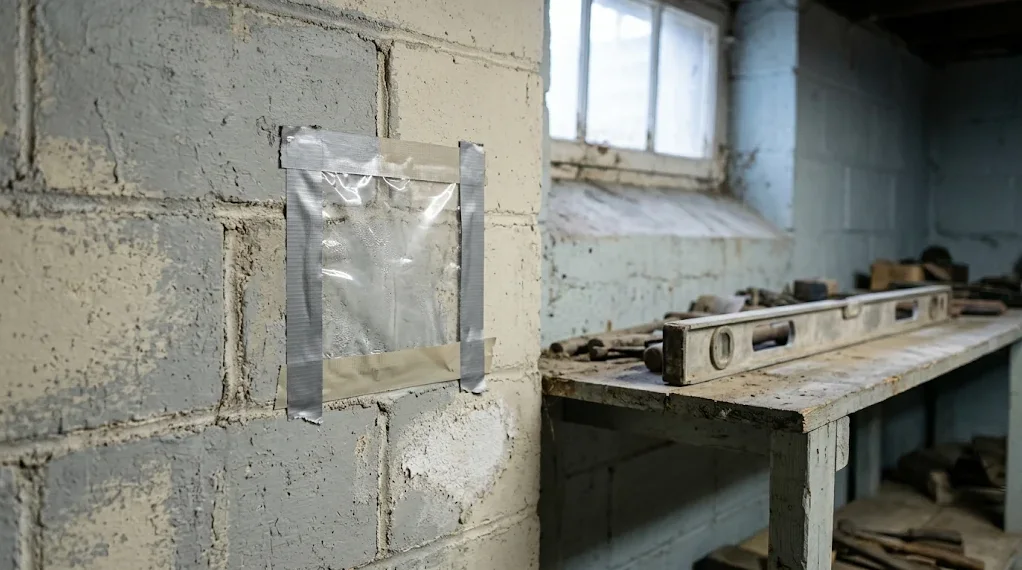
Damp. Tape an 18 by 18 inch sheet of clear plastic tight to the wall for at least 16 hours; moisture under it means the wall is not ready, though a dry sheet is not proof. The vapor barrier guide shows the same plastic-sheet test on a slab. White powder (efflorescence) means water has moved through.
Cold concrete can stay wet behind the glass, out of sight; the dehumidifier guide explains the dew point rule.
When should a glass installer take over?
Hire a glass installer if any one of these is true: the glass is large or in several panels, no maker rating clearly covers your wall, the wall is hollow, damp or crumbling, or you have any doubt. This guide cannot clear your wall.
- One panel of about 15 sq ft or more (a 36 by 60 inch mirror is about 50 lb of glass).
- Two or more panels in a run.
- Hollow block, old brick, cracks, loose mortar or any damp.
- A kit or manual that lists no masonry hardware.
- No second person to help set the glass.
The 15 sq ft line is my cut-off for hiring help. Below it, hiring is optional, not a safety clearance. Ask any installer which anchor they will use, which maker table covers your wall, and how they will keep the channel level.
FAQ
How do you hang a gym mirror without glue?
Use a bottom channel anchored to the wall plus top clips, and let no adhesive carry the weight. The channel holds the glass up; the clips hold it to the wall. If your kit ships adhesive, follow its sheet.
Is mirror adhesive or tape safe for a heavy gym mirror?
Not as the only support. Two mirror-mastic data sheets call for mechanical fasteners, and one adds that double-sided tape gives only initial hold. Adhesive also needs a dry, sealed, unpainted wall.
Can you hang a gym mirror on concrete without drilling?
Not a full-size panel on adhesive strips. One strip pack is rated for 20 lb and mirrors up to 24 by 36 inches; a 36 by 60 inch gym mirror is about 50 lb of glass. Renters: ask the landlord, then read the renter-friendly storage guide.
How do you hang a gym mirror in a garage?
Use the same bottom-channel method, plus two checks: test the wall for damp, and keep the glass out of the car door zone covered in the garage storage with a car guide.
Can you drill into a concrete wall with a regular drill?
A hammer drill with a carbide-tipped masonry bit is the usual tool, and concrete-screw makers specify it. A regular drill with a masonry bit can work but takes more effort. Use the bit size your anchor’s sheet names.
Final thought
Add up the glass, split it across the anchors under the channel, and let the maker’s rating and your wall set the limit. Anything large, hollow, damp or doubtful goes to a glass installer.
Next, browse all home gym planning guides and plan the room around the mirror.
How we wrote this guide
I wrote this guide from standard glass density, retailer listings, maker data and my own arithmetic, checked in November 2026. The weights are estimates: 3.3 and 3.9 lb per square foot are planning figures, not specs for your mirror. I have not tested any mirror, anchor or wall. For anchors, wall condition and large panels, follow the makers’ instructions and ask a qualified installer.
Want a second look at your mirror plan?
Send me your wall type, panel sizes and the supplier’s listed weight, and I will point you to the guide that fits your next step.
Write to me