Layout
How Big Should a Gym Mirror Be? Width, Height and Bottom Edge
Halve the span you want in view to get the mirror’s width, then set its edges halfway between your eye height and the lowest and highest points you want to see.
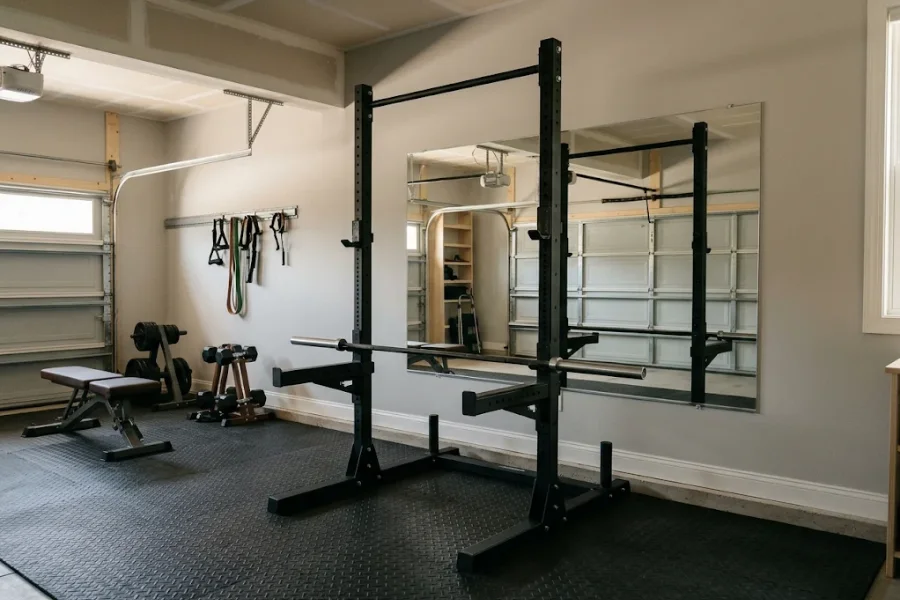
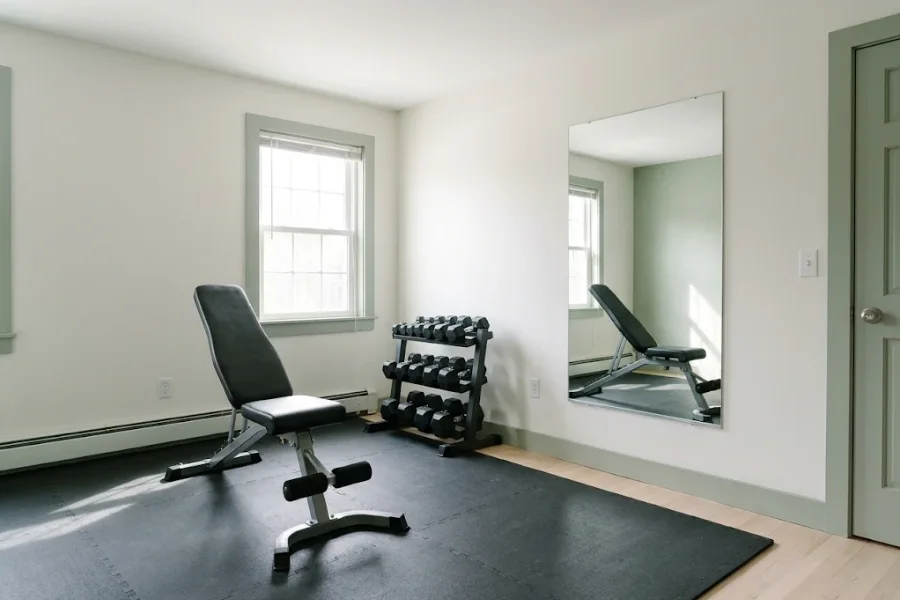
You have a bare wall, a rack on the floor plan and a glass shop asking for a size. So how big should a gym mirror be? Size it from what you want in the reflection, not from the wall.
Two rules do most of the work. A flat mirror shows a slice of the room about twice its width, so a 48 inch panel frames 96 inches. Its edges sit halfway between your eye height and the highest and lowest points you want in view.
This guide covers size and placement only. The room plan lives in the home gym layout guide, and wall strength belongs to a qualified pro.
How wide should a gym mirror be?
Match the width to the span you want in the picture, then halve it. At your distance, a flat mirror shows a slice of the room about twice its own width, so a 48 inch panel frames 96 inches of rack, bar and floor. Stepping closer or farther does not change that.
A men’s Olympic bar is about 86.6 inches long. How big should a gym mirror be to show it end to end? At least 43.3 inches, with you exactly on the centerline, and more once you allow for drift.
| Mirror width (in) | Window at your distance (in) | 86.6 in bar in view? |
|---|---|---|
| 36 | 72 | No, ends cut off |
| 48 | 96 | Yes, within 2 in of center |
| 60 | 120 | Yes, within 8 in of center |
| 72 | 144 | Yes, within 14 in of center |
Each inch you stand off the mirror’s centerline slides the window 2 inches, so the drift allowance is (window – bar) / 4. For a 48 inch panel that is (96 – 86.6) / 4 = 2.35 inches. Center the glass on where you stand, not on the wall.
These are planning figures for a flat mirror, with the bar about as far from the glass as your eyes. Rack frames typically run 46 to 52 inches wide, so even a 36 inch panel frames one. The storage guide lists other gear sizes.
How much wall can the glass use?
Work in inches: take the wall’s length and subtract everything that already claims it: end gaps, doors, plate storage, and any outlet or switch the glass would cover. What remains is your usable width. Round it down to whole panels.
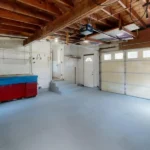
The example uses a made-up 15 foot garage wall, not a spec. A plate tree is about 24 inches wide, and the plate tree versus wall peg comparison counts the rest.
- Wall: 15 ft x 12 = 180 in.
- Minus a 2 in gap at each end: 180 – 4 = 176 in.
- Minus a 36 in side door and trim: 176 – 36 = 140 in.
- Minus 30 in for a plate tree and a 6 in buffer: 140 – 30 = 110 in.
Two 48 inch panels use 96 inches and leave 14, enough to slide the pair along the wall and center it on the rack. Three 36 inch panels use 108 and leave 2, which gives no room if the wall is out of square.
A garage wall also loses run to car doors. See how a parked car changes garage wall space.
How tall, and how high off the floor?
The glass must span two midpoints: halfway between your eyes and the floor, and halfway between your eyes and the highest point you want in view. Standing closer or farther does not change either one. The examples use eyes at 66 inches, for a 70 inch lifter; measure yours.
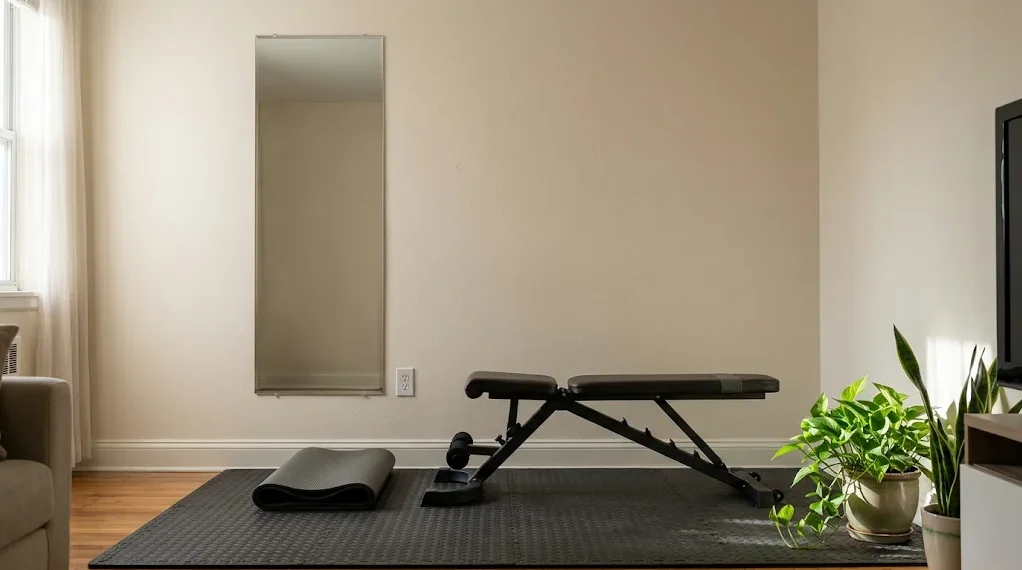
How tall should the panel be?
Tall enough that its top edge reaches the upper midpoint. With eyes at 66 inches (a textbook allowance of 4 inches below the head), a bar held 84 inches up needs a top edge at (66 + 84) / 2 = 75 inches. From a 6 inch bottom edge, a 72 inch panel reaches 78.
Check the ceiling too: 6 + 72 = 78 inches leaves 6 under a 7 foot (84 inch) ceiling. An 84 inch panel from 6 inches reaches 90, which wants an 8 foot ceiling. See what fits under a 7 foot ceiling.
How high should the bottom edge sit?
As low as your obstacles allow, never above half your eye height: 33 inches at 66. Two guides I read put the edge 6 to 12 inches up. My reasoning: that clears baseboards, outlets and loose plates. Outlet heights vary, so measure yours.
For a bench, sit where you will lift, measure floor to eye and halve it, since seated eyes sit lower. Then measure the wall’s real clear height with the ceiling-height tool on the home page; lights and beams lower it.
Where does the mirror sit near the rack?
Put the mirror on the wall you face while lifting, centered on the rack, with a gap you choose because no standard sets one. I plan at least 36 inches from the rack front to the glass. That is a floor-plan allowance, not a safety rating.
A side-wall mirror shows your profile. The width rule still holds: half the rack depth you want in view, about 24 inches for a 48 inch deep rack. The 12×12 home gym layout shows a mirror wall and rack sharing 144 square feet.
Two guides warn that dropped weights and bars can hit the glass, so give plates and dumbbells their own wall. Dumbbell racks and floor load have their own guide.
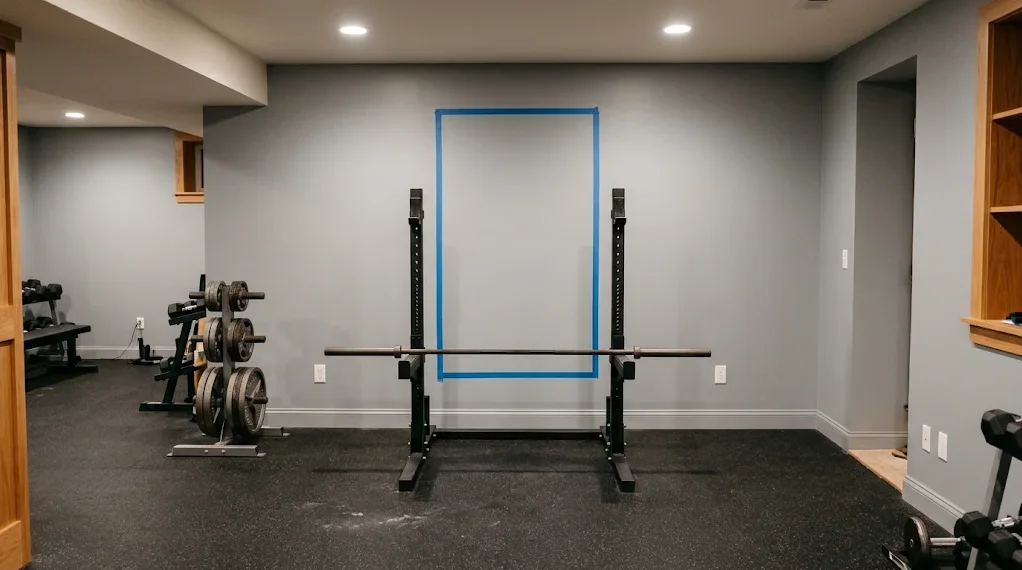
Before you order, confirm the plan on the wall with painter’s tape.
- Measure your eye height, standing and seated.
- Tape the glass outline, centered on the rack.
- Mark the two midpoints from the rules above.
- Mark every outlet and switch inside the tape.
- Measure from the rack front to the wall.
How heavy is a gym mirror panel?
Glass weighs about 156 pounds per cubic foot, so 1/4 inch glass is about 3.25 pounds per square foot (0.25 / 12 x 156). A 4 by 6 foot panel is 24 square feet, or about 78 pounds before backing and hardware. Your supplier’s own figure replaces mine.
| Panel size (in) | Area (sq ft) | Glass weight (lb) |
|---|---|---|
| 36 x 72 | 18 | 58.5 |
| 48 x 72 | 24 | 78 |
| 48 x 84 | 28 | 91 |
| 60 x 72 | 30 | 97.5 |
| 72 x 96 | 48 | 156 |
The stock kits I read list size and thickness but not weight, so ask for it in writing. A 72 by 96 inch panel likely means custom glass.
Hamilton Home Fitness sells commercial-grade gym mirrors and quotes them to the size of your wall on request.
On a framed wall, studs, anchors and weight limits shows how to find studs and read a rating.
I cannot say whether your wall, anchors or adhesive can carry that load, and I give no safe figure. That depends on the wall and the installation; large panels suit a qualified installer. Hanging a gym mirror on a concrete wall covers glass weight and anchors.
FAQ
What is the standard gym mirror size?
There is no single standard. Stock gym kits commonly run 36 to 60 inches wide and 60 to 84 inches tall. Wider walls take custom glass or several panels side by side.
Is a 4×6 mirror enough, or do I need 6×8?
For one station, 4×6 feet (48 by 72 inches) is enough: its 96 inch window is wider than an 86.6 inch bar. A 6×8 foot panel is about 156 pounds of glass, so choose it only for a long wall.
Should I use one big gym mirror or several panels?
Several panels are easier to carry. Two 48 by 72 inch panels are two 78 pound loads instead of one 156 pound sheet. Each seam shows as a thin line in your reflection, so plan where it lands.
What glass thickness and backing should a gym mirror have?
Ask for 1/4 inch (6 mm) glass and a written spec showing how it is made safe: tempered with a vinyl safety backing, or laminated. Stock gym kits I read list 1/4 inch. Ask for the panel weight too.
Does a home gym need a mirror?
No. A mirror is optional, and it uses your clearest wall. The smallest size I saw recommended is 24 by 48 inches. Renting? Check your lease before fixing glass to a wall, and see how renters store gear without drilling.
Final thought
Work three sums before you order: half the span you want in view for width, two midpoints for the edges, and wall length minus what is already taken for the panel count. Then get the panel weight from your supplier in writing.
Next, browse all home gym planning guides for the room your mirror wall sits in.
How we wrote this guide
I wrote this guide from standard sizes and my own arithmetic. The bar length, rack width and glass density figures are typical values checked in November 2026, and makers vary, so check your own spec sheets. The window and midpoint rules are flat-mirror geometry that I worked through by calculation. I have not tested any mirror, wall, rack or panel. For weight, anchors and wall strength, ask a qualified pro or glass installer.
Want a second look at your mirror wall?
Send me your wall length, ceiling height and the gear you lift with, and I will point you to the guide that fits your tightest limit.
Write to me