Storage
Renter Friendly Home Gym Storage: What Works Without Drilling
Store plates, a bar and dumbbells in a rental without drilling: freestanding gear on a loose base, a corner weight check you can do yourself, and your landlord’s okay in writing.
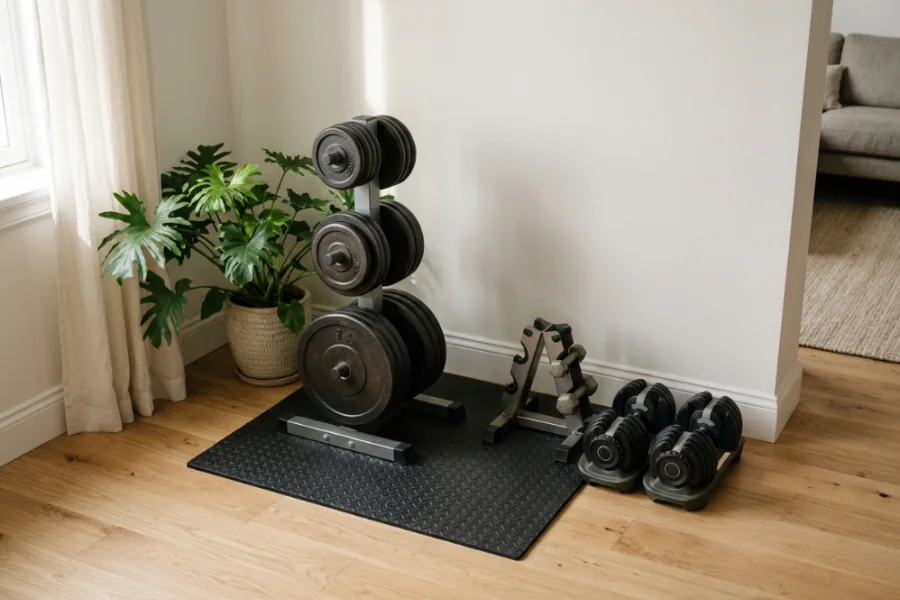
You rent a second-floor apartment. The lease bans holes in the walls, and you own a barbell, plates and dumbbells. Renter friendly home gym storage means gear that stands on the floor, sits on a removable base and never touches the walls.
The catch is the floor. Weight stored in one corner is far denser than weight spread across a room, and your lease may have a say. I work through a bedroom-corner example with the arithmetic shown.
This is planning guidance, not legal or structural advice. Here is how I treat numbers and limits in every guide.
What can you store without drilling?
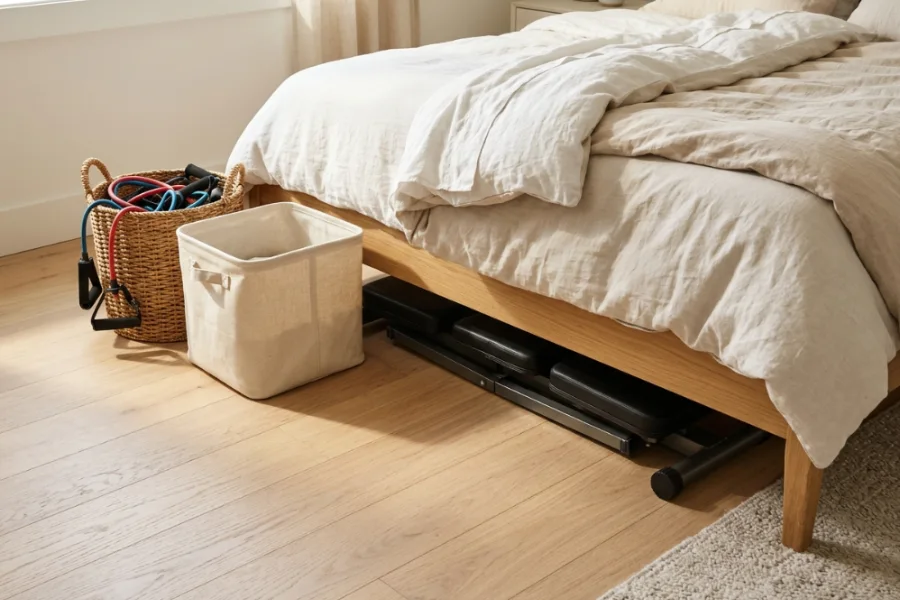
Anything that stands on the floor under its own weight stores without a hole: a plate tree, a dumbbell rack, freestanding shelving, a wheeled cart, an under-bed bin or a closet shelf. Each one trades wall space for floor space and floor load. The table shows who each suits and when to skip it.
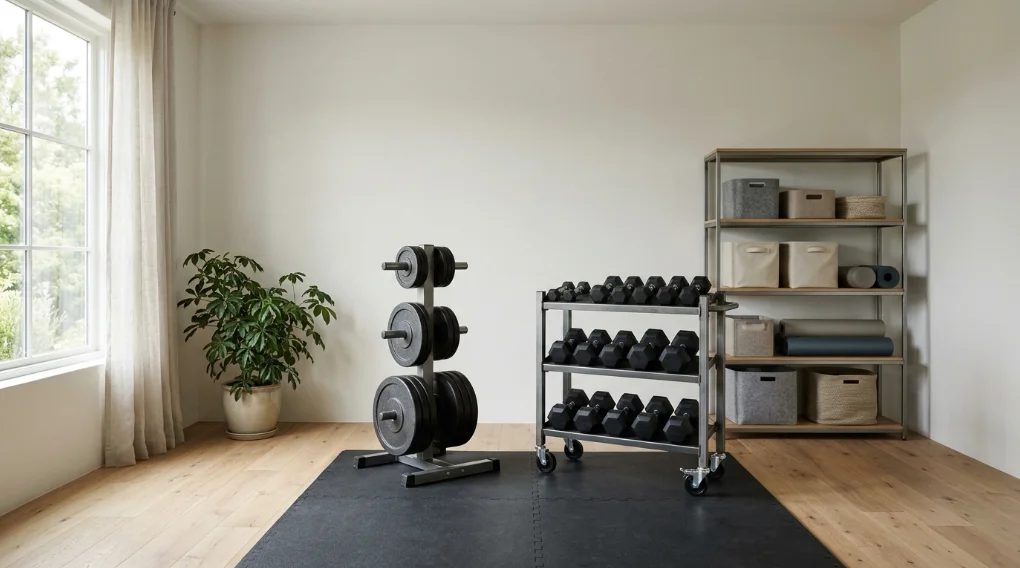
| Option | Why it works, who it suits | Skip it when |
|---|---|---|
| Plate tree | Holds plates on pegs in a small footprint; suits one bar and a few plate pairs. | Its feet would sit on bare carpet or soft wood with no base. |
| Dumbbell rack | Keeps pairs sorted and off the floor; suits fixed-weight sets. | Its rated load is below your total dumbbell weight. |
| Freestanding shelving | Takes bins of bands, mats and handles; suits light kit. | You would put heavy iron on upper shelves. |
| Wheeled cart | Rolls kettlebells or small plates to a corner after use. | The loaded cart passes its wheel rating. |
| Under-bed bin or closet shelf | Uses dead space for bands and light accessories. | The bed frame or shelf is not rated for the load. |
The tree is the usual renter answer for plates. If you are weighing it against a wall rack, the plate tree versus wall-mounted comparison settles it; in a rental, the wall option needs your landlord’s okay.
Are adhesive hooks and tension mounts okay?
Adhesive hooks and tension mounts work only for light kit, and only inside the maker’s printed rating. A resistance band, jump rope or foam roller suits one. Plates, bars and kettlebells do not. Ratings differ by product and surface, so I will not quote a number.
Sweat, dust and repeated tugging weaken the bond, and a failed hook can take paint with it. Tension rods and pressure-fit bars follow the same rule: stay inside the stated load and the stated surface.
My rule: if an item would hurt something when it fell, it goes on the floor. Hanging real weight on a wall needs holes. If your landlord agrees to that, the guide to studs, anchors and weight limits covers it.
What does a bedroom corner of gear weigh?
In my example, 425 lb of gear in a 3 by 4 ft corner averages about 35 lb per square foot. Spread across a 10 by 11 ft bedroom, the same gear is about 4 lb per square foot. The corner is roughly nine times denser, and that gap is what your landlord needs to see.
Swap in your own numbers.
- Bar 45 lb plus plates 170 lb (2 x 45, 2 x 25, 2 x 10, 2 x 5) is 215 lb.
- Dumbbells: pairs of 15, 25 and 35 lb make 150 lb.
- Stands: I assume 60 lb. The total is 425 lb.
- Corner: 3 by 4 ft is 12 sq ft. 425 / 12 is about 35 lb per sq ft.
- Room: 10 by 11 ft is 110 sq ft. 425 / 110 is about 3.9 lb per sq ft.
- Stands alone, if they cover 6 sq ft: 425 / 6 is about 71 lb per sq ft.
Dumbbells add up fastest: 150 of the 425 lb. The dumbbell storage guide covers rack types and floor load.
A standard Olympic bar is about 7 ft long. Measure your ceiling with the ceiling-height check on the home page before you stand it upright.
Does an upstairs floor change the plan?
An upstairs floor changes the plan: ask before you load it. I cannot tell you whether your floor carries your corner, and no article can, because the answer depends on joists, spans and the building’s age. Your landlord, building manager or a structural engineer holds the answer. Until you have it, keep the load light.
US residential codes design bedroom floors for 30 lb per sq ft and other rooms for 40 lb per sq ft of live load (people and furniture), spread across the floor. Those are design minimums, not a pass mark for a corner. Apartment buildings may follow a different code, and older ones predate today’s.
Some guides multiply room area by 30 or 40 and call the result a room’s capacity. For a 150 sq ft bedroom at 30, that gives 4,500 lb. The sum assumes weight is spread evenly, which a stacked corner is not.
Before you ask, total your gear and measure the corner, as the guide to how much floor and wall your gear needs shows. I am not an engineer, and I cannot clear a floor for you.
What should go under the gear?
Put a firm, loose layer under the gear, wider than its feet: a mat or a board cut to the base. It spreads each foot’s load and protects the surface from dents and scuffs. It does not cut the total weight on the floor structure, so it cannot replace your landlord’s answer.
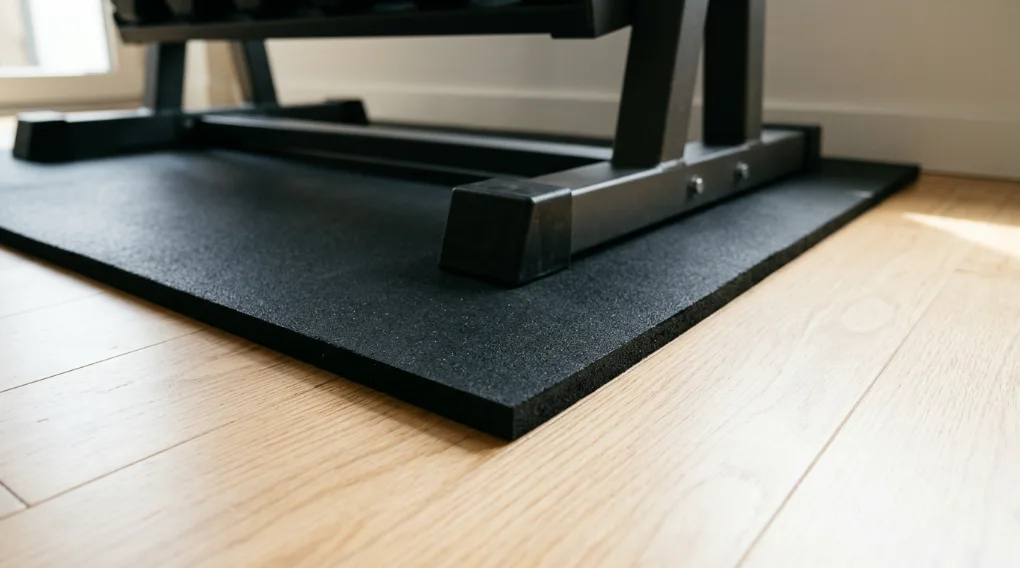
Take the plate tree from my example: 170 lb of plates plus an assumed 25 lb tree is 195 lb on an assumed four feet, about 49 lb per foot. If each foot is 2 inches square (4 sq in), that is about 12 lb per sq in. On a 24 inch square base (576 sq in), the same load is about 0.34 lb per sq in.
A stiff base spreads most and thin foam least. If you also lift here, compare 3/8, 1/2 and 3/4 inch mat thickness: thickness matters most for dropped weights, while a firm, wide base matters more for stored gear.
- Ask the mat maker if it can stain your floor type; rubber can yellow some vinyl.
- Lift an edge now and then to check the floor below is dry.
- Keep every layer loose. Skip tape and glue unless your landlord agrees.
- Lift stands and plates; dragging them scratches floors.
What should you check in the lease first?
Before storing weights in a rental, read the lease for clauses on alterations, floor coverings, heavy items, noise and quiet hours. Then ask your landlord in writing. A spoken yes is hard to prove later. This is planning guidance, not legal advice, and tenant and deposit rules differ by state.
A lease may not name weights, so search for clauses that could cover them. Some leases limit waterbeds or heavy furniture, so try those words.
Then send a short message: “I plan to keep about [your total] lb of weights on a mat in the bedroom corner, with nothing attached to the walls. Does my lease allow this? Please reply in writing.” Keep the reply with your lease.
If the answer is no, look at gear that suits small spaces.
FAQ
Can you put a home gym on carpet?
Light storage often can, but check the manual first, because some rack makers say not to place the rack on carpet. You usually cannot remove a landlord’s carpet, so use a loose base. See what works over carpet.
Will storing weights disturb the neighbors?
Storage itself is quiet. The noise comes from setting plates down, sliding racks and moving gear, and it carries through floors and shared walls. I cannot give decibel figures. Set weights down, never drop them, and follow your building’s quiet hours.
Can you keep gym equipment on an apartment balcony?
Only if your lease and building rules allow it, and I would not guess a balcony’s load limit. Weather is the second problem: damp air rusts bare iron, as the guide on why gym equipment rusts explains.
Can a landlord keep your deposit for floor dents?
Possibly, if the marks count as damage beyond normal wear. What counts varies by state and lease, and I cannot give legal advice. Photograph the floor and walls with dates before gear moves in, and keep your landlord’s written okay.
Final thought
Renter friendly home gym storage comes down to gear that stands on its own, a loose base under it and a weight total before you ask. Your landlord’s written answer decides what stays. My arithmetic only shows what to ask.
Next, list your gear and measure your corner. Then browse the Guides hub for your next small-space question.
How we wrote this guide
I wrote this guide in November 2026 from published figures and my own arithmetic. The weights in the worked example are example inputs, not test results, and I have not tested any product. Code figures are US design minimums, given for context only. For floor load or lease questions, ask your landlord in writing and, if needed, a structural engineer.
Want a second look at your corner plan?
Send me your corner size, floor type and gear list, and I will help you total the weight and draft the question for your landlord.
Write to me