Storage
How to Store a Weight Bench in a Small Space
Fold-flat benches slide under a bed, non-folding ones stand on end, and wall hanging needs a bench-specific mount fixed to studs. Measure three numbers first, then pick.
The last set is done, and a 50-inch bench now blocks the gap between your bed and the dresser.
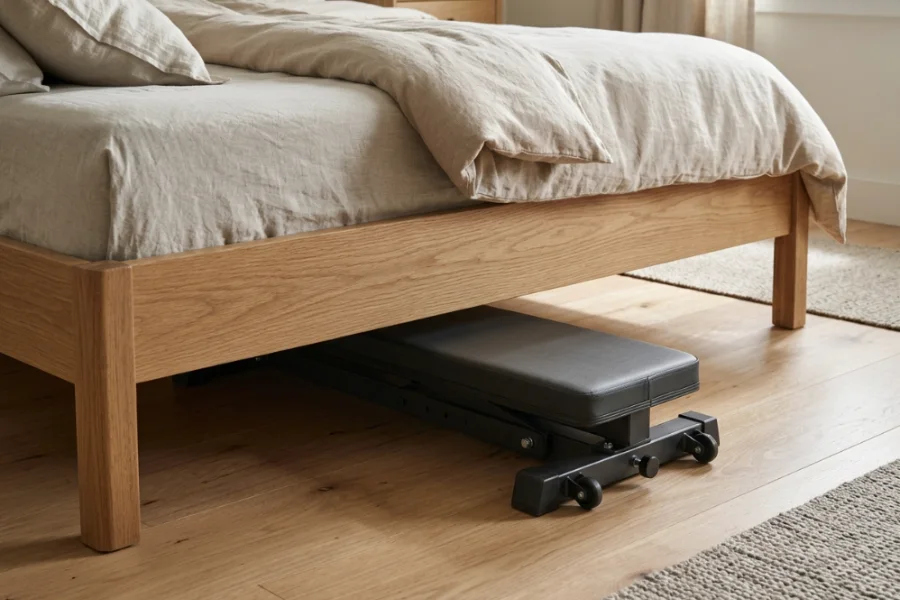
Here is how to store a weight bench in an apartment, garage or shared room: fold it flat under a bed if it folds, stand it on end if it does not, and hang it only on a mount made for it.
Which one works comes down to three numbers: stored footprint, stored height and clearance. I use typical sizes and show the arithmetic, so you can swap in your own.
Sizes vary by maker, so read how this site evaluates specs and check your manual.
Which storage method suits your bench?
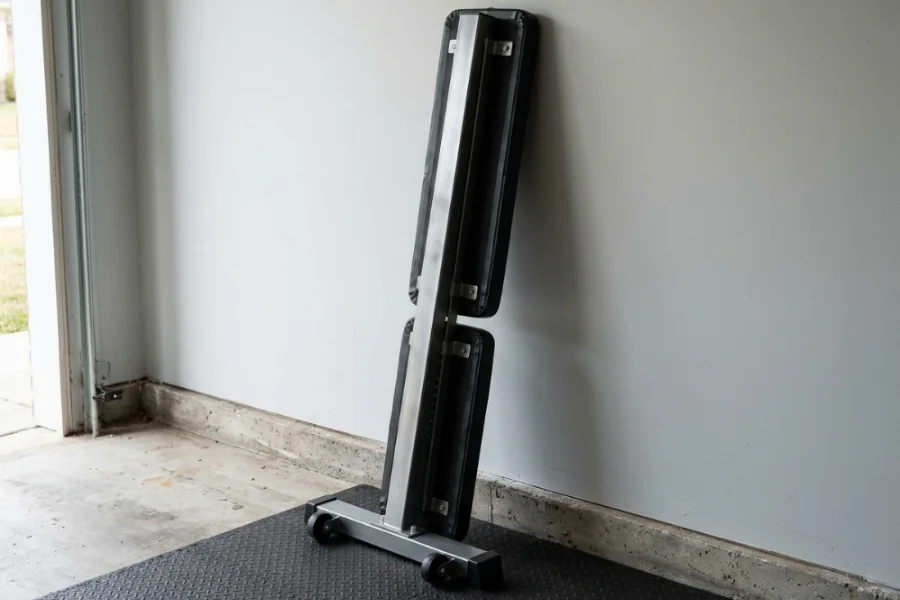
Your bench’s folding design decides your options. A fold-flat bench goes under a bed or on end beside a wall. A non-folding adjustable bench stands on end, often rolling on transport wheels. A fixed flat bench lies lengthwise along a wall or stands on end. Check your manual first.
That matters because roundups often say to slide the bench under the bed. Some adjustable benches do not fold at all; their makers list upright storage on wheels instead.
| Bench type | Parks | Wrong choice when |
|---|---|---|
| Fold-flat | Under a bed, or on end beside a wall | The gap under the bed is smaller than the folded thickness |
| Non-folding adjustable | On end, wheels facing out | Children or pets can pull it over |
| Fixed flat | Lengthwise along a wall, or on end if the manual allows | The free wall run is shorter than the bench |
Dumbbells, plates and bars are separate storage problems. For racks and trays, see dumbbell storage for small spaces.
Hamilton Home Fitness’s adjustable bench page covers flat-to-incline, FID and folding styles, and lists wheels, folding or upright storage as a check for tight spaces.
Can you store a weight bench upright?
Yes, if the manual allows it. Standing a typical non-folding adjustable bench on end cuts its floor use from about 9.2 to 3.2 square feet, but it then stands about 5 feet tall. Park it where it cannot tip, ideally against a wall.
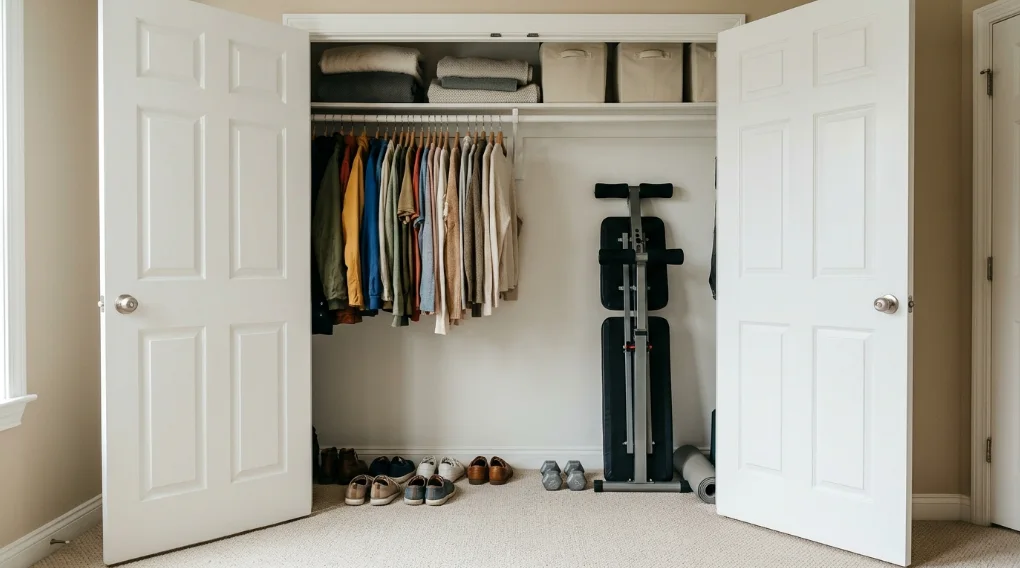
The math uses one maker’s typical listing. In use, the bench is about 51 by 26 inches: 51 x 26 = 1,326 square inches, or 9.2 square feet. On end, it takes about 26 by 17.5 inches: 455 square inches, or 3.2 square feet. Another maker lists 3.1 square feet on end for a 59.5-inch bench.
Height is usually not the limit. At 59.5 inches, the bench clears a 7-foot (84-inch) ceiling by 24.5 inches, though lights and pipes still need checking. See what equipment fits under a 7 foot ceiling for the wider picture.
Check four things before you stand it up:
- The manual allows on-end storage.
- The spot is away from doorways and play areas.
- Wheels, if fitted, face outward for pulling it out.
- The maker approves an anti-tip strap, if you want one.
A parked car changes which wall is free. For door swing and bumper room, see storing gym gear in a garage with a car.
Will a foldable weight bench fit under a bed?
A foldable weight bench fits when its folded thickness is smaller than the gap under your lowest bed rail and its folded length can slide in from one side. One fold-flat listing gives 55 by 13.8 by 7.5 inches folded.
Thickness comes first. One furniture guide says standard beds clear 12 to 18 inches, so a 7.5-inch fold has room. Your frame may sit lower, so measure from the floor to the lowest rail and add an inch of margin: 7.5 + 1 = 8.5 inches.
Length comes second. A twin mattress is 38 by 75 inches, so a 55-inch bench cannot enter from the side but has 20 inches to spare from the foot (75 – 55 = 20). A queen is 60 by 80 inches, leaving 5 inches from the side. Real frames and legs shrink those margins.
If the gap is too small, stand the folded bench on end instead. On end it takes 13.8 x 7.5 = 103.5 square inches, about 0.7 square feet, and stands about 55 inches tall. Laid flat against a wall, it takes 55 x 13.8 = 759 square inches, or 5.3 square feet.
Sliding under needs no drilling, which suits a lease. For more drill-free ideas, see renter-friendly home gym storage.
Can you hang a weight bench on a wall?
Only with a mount made for your bench, fixed into a structural wood stud or solid masonry wall. One maker’s vertical bracket for a 128 lb bench rules out mounting into drywall alone. A generic hook is not a substitute.
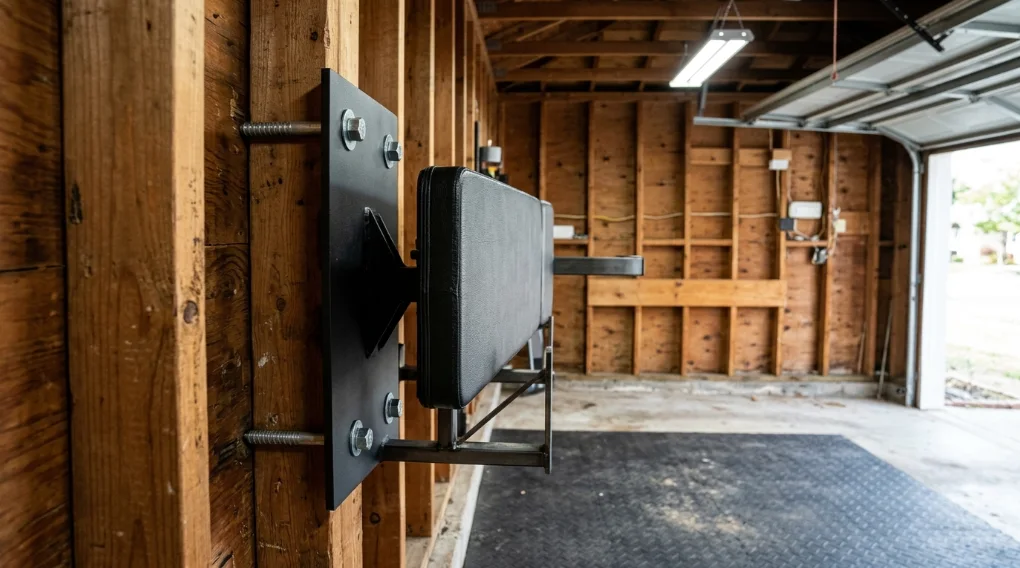
Three checks apply. Fit: one maker’s hanger listing names the few models it suits and says it will not work with that maker’s adjustable or fold-up benches. Wall: studs are commonly 16 inches apart, and the vertical bracket’s page calls for 3/8-inch lag bolts, bought separately. Upkeep: the same page says to inspect the bolts periodically.
A few benches are built to bolt to a wall or rack and fold back flat. That mount belongs to the bench, so follow its manual.
This is a structural call, and I cannot see your wall. If you are unsure what sits behind the drywall, ask a qualified contractor. Renters should check the lease before drilling.
For stud finding, anchors and weight limits, read the stud, anchor and weight-limit rules for wall-mounted gym storage.
How do you protect floors, pads and frames?
Keep the bench indoors and dry, on a mat where it touches the floor. The bench manuals I read say to keep it indoors, away from moisture and dust, and to put a mat or other cover under it to protect the floor or carpet.
Soft carpet. Plush carpet lets a bench sink and wobble. Thick pile usually needs plywood under rubber or removal, as the guide on home gym flooring over carpet explains.
Stiff or cracked pads. Heat and direct sun stiffen vinyl covers over time, and garage swings from hot to cold are harder still. I could verify only that general point, with no temperature limits, so keep the bench out of sunny windows and away from heater vents.
Rust. Rust follows damp. Read why gym equipment rusts in a garage and how to stop it, then wipe sweat off the frame after sessions.
Damp that returns every week points to the room, not the bench. Fix the damp before you move the bench again.
FAQ
Can you keep a weight bench outside?
No, not for storage. The bench manuals I read say to keep it indoors, away from moisture and dust. If a garage is your only option, see what to fix first in garage gym climate control.
How much does a weight bench weigh?
Listings I read range from about 33 lb for a light fold-flat bench to about 130 lb for a heavy-duty adjustable one. Several sit between 60 and 80 lb. Check your manual’s weight before you tilt one up alone.
What are the dimensions of a weight bench?
Flat benches run about 45 to 50 inches long, 10 to 12 inches wide at the pad and 17 to 18 inches high. Adjustable benches reach 50 to 60 inches long and about 23 to 26 inches wide. Sizes vary by maker.
Can you store a weight bench in a closet?
Yes, if it stands on end and the closet is deep and wide enough. A standard reach-in closet is 24 inches deep, so a bench with a 17.5-inch on-end depth leaves 6.5 inches spare. Its 26-inch width must still clear the door opening.
Do weight benches have wheels?
Several non-folding adjustable benches do, often with a handle, so you can roll them to their parking spot. Wheels vary by model, so check the listing for yours.
Final thought
Match the method to the bench: fold flat under a bed, stand a non-folding bench on end, and hang one only on a mount made for it. Measure thickness, footprint and height first. For the whole room, see how much wall and floor your gear needs.
Ready for the next problem? Browse the Guides hub.
How we wrote this guide
I wrote this guide in November 2026 from maker listings and manuals, so every size is a typical figure, not your bench’s. The floor-space numbers are my own arithmetic from those sizes, shown above. I have not tested any bench, bracket or mat. For wall fixings, ask a qualified contractor, and check your manual before standing a bench on end.
Not sure which method fits your room?
Send me your bench type, its folded or on-end size and the free wall length, and I will help you work out which method fits.
Write to me