Layout
Apartment Home Gym Layout: Fit a Workout Zone Into a Living Room, Studio or Bedroom
Tape out a clear zone of about 39 sq ft, then test the room twice: gym out and gym put away. Your lease and the unit below decide what that floor can take.
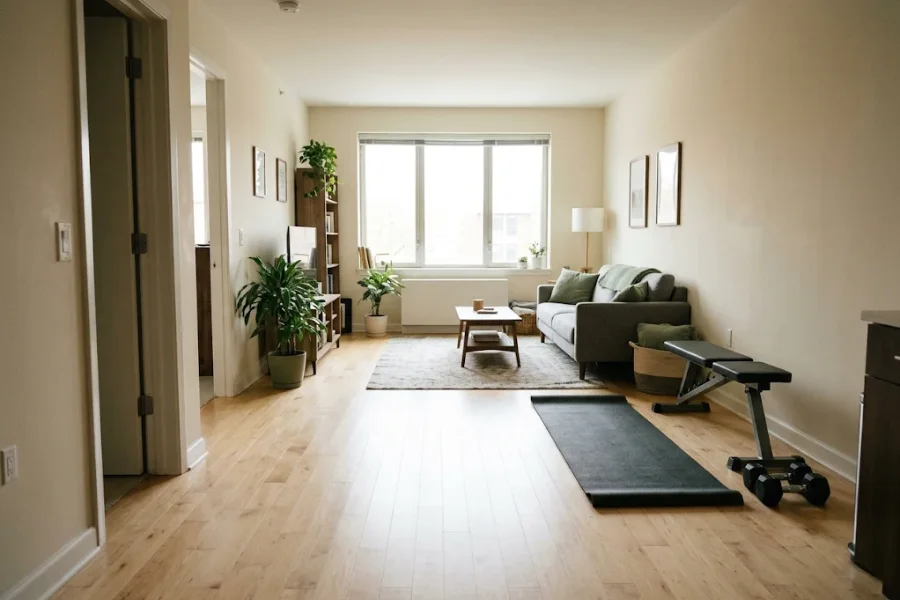
You have a living room, a studio corner or a bedroom wall, a neighbor below and a lease you have not reread. A home gym can fit if the building allows it and the room works with the gear out and put away.
That two-state check drives any apartment home gym layout. A clear zone of about 39 sq ft covers floor work and a bench, which is under a tenth of a typical studio. For the wider method, see how to lay out a home gym in zones.
This guide counts space only. It does not read your lease, rate your floor or give a safe weight. Your building manager or a qualified pro answers those.
How much floor does a workout zone need?
For an apartment home gym setup, plan on about 39 sq ft: a clear 6.5 by 6 ft rectangle that holds floor work and a bench. A mat alone needs 6 by 6 ft, or 36 sq ft. These are my planning figures, not standards, and they assume the gear sizes below.
| Piece | Clear floor | Math |
|---|---|---|
| Mat for floor work | 72 x 72 in | 24 in mat + 24 in on each long side |
| Adjustable bench | 78 x 54 in | 54 + 12 + 12 in long; 18 + 36 in wide |
| Both, sharing floor | 78 x 72 in | the larger of each side |
A standard yoga mat is about 24 by 68 inches. Many adjustable benches run roughly 50 to 60 inches long, so I use 54 by 18, plus 12 inches at each end and a 36 inch working side. You use the mat and the bench one at a time, so they share floor: 78 x 72 = 5,616 sq in, and 5,616 / 144 = 39 sq ft.
National averages put a studio near 440 to 460 sq ft, so 39 sq ft takes about 9% of it (39 / 440 = 8.9%; 39 / 460 = 8.5%). The home gym storage guide shows how to count floor, wall and height for every item.
How do you build the zone, step by step?
Tape the zone on the floor, walk the paths around it, then tape where each piece sits when put away. That is the whole apartment gym layout: if both states leave a clear 36 inch path, it works. If either state blocks a path, move the zone or drop a piece.
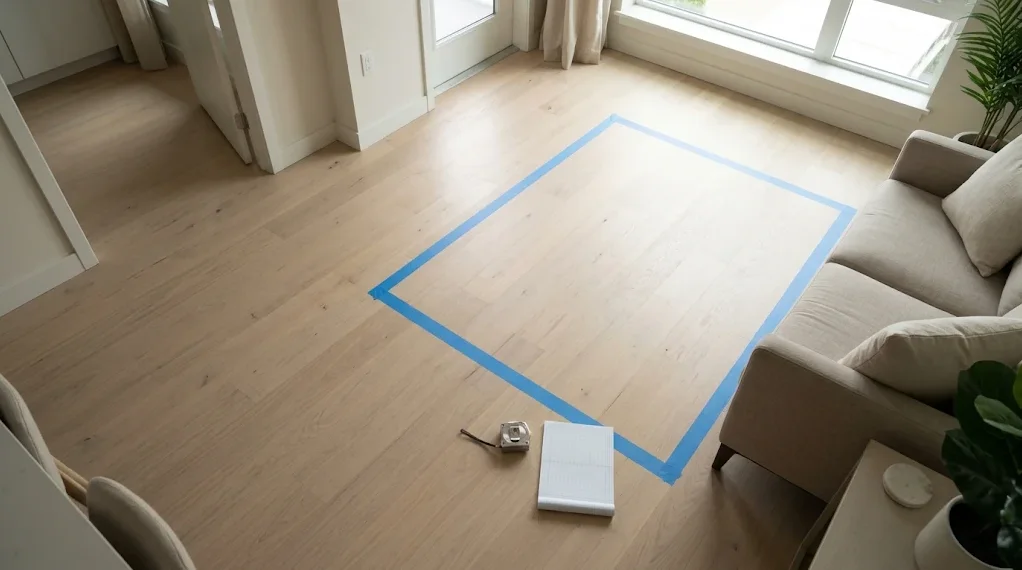
- Mark door swings, windows and vents, then check height with the ceiling-height tool on the home page.
- Tape the open zone, 78 by 72 inches, with painter’s tape.
- Walk it: keep 36 inches clear for the main path and 24 for side paths (my rules, not codes).
- Tape the stowed state: each item’s footprint when put away.
- Test both states. Move the zone, never the path.
Take a made-up apartment gym floor plan with round figures: a 12 by 15 ft living room is 180 sq ft, and the open zone takes 39 / 180 = 21.7% of it. Stowed, a 20 by 20 inch dumbbell stand (400 sq in) and a mat roll of 24 by 6 inches (144 sq in) total 544 sq in, or 3.8 sq ft: 2.1% of the room.
If the room is also your desk space, see the home office and gym in one room guide.
Where does the gear go when you are done?
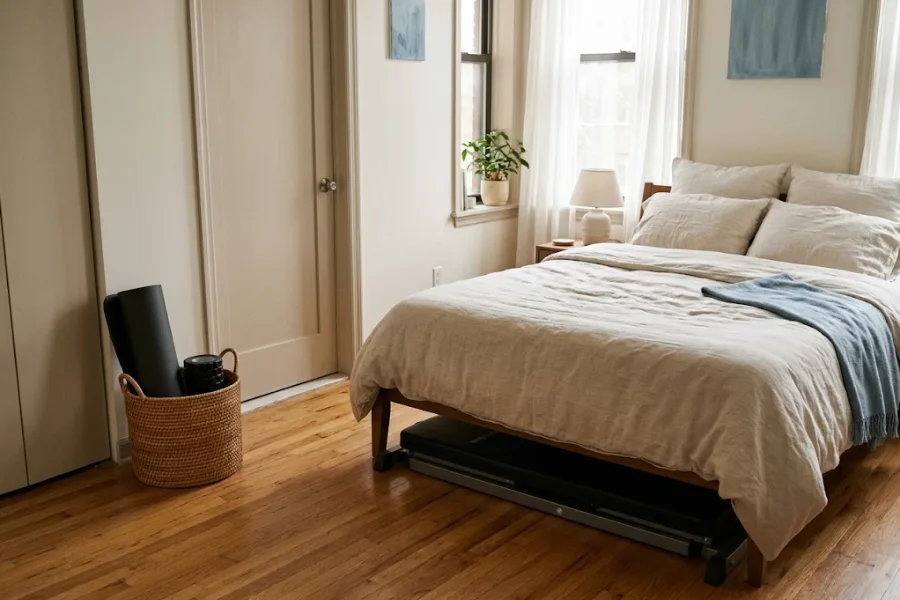
Most apartment home gym ideas come down to one move: get the gear off the floor. In a home gym for a studio apartment, the bed is free storage. A bench slides under it, dumbbells sit on a stand and a mat rolls into a corner.
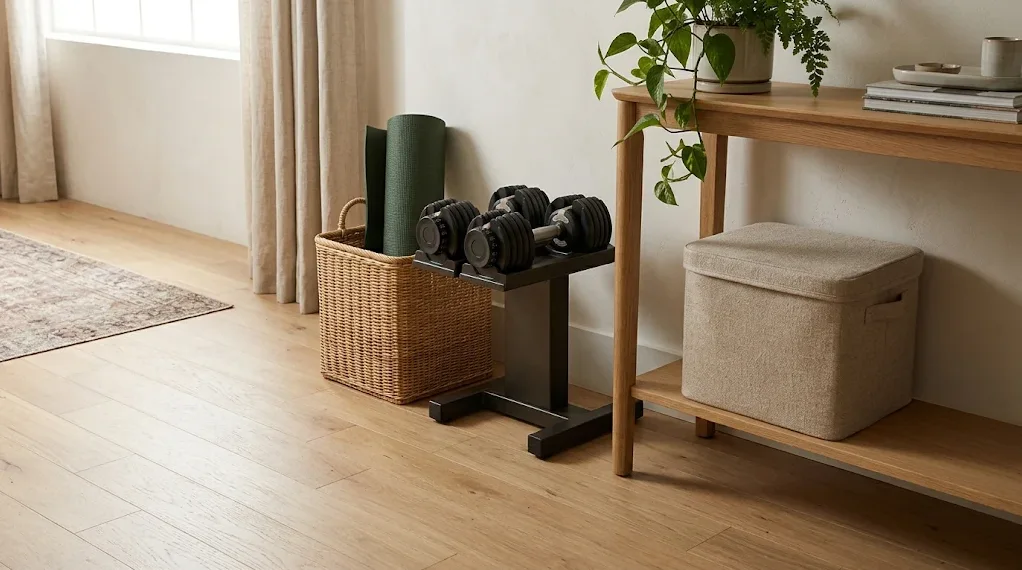
| Option | Floor taken | Suits | Wrong when |
|---|---|---|---|
| Fold-flat bench under the bed | None | Beds with a gap beneath | The gap is thinner than the folded bench; measure it first |
| Adjustable dumbbells on a stand | The stand’s listed footprint | A spare corner | The stand’s rating is below your dumbbell total |
| Mat rolled into a corner or bin | About 1 sq ft | Floor work | You want a thick mat, which rolls bulky |
| Wall hooks or a wall rack | Wall run, not floor | Walls you may drill | The lease bans drilling or studs are out of reach |
Wall options save the most floor but need drilling, so they are a lease question first. The renter-friendly storage guide covers what works without drilling.
How do you cut noise for the unit below?
Soften what lands, choose quieter gear and find out what sits below you. A mat reduces the thud but does not erase it, and low rumble travels through the floor itself. In apartment gym design, I treat any dropped weight as a question for the building manager, not a mat question.
The building’s sound rating will not settle it. US codes ask for IIC 50, an impact rating from a lab test, on floors between homes. That test uses five hammers, is not designed to copy any one real impact and reads from about 100 Hz (a low hum) up. Heavy, soft impacts carry far more energy at lower pitch, so a rated floor can still thump.
In one drop test of gym floor builds on a concrete slab, rubber underlays did little for vibration and sometimes worsened it under heavy drops. That is one test, one set of products and no apartment, so treat it as a caution only. If you add rubber, the flooring thickness guide compares 3/8, 1/2 and 3/4 inch mats, though it covers garage slabs.
My rule: ask what sits under each part of the room. Over a bedroom, keep the zone to quiet, low-impact gear, and tell the neighbor below your plan.
Do apartments allow home gyms?
It depends on your lease and house rules, and I cannot read yours. Look for clauses on alterations, floor coverings, noise and heavy items. If they say nothing, ask the property manager and keep the answer in writing. None of this is legal advice.
- Do any rules limit exercise equipment, total weight or noise hours?
- Is my floor wood frame or concrete, and what is below my unit?
- May I put mats or plywood over the flooring or carpet?
- May I fix anything to walls or door frames, and who patches holes?
- What are the quiet hours, and how are complaints handled?
If the answer on walls is yes, read the studs, anchors and weight limits guide before you drill.
Floor load is the part I cannot answer for you. US pounds-per-square-foot figures in house guides come from the residential code for houses and townhouses. A building with more than two homes falls under a different code, and its floors may be built differently. Made-up example: 300 lb on a 2 by 2 ft stand is 300 / 4 = 75 lb per sq ft, yet across the 39 sq ft zone it averages 7.7. A mat does not shrink the 300 lb. A structural pro or the building’s engineer must judge it. The dumbbell storage guide shows the weight-over-footprint method.
FAQ
Can I lay out a gym in a living room without it taking over the room?
Yes, if the zone shares floor instead of owning it. A living room gym layout tapes the 39 sq ft zone, keeps a 36 inch path to the door and stows gear so the stowed total stays small.
Can a rack ever work in an apartment layout?
Sometimes, but the building has to say yes first. A full rack is about 50 by 50 inches and over 80 inches tall, and room to load it takes roughly 65 to 80 sq ft. Check the minimum ceiling height for a home gym first.
Can I put gym mats over my apartment’s carpet?
For light gear, often yes. A firm mat or raised tile over low, firm carpet can carry a bench and dumbbells, while racks and dropped weights need more. Removing carpet needs the landlord’s yes, so read what works over carpet first.
Is the living room or the bedroom better for the zone?
Pick the room with the clearer 36 inch path and the least sensitive room below. A living room home gym usually offers more floor; a bedroom hides gear behind a door. Upper-floor bedrooms raise the questions in the spare bedroom layout guide.
Final thought
A good apartment home gym layout counts the zone twice: about 39 sq ft open, a few sq ft stowed, and a 36 inch path either way. Run your apartment gym plan past the building in writing. Each gear type has its own guide in the Storage category.
Next, browse all home gym planning guides to find the layout that matches your room.
How we wrote this guide
I wrote this guide from standard sizes, public averages and my own arithmetic, checked in November 2026. The mat, bench, studio and rack sizes are typical, and your gear and unit will differ, so use your own measurements. The 12 by 15 ft room and the 300 lb example are made-up numbers that show the method. I have not tested any product, floor or building. For leases, floors and structure, ask your building manager or a qualified pro.
Want a second look at your apartment layout?
Send me your room measurements, what sits below your unit and your gear list, and I will point you to the guide that fits your tightest limit.
Write to me