Flooring
How Thick Should Garage Gym Flooring Be?
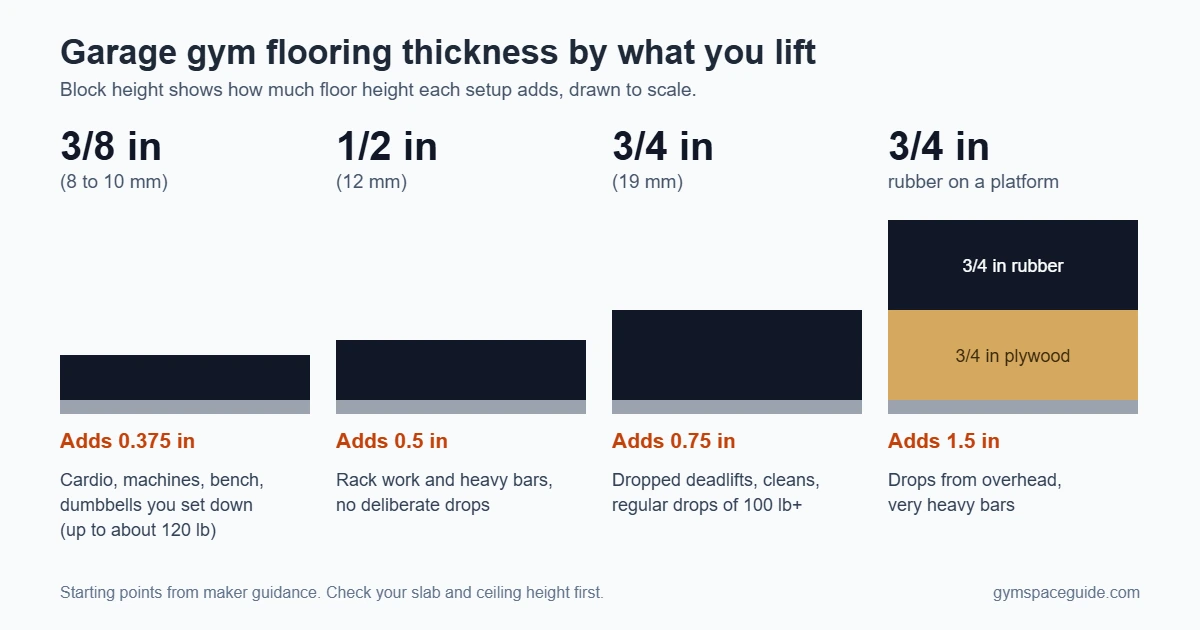
For most garage gyms, 3/8-inch (8 to 10 mm) rubber is enough if you train with machines, cardio equipment and dumbbells. Step up to 1/2 inch under a power rack if you lift heavy but always set the bar down with control. Use 3/4 inch where you deadlift, clean or drop a loaded barbell, and add a platform on top if you drop weight from overhead.

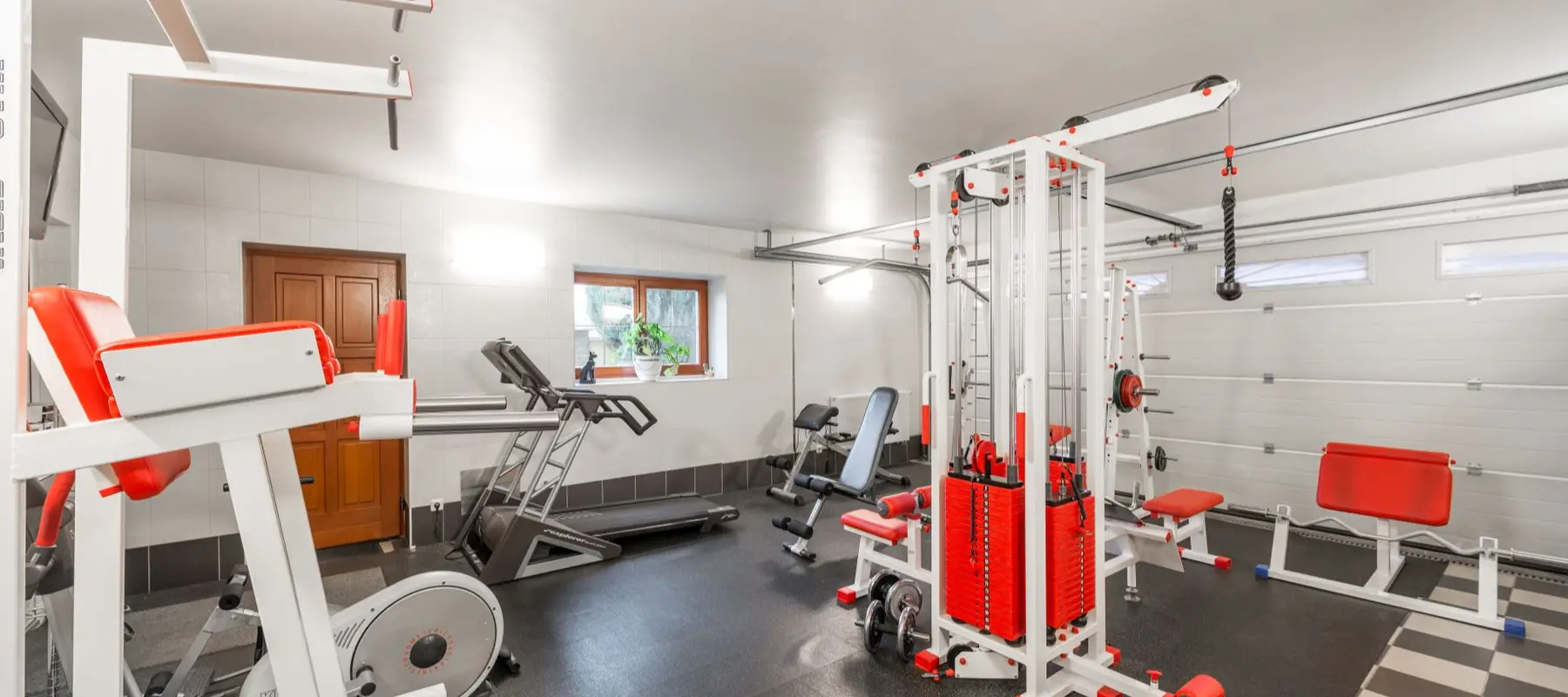
Those picks come from manufacturer and retailer guidance, and the sources disagree at the edges. This guide shows where they disagree, then helps you choose for your own lifts, your slab and your ceiling height.
Quick answer: thickness by what you do
| What you do in the garage | Start from | Why |
|---|---|---|
| Cardio machines, bench, bodyweight work | 1/4 to 3/8 in (6 to 10 mm) | The floor carries steady loads and light impacts, not drops. |
| Dumbbells and kettlebells you set down, up to about 120 lb | 3/8 in (8 to 10 mm) | Greatmats lists this range for regular free-weight use without drops. |
| Heavy barbell work and rack lifts, no deliberate drops | 1/2 in (12 mm) | U.S. Rubber specifies 12 mm for heavy lifting areas. Greatmats uses 1/2 in for weights over 120 lb that are not dropped. |
| Deadlifts you let go of, cleans, regular drops of 100 lb or more | 3/4 in (19 mm) | Greatmats reserves 3/4 to 1 in for deliberate drops. A Garage Gym Reviews expert prefers 3/4 in. |
| Drops from overhead, or very heavy bars | 3/4 in rubber on a platform, about 1.5 in total | Garage Gym Reviews puts lifting platforms at roughly 1 to 2 in. |
These are starting points, not safety guarantees. Thick rubber lowers the risk of damage. It does not make dropping a barbell risk-free. Bumper plates are made to be dropped; cast-iron plates are not.
What does flooring thickness actually protect?
Thickness mainly protects your concrete slab and dampens noise. It does not repair a damaged slab, and it does not replace the right plates.
A dropped bar or plate lands on a small area. Thicker rubber compresses and spreads that hit over a wider patch of concrete, so less of it reaches the slab. U.S. Rubber names slab protection as the main job of thicker rubber under heavy free weights.
Thicker rubber also quiets the thud of a drop, which matters if a bedroom shares a wall with the garage. For the lifter, a cushioned surface takes some sting out of jumps and floor work.
Which thickness fits what you do?
Pick thickness for your heaviest regular drop, not for your average workout. Work through these questions in order:
- Do you ever let go of a loaded barbell? If yes, plan 3/4 inch under that spot.
- Do you drop from overhead, or lift very heavy? Add a platform under the landing area.
- If you never drop anything, do you move more than about 120 lb in free weights? Use 1/2 inch under the rack and lifting area.
- Otherwise, 3/8 inch is enough.
The 120 lb line comes from Greatmats. Other makers draw it in different places, so treat it as a rough marker, not a rule.
Is 3/8-inch (8 mm) gym flooring thick enough?
Yes for cardio machines, benches, dumbbells and kettlebells you set down. No if you plan to drop a loaded barbell.
The two sizes are nearly the same product. Greatmats says the performance difference between 8 mm and 3/8 inch is negligible, and that 8 mm is slightly lighter and cheaper to ship.
Here is where sources disagree. An older Greatmats article (last changed October 2023) says 3/8-inch rubber can protect a subfloor from dropped weight up to 150 lb. Its current thickness guide (changed August 2026) lists 3/8 inch for regular free weights between 50 and 120 lb and says to step up when weights are dropped on purpose. Because the two do not match, this guide plans for the stricter reading.
1/2-inch vs 3/4-inch stall mats: which one?
Choose 1/2 inch if you lift heavy but set the bar down. Choose 3/4 inch if you drop it.
| Spec | 1/2-inch mat | 3/4-inch mat |
|---|---|---|
| Weight of a 4 x 6 ft mat | About 67 to 75 lb | About 90 to 100 lb |
| Height added | 0.5 in | 0.75 in |
| Best for | Racks and heavy lifts, no deliberate drops | Dropped deadlifts, cleans, regular heavy drops |
| Main drawback | Too thin for repeated drops | Heavy to move and lay |
Mat weights vary by maker. RubberCal’s spec sheet lists 90 lb for a 3/4-inch mat and 67 lb for a 1/2-inch mat. A Tractor Supply listing shows 94 lb for a 3/4-inch mat, and Greatmats puts a 1/2-inch mat near 75 lb. Check the weight on the exact mat you buy.
If you never drop weight, the extra quarter inch of height and 20 to 30 lb per mat of 3/4 inch buy you little. Stall mats are sold for horse stalls, so also check the listed thickness. New ones can smell strongly of rubber, so air them out before you shut the garage door.
How does your garage slab change the answer?
The slab is what the mat protects, so check it before you buy. Thicker rubber cannot fix a damaged slab.
- Cracks and damage. Look for wide or growing cracks, flaking, or a corner that has settled. If you see them, ask a concrete contractor before you lift heavy. This guide is not structural advice.
- Flatness and dryness. U.S. Rubber says to confirm a slab is flat to about 1/8 inch over 10 ft, and dry, before laying rubber.
- What is inside the concrete. Garage Gym Reviews notes that slabs reinforced with steel cope better with impact. Most owners cannot tell what is inside theirs. If you are unsure, take the thicker option under the drop zone.
- Living space nearby. For a gym above living space, manufacturers advise an acoustic underlayment, and some gym flooring is not warrantied over wood. Ask the maker before you buy.
How much ceiling height will flooring cost you?
Every layer of flooring comes off your ceiling clearance, so add it to your rack’s minimum before you buy.
| Floor setup | Height added |
|---|---|
| 8 mm rubber | About 0.31 in |
| 3/8-inch rubber | 0.375 in |
| 1/2-inch rubber | 0.5 in |
| 3/4-inch rubber | 0.75 in |
| Platform: 3/4-inch plywood plus 3/4-inch rubber | 1.5 in |
Here is a worked example. PRx Performance lists its Profile squat rack with a pull-up bar at a 94-inch minimum ceiling height, and 107 inches recommended. In a garage that measures 96 inches to the ceiling, a 1.5-inch platform leaves 94.5 inches. That clears the minimum by half an inch and falls well short of the recommended height. With plain 3/4-inch mats, you keep 95.25 inches.
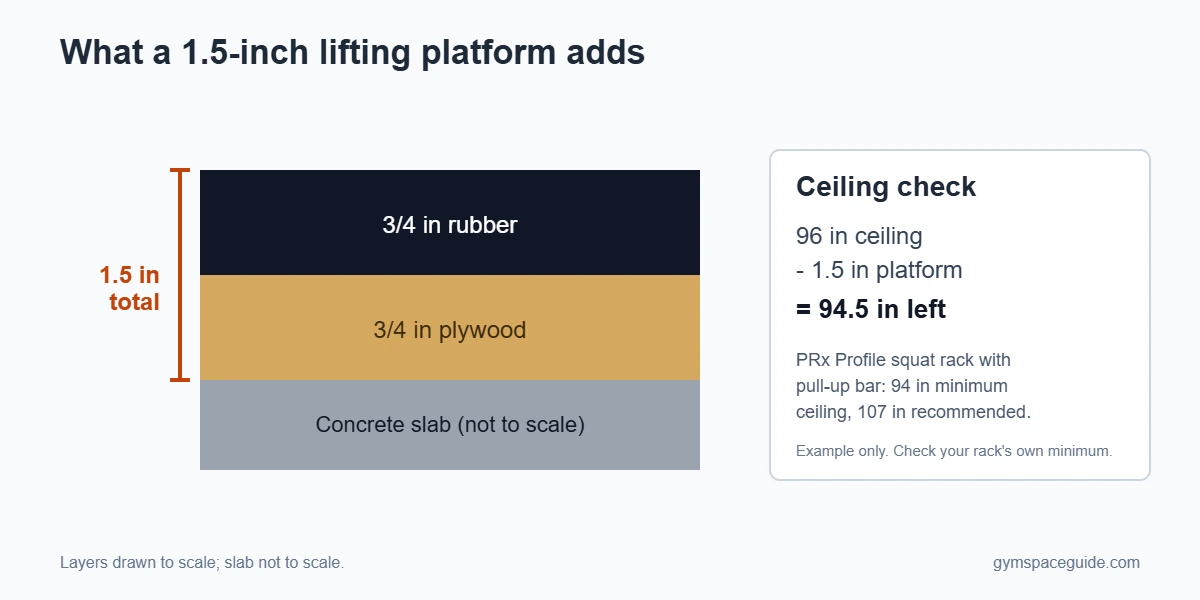
Measure to the lowest thing overhead, such as garage door tracks, the opener or a beam, not to the ceiling surface. PRx is one example. Look up the published minimum for the rack you plan to buy.
How heavy are the mats, and can you lay them alone?
Tiles and rolls you can often handle alone. Full 4 x 6 ft stall mats need two people.
A 4 x 6 ft mat covers 24 square feet. A 10 x 12 ft lifting area is 120 square feet, so it takes five mats. In 3/4-inch rubber that is roughly 450 to 500 lb in total. Greatmats says a 70 lb mat already takes two people to carry, so plan for help, and plan the route from the driveway to the spot before the mats arrive.
Where is thick flooring worth it, and where is it not?
Put thick rubber where the weight lands and use thinner rubber elsewhere. U.S. Rubber advises matching thickness to each use area. It also warns that mixed thicknesses need a transition strip where they meet, or the join becomes a trip hazard.
- Dumbbells, a bench and a treadmill in one bay. Use 3/8 inch across the whole area. Thicker rubber adds cost and height with no benefit here.
- A powerlifter with a rack and heavy pulls. Use 3/4-inch mats under the rack and pulling spot. Two 4 x 6 ft mats side by side give you an 8 x 6 ft landing area. Use 3/8 or 1/2 inch elsewhere.
- An Olympic lifter who drops from overhead. Use a platform with 3/4-inch rubber on top, and confirm your ceiling height first.
Thickness checklist
- Write down your heaviest regular drop: the weight and the height.
- Measure floor to the lowest overhead obstruction, then subtract your flooring height.
- Check the slab for cracks, flatness and damp.
- Decide how big the drop zone is. Often it is one or two stall mats.
- Pick a thickness for each zone and plan the transition strips.
- Read the product page: thickness in inches or mm, weight per piece, rubber type, warranty.
Common mistakes
- Using one thickness for the whole garage. You pay for height and weight you only need in one corner.
- Skipping the ceiling math. A platform can cost you the pull-up bar.
- Putting foam under a barbell. Foam is made for bodyweight work, not for racks and loaded bars.
- Laying mats over a cracked slab and hoping. Rubber hides damage; it does not stop it spreading.
- Joining two thicknesses with no transition. The edge catches feet.
FAQs
Is 3/8 inch thick enough for gym flooring?
Yes for machines, cardio and dumbbells you set down. It is too thin for dropping loaded barbells. See the section above for where sources differ.
How thick is a gym floor?
Most general-use gym floors run from 8 mm to 1/2 inch, and lifting zones go to 3/4 inch or more. Garage Gym Reviews says 8 mm rolls are the most common size sold.
How much does a 3/4-inch stall mat weigh?
A 4 x 6 ft mat weighs about 90 to 100 lb. RubberCal lists 90 lb and Tractor Supply lists 94 lb. Weights vary by maker.
Can you put gym flooring over concrete?
Yes. Concrete is the usual base, and rubber tiles or rolls can go straight on it if the slab is flat and dry. Check for damp before you lay anything.
Is EVA foam or rubber better for a gym floor?
Rubber, if you use weights. Foam suits stretching and bodyweight work, but Garage Gym Reviews says it is not made to carry heavy loads.
Can you park a car on garage gym flooring?
Only if the maker rates it for vehicles. Greatmats, for one, notes that rubber flooring should not go under vehicles, and lists a separate polypropylene garage floor for that job.
How we wrote this guide
This guide draws on published specifications and sizing advice from flooring makers and retailers (Greatmats, U.S. Rubber, RubberCal, Tractor Supply), a home gym publication (Garage Gym Reviews) and a rack maker’s ceiling requirements (PRx Performance). Where sources disagree, we say so. Specs were checked in November 2026 and can change. If your slab is cracked or settling, ask a licensed contractor.
Sources
- Greatmats: How Thick Should Gym Flooring Be?
- Greatmats: Why You Should Not Buy 4×6 ft x 3/4 Inch Rubber Mats for Home Gym
- Greatmats: What Are Stall Mats?
- Greatmats: Top 5 Portable Horse Stall Mats
- Greatmats: What is the Best Thickness for Garage Flooring
- U.S. Rubber Recycling: How Thick Should Rubber Gym Flooring Be?
- Garage Gym Reviews: How Thick Should Gym Flooring Be?
- RubberCal: Horse Stall Mat specification sheet
- Tractor Supply: 4 ft x 6 ft x 3/4 in Rubber Stall Mat
- PRx Performance: Profile rack ceiling height table
Does your garage not match these numbers?
Tell me what you are working with, such as the slab, the ceiling height or the heaviest lift, and I will consider it for a future guide.
Write to me