Heating
What a Space Heater Needs From a Garage Circuit
A 1,500-watt heater draws 12.5 amps. Check what your garage circuit can carry before the breaker, or the plug, shows you.

You plug a space heater into the nearest garage outlet. Twenty minutes later the lights go out, or the plug feels warm. A 1,500-watt heater draws 12.5 amps at 120 volts. That is more than a standard 15-amp circuit should carry for hours, and most of what a 20-amp circuit can.
This guide shows how to check a space heater on a garage circuit before you run it. If you have not sized the heat yet, start with our BTU guide for garage gyms. The math here covers amps, limits and shared loads. Wiring changes belong to a licensed electrician.
How Many Amps Does a Space Heater Draw?
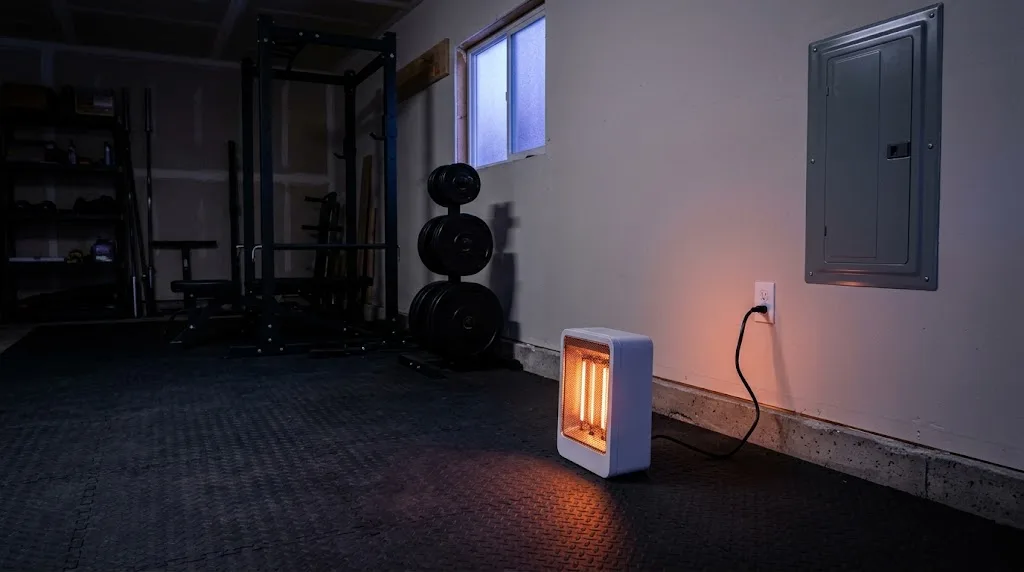
Divide the heater’s watts by the outlet’s volts. A 1,500-watt heater on a 120-volt outlet draws 12.5 amps. On 240 volts the same heater draws 6.25 amps. Read the wattage on the heater’s label, because the box and the heat setting can differ.
| Heater | At 120 V | At 240 V |
|---|---|---|
| 750 W | 6.25 A | 3.13 A |
| 1,000 W | 8.33 A | 4.17 A |
| 1,500 W | 12.50 A | 6.25 A |
| 5,000 W | Not a plug-in size | 20.83 A |
These are US figures. At 230 volts, as in the UK and Australia, a 1,500-watt heater draws about 6.5 amps. Canada also uses 120 volts but has its own electrical code, so check local rules.
What Can a 15 or 20 Amp Circuit Carry?
A 15-amp circuit tops out at 1,800 watts and a 20-amp circuit at 2,400 watts. For loads that run three hours or more, US electrical code limits you to 80 percent: 12 amps (1,440 watts) on 15 amps, and 16 amps (1,920 watts) on 20 amps.
Why Heaters Count as Continuous Load
A load that runs three hours or more is a continuous load, and heaters often run that long on a cold day. Steady current warms the outlet, plug and wire more than short bursts do, so the limit sits below the breaker’s rating.
That makes a 1,500-watt heater a problem on a 15-amp circuit by itself: 12.5 amps is over the 12-amp limit. On a 20-amp circuit it fits, with 3.5 amps to spare.
How to Tell Which Circuit You Have
Open the panel and read the number on the breaker that feeds the outlet. A 15 means 15 amps, and a 20 means 20 amps. Then look at the outlet: a 20-amp outlet has a sideways T-shaped slot.
A 15-amp outlet on a 20-amp circuit still limits a plug-in heater to 12 amps, so a 1,500-watt heater belongs on a 20-amp outlet. If the breaker is unlabeled, ask an electrician rather than guessing.
What Else Shares the Garage Circuit?
Everything on the same breaker adds to the heater’s load. Garage lights, a door opener, a treadmill, a freezer, a compressor or a dehumidifier can all share one. Add their amps to the heater’s before you plug in.
Find Every Outlet on the Breaker
The fastest way to find shared loads is to switch the breaker off and see what goes dead. That list, plus the heater, is your real load.
- Plug a lamp into the heater’s outlet.
- Switch breakers off until the lamp goes dark.
- Note every light, outlet and opener that dies.
- Label that breaker, then switch it back on.
Add Up the Load
Add the amps from every label on the circuit and compare the total with 12 amps on a 15-amp circuit or 16 amps on a 20-amp circuit.
Say a 20-amp circuit also runs a freezer that lists 4 amps and shop lights that list 1 amp. These are example figures, so read your own labels. The 12.5-amp heater plus 5 amps is 17.5 amps, over the 16-amp limit. A 1,000-watt heater draws 8.33 amps, and the 13.33-amp total fits.
Cords, Power Strips and Hot Plugs
Yes, a space heater is safe in a garage outlet if it plugs straight into the wall and nothing else shares that outlet. Fire-safety guidance says no extension cords and no power strips, because both can overheat at heater loads.
Can You Use an Extension Cord?
No. A thin or loose cord can overheat at heater loads, which is why fire-safety guidance says to plug a heater straight into the wall. A power strip is no better, since strips are not built for a heater’s steady current. If the cord will not reach, move the heater or have an electrician add an outlet.
Check the Plug and Outlet for Heat
After 15 to 30 minutes of running, unplug the heater and feel the plug and the wall plate. If either is hot to the touch, discolored or loose, stop using that outlet and have an electrician look at it.
A breaker watches current, not heat at the plug, so it can stay on while a loose plug overheats. This check catches what a trip never will.
Why Does the Breaker Keep Tripping?
Most trips happen because the heater and something else together pass the breaker’s rating. A 1,500-watt heater alone draws 12.5 amps, which leaves only 2.5 amps of room on a 15-amp breaker, so a second load of that size pushes it over. Worn breakers and loose outlets are less common causes.
- Two heaters, or one heater plus a second big load
- Loads you did not know shared the breaker
- An old breaker that trips below its rating
- A loose outlet or plug that runs hot
Do not swap in a larger breaker. The wire in the wall sets the limit, and a bigger breaker lets that wire overheat. Try the low setting first: many heaters drop to roughly half power there, about 6 amps.
When a Garage Heater Needs Its Own Circuit
A heater needs its own circuit when you want more than one 1,500-watt unit, when the garage circuit is shared, or when the heater is hardwired. A 5,000-watt, 240-volt heater draws about 21 amps and often sits on a 30-amp breaker that an electrician sizes to its label.
Plug-In 120 V or Hardwired 240 V
A 1,500-watt plug-in heater covers about 5,000 BTU an hour. Past that, one plug-in cannot keep up, and a hardwired 240-volt heater on its own circuit is the usual step.
Mounted units also take space, so read our guide to the minimum ceiling height for a home gym first.
In a low garage, a ceiling-hung heater can take headroom you need. Our guide to a home gym with a 7-foot ceiling shows what equipment fits.
What to Bring to an Electrician
Bring the numbers an electrician needs to size a safe circuit, and ask whether your area requires a permit.
- The heater’s label: watts, volts, amps
- Your breaker-test list of shared loads
- Where you want the heater mounted
- Your ceiling height at that spot
FAQ
Can you run a space heater in a garage?
Yes, if the heater is rated for indoor use, plugs straight into a wall outlet and the circuit can carry its amps. Check the label first, then the breaker and shared loads.
Can two space heaters share one outlet?
No. Two 1,500-watt heaters draw 25 amps, far over the 12-amp limit on a 15-amp circuit and the 16-amp limit on a 20-amp circuit. Use one heater, or put each on its own circuit.
Can you leave a garage heater unattended?
No. Stay in the garage while it runs, keep it 3 feet from anything that burns, and pick a model with a tip-over shutoff. Turn it off and unplug it when you leave.
Final thought
Check three numbers before you plug in: the heater’s amps, the circuit’s limit, and everything else on that breaker. A 1,500-watt heater fits a 20-amp circuit that nothing else shares. Anything bigger is an electrician’s job. More planning guides sit on the guides page.
Written by Md Shohan Sheikh from published electrical rules and the figures printed on heater labels. No heater was tested.
Every number is a US figure for 120-volt circuits. See how we evaluate guides for how figures are checked and dated.
This page has no affiliate links. The affiliate disclosure explains how any future links are marked.
Spotted a mistake or a gap?
Tell me what is wrong or missing in this guide, and I will fix it.
Write to me