Heating
How Many BTU to Heat a Garage Gym
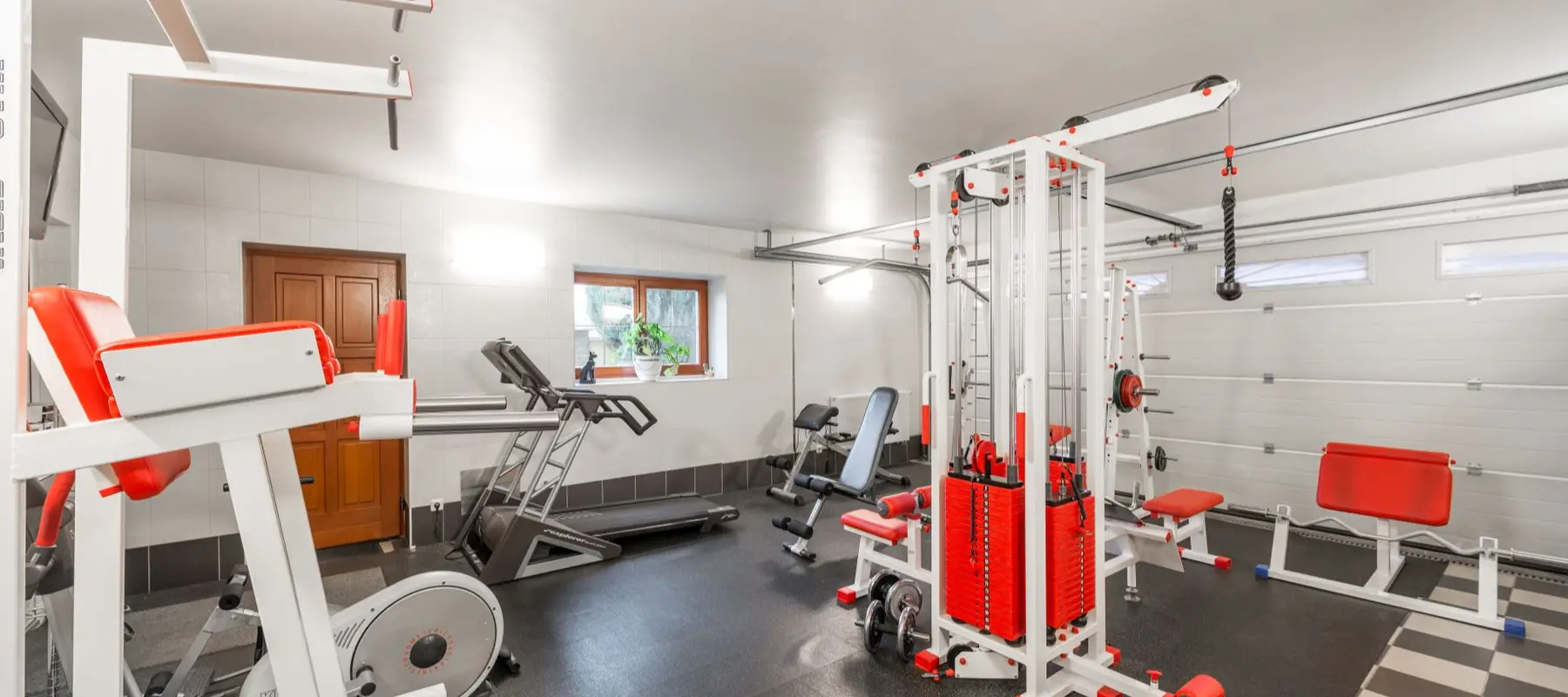
Heating a garage gym is a heat-loss problem, not a floor-area problem. The same 400 square feet can need 5,000 BTU an hour or 30,000, depending on walls, ceiling, door and air leaks. This guide shows the math so you can size a heater for your own garage.
Every figure below is my own calculation from standard conversion factors and R-values, not a heater test. I use US units, a 55°F workout target (my assumption, not a standard) and a 15°F outdoor day, so the temperature difference is 40°F. Change those inputs to match your winter.
Quick answer: BTU by garage size
For a tight, insulated garage held at 55°F on a 15°F day, plan about 3,500 BTU per hour for one car and 5,000 for two. For a bare, leaky garage, plan about 21,000 and 30,400. Electric heat converts at 3.412 BTU per hour per watt, so 5,000 BTU an hour is about 1,500 watts.
| Garage, 8 ft ceiling | Insulated and tight | Bare and leaky |
|---|---|---|
| 1-car, 12 × 20 ft (240 sq ft) | 3,500 BTU/h (1,000 W) | 21,000 BTU/h (6,100 W) |
| 2-car, 20 × 20 ft (400 sq ft) | 5,000 BTU/h (1,500 W) | 30,400 BTU/h (8,900 W) |
| Large, 24 × 25 ft (600 sq ft) | 6,800 BTU/h (2,000 W) | 40,500 BTU/h (11,900 W) |
My own calculation at a 40°F temperature difference, with a 10% allowance. The 24 × 25 ft row assumes a 16 × 7 ft door. Multiply by 1.25 for a 50°F difference and 1.5 for 60°F.
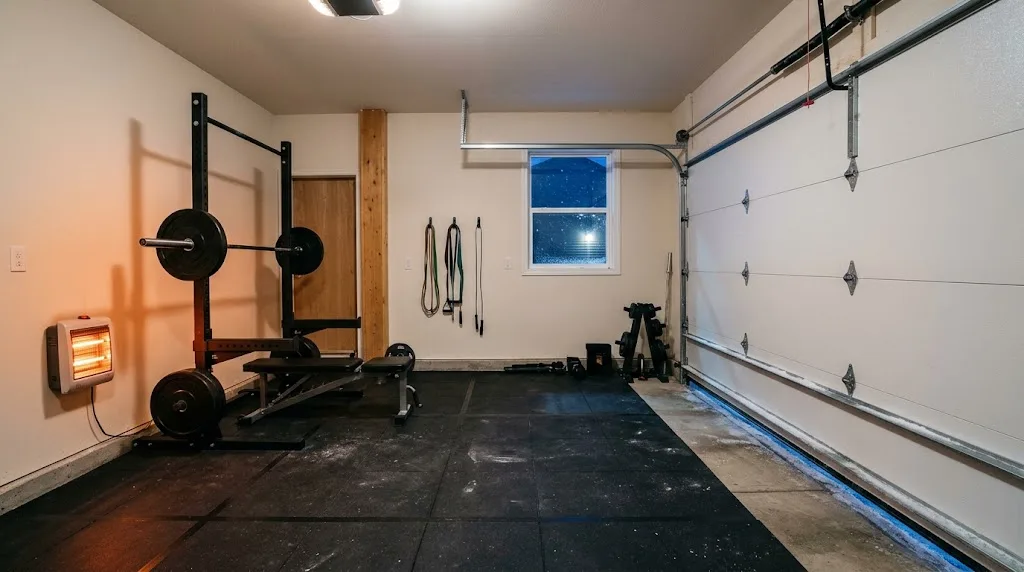
How do you calculate BTU for a garage gym?
Add the heat each surface leaks to the heat carried out by air leaks. Surface loss is area times temperature difference divided by R-value. Air loss is 0.018 times volume times air changes per hour times temperature difference. The sum, in BTU per hour, is what your heater must replace.
Pick the temperature difference
Subtract the coldest outdoor temperature you plan to train in from your indoor target. A 55°F target on a 15°F day gives 40°F. A local heating contractor can tell you your area’s winter design temperature.
Add the surface losses
Each wall, the ceiling and the door lose heat at area times temperature difference divided by R-value. A 120 sq ft wall at R-12 and a 40°F difference loses 400 BTU an hour (120 × 40 ÷ 12).
Add the air leaks
Warming one cubic foot of air by 1°F takes about 0.018 BTU, and every air change the garage makes per hour must be reheated. Planning rates: 0.5 air changes per hour for very tight, 0.75 tight, 1 average and 2 or more for old buildings.
What R-values should you use?
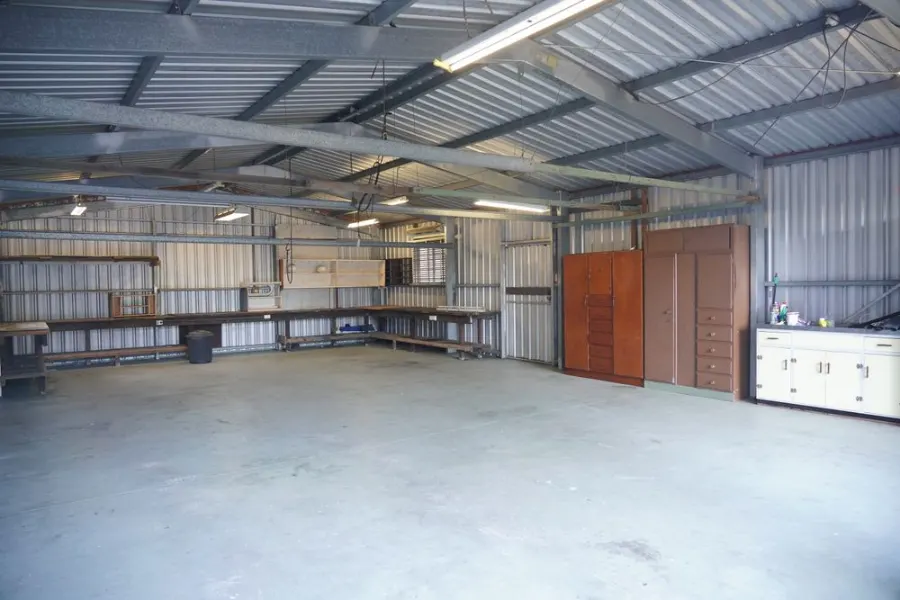
Use the R-value printed on your insulation or door, then fall back on these planning numbers. They are my rounded assumptions, and wall framing makes a real wall slightly worse than its cavity R-value suggests, so treat the result as a floor.
| Item | Insulated | Bare |
|---|---|---|
| Walls | R-12 | R-2 |
| Ceiling | R-30 | R-2 |
| Door | R-8 | R-1 |
| Air changes per hour | 0.75 | 2 |
Door values are placeholders, so read your door’s label. I add 10% for the slab and unknowns: ground is usually warmer than winter air, but a cold floor still makes a room feel cold. A damp slab is a separate problem, covered in the garage gym floor vapor barrier guide.
Flooring changes how the floor feels, and I counted nothing for it. To choose one, read the guide to the best flooring for a garage gym.
How many BTU for a 1-car garage gym?
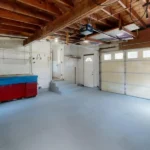
A 12 × 20 ft one-car garage with 8 ft walls needs about 3,500 BTU per hour when insulated and tight, and about 21,000 when bare and leaky, at a 40°F temperature difference. The table shows the arithmetic so you can swap in your own numbers.
| Heat loss, BTU/h | Insulated | Bare |
|---|---|---|
| Walls, 449 sq ft (net of a 9 × 7 ft door) | 1,497 | 8,980 |
| Ceiling, 240 sq ft | 320 | 4,800 |
| Door, 63 sq ft | 315 | 2,520 |
| Air leaks, 1,920 cu ft | 1,037 | 2,765 |
| Subtotal | 3,168 | 19,065 |
| Plus 10% allowance | 317 | 1,906 |
| Total | 3,485 (1,021 W) | 20,971 (6,146 W) |
How many BTU for a 2-car garage gym?
A 20 × 20 ft two-car garage with 8 ft walls needs about 5,000 BTU per hour when insulated and tight, and about 30,400 when bare and leaky, at a 40°F difference. Insulation and air leaks, not floor area, create that six-fold gap.
| Heat loss, BTU/h | Insulated | Bare |
|---|---|---|
| Walls, 528 sq ft (net of a 16 × 7 ft door) | 1,760 | 10,560 |
| Ceiling, 400 sq ft | 533 | 8,000 |
| Door, 112 sq ft | 560 | 4,480 |
| Air leaks, 3,200 cu ft | 1,728 | 4,608 |
| Subtotal | 4,581 | 27,648 |
| Plus 10% allowance | 458 | 2,765 |
| Total | 5,039 (1,477 W) | 30,413 (8,913 W) |
In the bare case, walls and ceiling carry two-thirds of the loss (18,560 of 27,648 BTU), so insulate them first. In the insulated case, walls and air leaks each carry about 38%, so sealing door gaps matters next.
Does ceiling height change the BTU?
Yes. Taller walls add surface area and more air to reheat. Raising the two-car example from 8 ft to 10 ft lifts the insulated total from about 5,000 to 6,100 BTU per hour, roughly 21% more, and the bare total from 30,400 to 35,200, about 16% more.
Rack height is one reason to want a tall room, and the extra heat is its running cost. For the clearance your lifts need, read how much ceiling height a home gym needs.
How many watts is that in electric heat?
Multiply watts by 3.412 to get BTU per hour, or divide BTU per hour by 3.412 to get watts. Electric resistance heat turns all its power into heat, so a 1,500-watt heater gives 5,118 BTU per hour and a 5,000-watt heater gives 17,060.
So 1,500 watts matches the insulated two-car case (5,039 BTU, or 1,477 W) with almost no margin. A 5,000-watt heater covers either insulated case but falls well short of the bare two-car garage, which needs about 8,900 watts.
At 120 volts a 1,500-watt heater draws 12.5 amps, so check the circuit first: read what a space heater needs from a garage circuit. Larger heaters often need a dedicated 240-volt circuit, which a licensed electrician should size and install.
Should you size up?
Size to the calculated number plus a modest margin. Extra capacity mainly speeds warm-up: air alone needs only 2,304 BTU to rise 40°F in the two-car example. Gas and propane heaters are rated in BTU, so compare output, not input, and see propane vs electric heaters for a garage gym.
FAQ
How many BTU do I need to heat a garage?
It depends on insulation, door and air leaks, not floor area alone. A tight, insulated one-car garage needs about 3,500 BTU per hour, a two-car about 5,000. Bare, leaky ones need about 21,000 and 30,400.
How many BTU to heat a 2 car garage?
About 5,000 BTU per hour for a tight, insulated 20 × 20 ft garage with 8 ft walls, and about 30,400 for a bare, leaky one, at a 40°F difference.
How many BTU to heat an uninsulated garage?
About 76 to 87 BTU per square foot at a 40°F difference in these examples: 21,000 for the one-car and 30,400 for the two-car. Walls and ceiling carry about two-thirds or more of that loss.
How many watts does a garage gym need?
Divide BTU per hour by 3.412. The insulated examples need about 1,000 to 1,500 watts, and the bare two-car garage needs about 8,900. Above 1,500 watts, expect a hardwired 240-volt heater that a licensed electrician should size.
What size heater for a garage gym?
Size it to your own calculation, then round up to the next model. For a tight, insulated two-car garage that is near 5,000 BTU per hour, or 1,500 watts. For an uninsulated one, insulate first or plan for 30,000 BTU or more.
Final thought
A garage gym heater is a small number if the shell is tight and a large one if it is not. Run the sum for your own walls, door and winter, then decide whether to insulate first or buy more heat. More planning guides sit on the guides page.
How we wrote this guide
This guide uses standard conversion factors, R-values and air-change rates, with every calculation my own and shown. I have not tested any heater. Scenario values are labeled assumptions. See how we evaluate guides for how numbers are checked.
Is your garage different from these two?
Send your garage size, insulation and coldest training day, and I will tell you which numbers to check.
Write to me