Flooring
Garage Gym Floor Vapor Barrier: When You Need One
A garage slab needs a moisture check before gym flooring goes down, and a vapor barrier only when the check or the maker’s install guide calls for one. The six flooring guides compared here set limits from 3 to 8 lb of vapor per 1,000 sq ft per 24 hours, so the guide for your flooring matters more than any blanket rule.

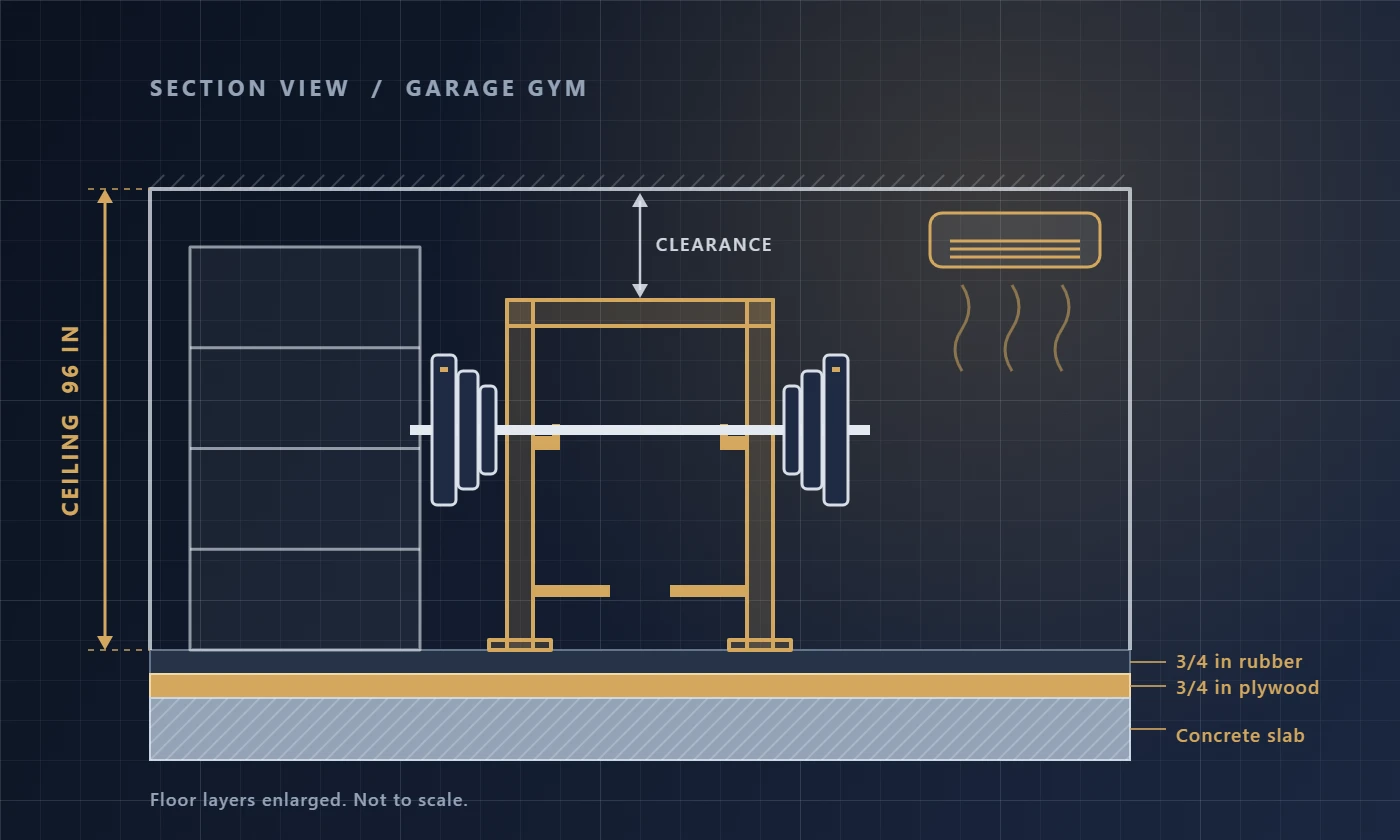
A garage gym floor vapor barrier is a sheet, membrane or coating between a concrete slab and the flooring above it, meant to slow moisture rising from below. Whether your slab needs one depends on its age, its history and what a test shows. This guide covers the checks, what flooring makers write about rubber mats, interlocking tiles and floating floors, and a decision table by slab condition.
It draws on a concrete-industry technical series, ASTM standard pages and maker install guides, and it flags where they disagree. For the flooring itself, see choosing flooring for a garage gym. Grinding, sealing, coating and treating a damp slab are flooring-contractor jobs, so the guide gives no steps for them.
Quick answer: which slab needs what
| Slab situation | Check first | What maker guidance says | Where sources split |
|---|---|---|---|
| New slab, poured in the last few months | Slab age, and whether a retarder went under it | Wait out the cure period, then test. Guides ask for 28 to 60 days. | One maker says ideally 90 days. |
| Older slab, dry, no water history | The install guide’s lb and % limits, and a test if it asks for one | Several guides require a test on every slab, whatever its age. | A building-science Q&A says rubber over such a slab probably needs no extra barrier. |
| Damp, dark or stained slab | Where the water comes from, then a professional test | Do not install until readings pass or a mitigation system is in. | The guides compared below run from 3 to 8 lb and 75% to 90% RH. |
| White powder (efflorescence) | Treat as damp until tested | Salts are left where moisture evaporated, so moisture has moved through. | It is a sign, not a measurement, and no guide here sets a separate limit for it. |
Where guides disagree, the install guide for the exact flooring you buy wins, and the lower limit wins if two documents apply.
Why does moisture come up through a garage slab?
Most garage floors are slab-on-grade, meaning concrete poured on prepared ground. The National Ready Mixed Concrete Association (NRMCA) says the subgrade under a slab on ground measures close to 100% relative humidity, and that vapor rises whatever the water-table depth (CIP 28). In fine-grained soil, liquid water can also rise by capillary action. Leftover mix water adds to it, and a slab can take weeks to months to dry.
Flooring guides use two terms. On-grade means level with the surrounding ground, and below-grade means lower than it, as in a basement or sunken bay. The Greatmats Spectation 9mm tile guide asks for a confirmed retarder under both kinds of slab (Greatmats).
That under-slab retarder is separate from a barrier laid on top. NRMCA recommends one under every interior floor slab, at 10 mils (0.25 mm) and no more than 0.1 perm (CIP 29). Code text varies. Oklahoma’s adopted wording of IRC R506.2.3 (2018 edition) lists garages among its exceptions (Oklahoma), while South Carolina’s version names unheated accessory structures without mentioning garages (South Carolina). The builder or local building department can say what applies to your slab.
How do you test a garage slab for moisture?
Three tests appear in flooring guides. They measure different things, so their numbers cannot be swapped.
| Test | What it tells you | How sources describe it | Catch |
|---|---|---|---|
| Plastic sheet (ASTM D4263) | Whether moisture is present under the sheet | NRMCA: an 18 by 18 in (450 by 450 mm) sheet taped down for at least 16 hours | Yes or no only. A clean result does not show the slab is dry below the surface. |
| Calcium chloride (ASTM F1869-23) | Vapor leaving the surface, in lb per 1,000 sq ft (93 sq m) per 24 hours | NRMCA: runs 60 to 72 hours, three spots for the first 1,000 sq ft, one more per extra 1,000 sq ft | Near-surface only, and sensitive to temperature and humidity. |
| In-slab probes (ASTM F2170) | Relative humidity inside the slab | NRMCA: 72 hours for the reading to settle in the hole | Needs drilling, so a tester usually does it. |
All three are snapshots. Tnemec, a coatings maker, says results may not reflect year-round conditions (Tnemec), and ASTM F2170 limits its readings to the time and spots tested.
Some makers also give the plastic-sheet check little weight. Tnemec says the test is still used, but most flooring makers do not favor it. The Maple Flooring Manufacturers Association (MFMA) listed a 24-hour plastic-sheet pre-test in its April 2013 revision. Its December 2025 revision does not mention the sheet and lists probes, calcium chloride and electronic meters, without saying why.
What do flooring makers say about rubber, tiles and floating floors?
Install guides rarely say only “add a vapor barrier”. They set a test, a limit and sometimes a barrier or sealer. Here are six calcium chloride limits, each written for its own product.
Probe limits spread the same way. Greatmats lists 75% RH for the adhesive in its Spectation tile guide, its rolled-rubber guide says 85%, MFMA says 85% for non-glued maple and 75% for glued, and COREtec says 90%.
- Rubber mats. The Greatmats mat guide (revised 6/2014) sets the calcium chloride limit at under 3 lb, asks for 45 to 60 days of cure and allows only non-petroleum sealants. It does not mention a vapor barrier.
- Interlocking tile. Humane calls a moisture test vital for its loose-laid LokTuff tile, wants 6 weeks of cure and recommends sealing the concrete. The Spectation guide (dated 3/2017) requires probe testing on every slab, plus a retarder under on-grade or below-grade slabs, or an ASTM F3010 mitigation system.
- Floating floors. COREtec recommends 6-mil poly film only for floating installs over concrete, with taped seams. Stagestep, whose guide covers vinyl floors and sprung subfloors, makes a barrier mandatory for its products over concrete, either a liquid one or plastic sheet of 8 mil or thicker, and says skipping it voids warranties.
- Damp slabs. Greatmats says moisture can become trapped between concrete and rubber. For damp slabs it names full-spread adhesive, says a subfloor may be needed and points buyers to its support team (Greatmats).
Tile thickness is a separate question, covered in how thick garage gym flooring should be.
Which garage gym floor vapor barrier options are there?
| Option | What makers say | Catch |
|---|---|---|
| Polyethylene sheet over the slab | COREtec: 6-mil (0.15 mm) film for floating floors only. Stagestep: plastic sheet of 8 mil (0.20 mm) or thicker, or a liquid barrier, for its products. | Seams must be taped per the maker. COREtec sends over-limit slabs to a remediation system instead. |
| Dimpled underlayment | Dörken calls its 5/16 in (8 mm) Delta-FL a capillary break and vapor barrier, under 0.02 perm per its data sheet. | Adds 5/16 in (8 mm) of height. Dörken’s pages do not mention gym floors, so ask about point loads under racks. The data sheet lists both 4,500 and 5,200 psf. |
| Sealer or coating | Humane recommends sealing before its tile goes down. Greatmats accepts an ASTM F3010 mitigation system applied to the maker’s written instructions. | Contractor work. Get the scope in writing. |
| Nothing | Greatmats and Humane still ask for a test first. | Holds only while the slab stays dry. |
The sources split on rubber itself. In a thread about a basement gym, a GreenBuildingAdvisor expert member wrote in June 2026 that roll rubber is “probably a pretty good vapor barrier” and that a slab with no water issues needs little worry, adding that tiles have more seams. Another reply there suggested taping poly down for a while to see if water collects. These are reader replies, not maker specs, and the maker guides above ask for testing first.
If a car will share the floor, see garage gym flooring you can drive on. For tighter budgets, see cheap garage gym flooring.
Slab checklist before you buy flooring
- Note the slab’s age, any past water events and whether the builder put a retarder under it.
- Look for dark patches, white powder and damp spots after rain.
- Write down the lb and % limits from the install guide for your exact flooring.
- Hire a tester when the guide requires calcium chloride or probe readings, and keep the dated report.
- If the guide is silent on moisture, ask the maker in writing before you buy.
Common mistakes
- Calling a clean plastic-sheet check “dry”. NRMCA says a negative result is no assurance the slab is dry below the surface.
- Borrowing another maker’s limit. The chart runs from 3 to 8 lb, so use the number in your product’s guide.
- Using a sheet to cover a wet slab. Greatmats says installation must wait until the subfloor dries or a topically applied mitigation system goes in. A taped sheet is neither.
- Testing too early or on one dry day. MFMA says not to test within 60 days of placement, and Tnemec says results show one time period only.
- Sealing or coating first. Greatmats and Tnemec tie mitigation systems and primers to test readings, so test first, then hire a flooring contractor.
FAQs
Do I need a vapor barrier under rubber gym flooring in a garage?
Not automatically. Maker guides start with a moisture test and a limit, and add a barrier or sealer when the slab or the product calls for it. Stagestep makes a barrier mandatory for its own products, while a GreenBuildingAdvisor expert member saw little need under rubber with no water issues.
Can moisture get trapped under rubber gym mats?
Greatmats says it can, and tells buyers to check for high moisture within or beneath the concrete. For damp slabs its page offers full-spread adhesive or a subfloor.
How long should a new garage slab cure before gym flooring?
Guides range from a 28-day minimum to 60 days, and Stagestep says ideally 90. MFMA says not to test a new slab within 60 days of placement.
What does white powder on a garage floor mean?
It can be efflorescence, which is salt left on the surface after the water carrying it evaporates (CTEF). It does not reliably show how much moisture is present, so test the slab.
How thick should a vapor barrier sheet be under a floating gym floor?
Use the thickness the flooring maker names. COREtec names 6 mil (0.15 mm) and Stagestep 8 mil (0.20 mm) or thicker. NRMCA and Greatmats specify 10 mil (0.25 mm) for retarders under the slab.
How we wrote this guide
This guide draws on the NRMCA concrete series, ASTM standard pages, a maple-flooring trade group, maker install guides for rubber, vinyl and floating floors, and one building-science Q&A thread. Where sources disagree, we say so. Specs were checked in November 2026 and can change, and some guides are older. Slab testing, grinding, sealing and coating belong to a flooring contractor or concrete tester, and the building department can say what sits under your slab.
Sources
- NRMCA: CIP 28, Concrete Slab Moisture
- NRMCA: CIP 29, Vapor Retarders Under Slabs on Grade
- ASTM: F1869-23, calcium chloride test method
- ASTM: F2170, in situ relative humidity probes
- ASTM: D4263, plastic sheet method
- MFMA: Concrete Slab Moisture Content (revised 12/25)
- MFMA: Concrete Slab Moisture Content (revised 04/13 copy)
- Tnemec: 3 Ways to Test Concrete for Moisture
- Greatmats: Spectation 9mm rubber tile installation instructions
- Greatmats: installation instructions for rubber mats
- Greatmats: Regupol rolled rubber sport installation
- Greatmats: rubber flooring installation on concrete and other surfaces
- Humane Manufacturing: LokTuff installation guide
- Shaw: COREtec Scratchless installation
- Stagestep: Installation Guide 2025
- Dörken: DELTA-FL dimpled membrane
- Dörken: DELTA-FL technical data (distributor copy)
- GreenBuildingAdvisor: Rubber gym flooring Q&A
- Ceramic Tile Education Foundation: Understanding efflorescence
- Oklahoma Administrative Code 748:20-6-10, IRC Chapter 5 Floors
- South Carolina Code of Regulations 8-1225, IRC R506.2.3 Vapor Retarder
Does your space not match these numbers?
Tell me what you are working with, such as the room size, the ceiling height or the floor, and I will consider it for a future guide.
Write to me