Flooring
Cheap Garage Gym Flooring: Where Saving Works And Where It Backfires
Cheap garage gym flooring works when its thickness matches your heaviest use. Makers pair 3/4 in (19 mm) rubber with dropped barbells, and thinner rubber or foam with lighter work.

Cheap garage gym flooring is a good buy when its thickness fits the heaviest thing you will do on it. It is a poor buy when a low price hides weight, odor, waste or a layer that is too thin. This guide is for anyone flooring a garage gym on a tight budget.
It compares horse stall mats, rubber rolls, interlocking tiles, bare sealed concrete and plywood, using maker pages and retailer listings checked November 2026. Pick the minimum thickness first (the garage gym flooring thickness guide covers it), then compare the rest by cost per covered square foot.
Quick answer: which cheap flooring fits your use?
| Your situation | Start from | Why |
|---|---|---|
| Barbells dropped, smallest budget | Two 3/4 in (19 mm) stall mats under the lifting zone, slab bare elsewhere | Greatmats recommends at least 3/4 in of rubber for drops. Two mats cost about $120 in the example below (November 2026). |
| Barbells dropped, whole room | 3/4 in stall mats, or 3/8 in tiles plus a mat in the lifting area | Greatmats suggests the extra mat for large barbells and drops. |
| Dumbbells and kettlebells only | 3/8 in (10 mm) rubber tiles | The maker says they handle smaller dumbbells and kettlebells. |
| Spin bike or light cardio area only | 1/4 in (6 mm) rubber roll | The maker lists spinning and cardio areas. |
| Floor-level work, no heavy equipment | Foam tiles | Greatmats places foam with ground-based exercise, not drops. |
| Cannot handle 100 lb (45 kg) mats | Tiles or rolls | Greatmats often points buyers to these over stall mats. |
Sources differ on drop thickness, from 1/2 in (13 mm) to 3/4 in, so use the thicker figure.
What cheap garage gym flooring options exist, and what are they for?
The table reports each seller’s stated use. It is not a ranking.
| Option | Meant for, per the page | Example thickness | Limit stated |
|---|---|---|---|
| Horse stall mat, 4 x 6 ft (1.22 x 1.83 m) | Tractor Supply’s listing names garage gyms | 3/4 in (19 mm) | 94 lb (43 kg) per mat, strong odor per its Q&A |
| Rubber roll, 4 ft (1.22 m) wide | Greatmats: spinning and cardio areas | 1/4 in (6 mm) | 8 mm or thicker advised for heavy commercial equipment |
| Interlocking rubber tile, 2 x 2 ft | Greatmats: smaller dumbbells and kettlebells | 3/8 in (10 mm) | Add a mat for large barbells or drops |
| Interlocking foam tile, 2 x 2 ft | Greatmats: yoga and ground-based exercise | 5/8 in (16 mm) | Not for intentional heavy drops |
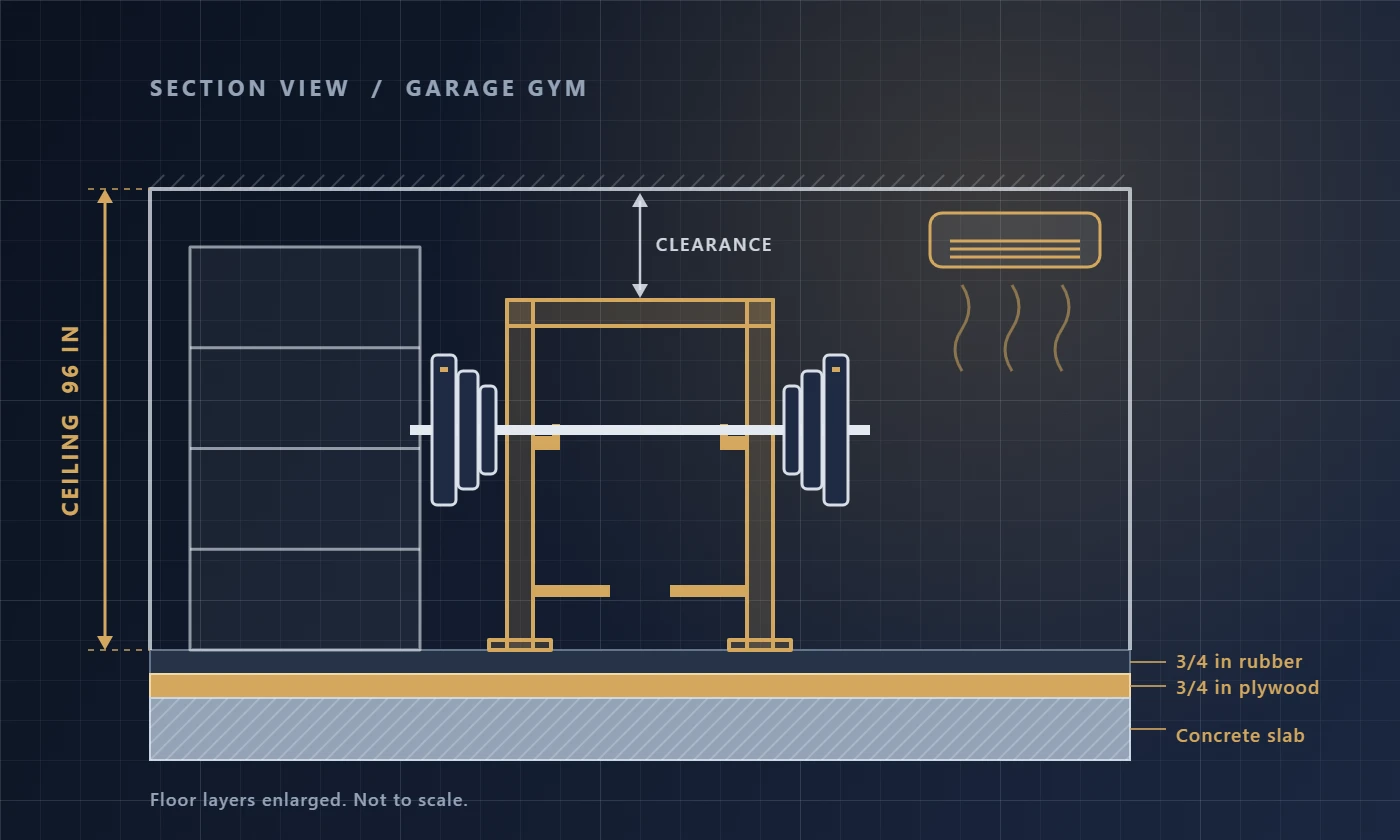
Plywood appears in the sources reviewed only as a stiff base under rubber, such as 3/4 in plywood under 3/4 in rubber for a 1.5 in (38 mm) platform. Ironmind’s plan credits the rubber with absorbing dropped-weight shock. None presents plywood alone as a cushioning floor.
How do you compare cheap garage gym flooring by cost per square foot?
A listed price per square foot rarely matches what you pay, because you buy whole mats, rolls and packs. Use this formula, then apply a thickness gate before trusting the cheapest result.
| Step | Formula | Worked on a 10 x 10 ft room with stall mats |
|---|---|---|
| 1. Room area | Length x width | 10 x 10 = 100 sq ft (9.3 sq m) |
| 2. Coverage per unit | From the spec, not the headline | 4 x 6 = 24 sq ft |
| 3. Units to buy | Area / coverage, round up, check layout | 100 / 24 = 4.17, so 5 mats |
| 4. Total cost | Units x price, plus delivery | 5 mats at $59.99 per mat = $299.95 |
| 5. Cost per covered sq ft | Total / room area | $299.95 / 100 sq ft = $3.00 per sq ft |
| 6. Thickness gate | Compare with the maker’s minimum for your heaviest use | 3/4 in meets the 3/4 in drop guidance |
Worked examples for a 10 x 10 ft and a 12 x 20 ft room
These four listings are examples of the spec range, not ranked or recommended. Prices were listed on the pages named, checked November 2026, and change.
| Example listing | Coverage per unit | 10 x 10 ft (3.05 x 3.05 m, 100 sq ft) | 12 x 20 ft (3.66 x 6.10 m, 240 sq ft) |
|---|---|---|---|
| 3/4 in stall mat, 4 x 6 ft, $59.99 per mat one-time price (Tractor Supply) | 24 sq ft | 5 mats, $299.95, $3.00 per sq ft | 10 mats, $599.90, $2.50 per sq ft |
| 1/4 in (6 mm) rubber roll, 4 x 10 ft (1.22 x 3.05 m), $119.99 per roll (Tractor Supply) | 40 sq ft | 3 rolls, $359.97, $3.60 per sq ft | 6 rolls, $719.94, $3.00 per sq ft |
| 3/8 in rubber tile, $10.47 per tile on sale, regular $13.08 per tile (Greatmats) | 3.88 sq ft | 26 tiles, $272.22, $2.72 per sq ft | 62 tiles, $649.14, $2.70 per sq ft |
| 5/8 in foam tile, $111.66 per 15-pack (Home Depot listing) | 58.1 sq ft | 2 packs, $223.32, $2.23 per sq ft | 5 packs, $558.30, $2.33 per sq ft |
| Your option | Fill in | Fill in | Fill in |
Tile counts are area-based minimums, so real layouts need extra for edges. The Tractor Supply roll listing gives no dropped-weight guidance, so the use guidance comes from Greatmats’ own 1/4 in roll. Home Depot gives no foam thickness, so 5/8 in comes from Greatmats’ spec sheet. The Tractor Supply mat page showed $63.99 beside the title, $59.99 for one purchase and $56.99 with a subscription, a spread of about 12%. Store-specific versions showed $51.99 and $45.99 beside the title with the same $59.99 one-time price, so confirm your local price.
The arithmetic shows four things:
- The cheapest rubber option changes with room size and sale price. In the 10 x 10 ft room, tiles at $10.47 per tile cost $27.73 less than stall mats. At the regular $13.08 per tile, 26 tiles cost $340.08, or $40.13 more. In the 12 x 20 ft room stall mats win by $49.24.
- Waste is part of the price. Five stall mats cover 120 sq ft, so a 100 sq ft room leaves 20 sq ft trimmed or spare.
- Headline coverage can be generous. The foam listing says $1.86 per sq ft over 60 sq ft, but Greatmats’ spec sheet gives 3.875 sq ft per tile, or 58.1 sq ft. That is $1.92 per sq ft before rounding up to whole packs.
- The cheapest per square foot fails the gate. Foam is lowest in both rooms, yet only the 3/4 in mat meets the 3/4 in drop guidance.
Greatmats’ cut-to-length 1/4 in roll was $1.76 per sq ft on sale (regular $2.20), but its calculator shows a 25 ft minimum and its text says 1 ft. Confirm before ordering.
What goes wrong with horse stall mats in a garage gym?
Stall mats are a common cheap answer for drops, with four recurring problems.
- Weight. Tractor Supply lists 94 lb (43 kg) per mat, and Rogue’s product guide says its 3/4 in mats weigh about 100 lb and recommends a mat-moving tool. At 94 lb, five mats weigh 470 lb (213 kg) and ten weigh 940 lb (426 kg). Greatmats notes the weight keeps them from sliding.
- Size and delivery. At 24 sq ft each, a 10 x 10 ft room needs trimmed pieces. Garage Gym Reviews calls cutting a hassle, and Greatmats says 4 x 6 ft mats are expensive to ship on a pallet.
- Odor. Greatmats calls it the “#1 regret” of stall mat buyers, and its odor page says indoors it could linger for months and advises ordering early to air the mats first. RitFit says sunning outdoors and scrubbing with mild dish soap speeds odor dispersion within 48 to 72 hours. The timelines differ, so plan for the longer case.
- Edges and seams. GymCrafter reports that unsecured mats shift and separate where they meet. Greatmats calls its interlocking tiles “nearly seamless,” and Rogue says minor shimming may be needed for a level surface.
Is bare sealed concrete or a partial floor a smart way to save?
Possibly, with trade-offs. Fringe Sport says quality bumper plates can be dropped on concrete and matting is not strictly necessary, but iron plates carry a slight risk of chipping it. That is one seller’s view, so check your plate maker.
A sealer treats the surface, not the impact. Rust-Oleum’s acrylic dustproofer is described as stopping dusting and adding stain resistance, and its page makes no impact claim and gives no moisture-vapor limits. For a damp slab, read the garage gym floor vapor barrier guide and ask a flooring installer first.
A partial floor cuts the cost sharply. Two stall mats side by side cover 8 x 6 ft (2.44 x 1.83 m), or 48 sq ft, for $119.98 at the example price. That is about $1.20 per sq ft of a 10 x 10 ft room and $0.50 per sq ft of a 12 x 20 ft room, against $299.95 and $599.90 for full coverage. Plan the zone with the home gym layout guide. If a car still parks inside, Greatmats cautions against rubber and foam under vehicles, so see flooring you can drive on. If the budget stretches, compare higher-cost garage gym floors.
Common mistakes
- Comparing headline prices per square foot. Work out cost per covered square foot, as above.
- Putting foam or a 1/4 in roll under barbell drops. Makers rate foam for floor-level work and the roll for cardio and light-duty areas.
- Ignoring delivery and handling. Pallet shipping and mats near 100 lb (45 kg) can offset a low listed price.
- Treating a sale price as the normal price. The tile example moves by $67.86 in a 10 x 10 ft room, between $10.47 per tile and $13.08 per tile.
FAQs
How thick should cheap garage gym flooring be?
It depends on the heaviest use. Greatmats recommends at least 3/4 in of rubber for dropped barbells, while an expert quoted by Garage Gym Reviews names 1/2 in as a minimum for heavy lifting and prefers 3/4 in.
Are horse stall mats a good cheap garage gym floor?
They can be, if you can handle the weight and the smell. Tractor Supply lists garage gyms among its mat’s uses, though Greatmats often recommends tiles or rolls instead.
How many stall mats do I need for a 10 x 10 ft garage gym?
Five. Divide the area by 24 sq ft per mat and round up, as RitFit also advises (100 / 24 = 4.17). Five mats cover 120 sq ft, so at least one needs trimming.
Can I reduce stall mat smell before using them?
Greatmats suggests washing both sides outdoors with a neutral pH cleaner, sunning the mats for a few days and not leaving them stacked.
How we wrote this guide
This guide draws on maker and seller pages (Greatmats, Tractor Supply, Rogue, Home Depot), a concrete sealer maker, a lifting-platform plan, and flooring guides published or updated from 2021 to 2026. Where sources disagree, such as on minimum thickness and stall mat odor timelines, the guide says so. Prices and specs were checked in November 2026 and change often. For a damp or cracked slab, or any sealing or cutting of concrete, ask a licensed flooring installer or concrete contractor.
Sources
- Greatmats: Garage gym flooring on a budget
- Greatmats: Comparing garage gym flooring
- Greatmats: Horse stall mats vs. gym mats
- Greatmats: How to get the smell out of rubber horse stall mats
- Greatmats: Horse mats for gyms
- Greatmats: Interlocking rubber tile 2×2 ft
- Greatmats: Rubber flooring roll, Geneva 1/4 in
- Greatmats: Foam floor premium spec sheet
- Tractor Supply: 4 ft x 6 ft x 3/4 in rubber stall mat
- Tractor Supply: US Rubber Recycling 48 x 120 in. gym flooring roll
- Home Depot: Greatmats Foam Kids and Gym interlocking tiles, 15-pack
- Rogue Fitness support: Product guide, Rogue Gym Mat 25 piece bundle
- Rust-Oleum: 5500 System Acrylic Dustproofer Floor Sealer
- Garage Gym Reviews: How thick should gym flooring be
- Garage Gym Reviews: Best horse stall mats for home gyms
- GymCrafter: Horse stall mats for gym flooring
- RitFit: Horse stall mats for home gym
- Fringe Sport: Can you drop weights on concrete
- Ironmind: Building a lifting platform
Does your space not match these numbers?
Tell me what you are working with, such as the room size, the ceiling height or the floor, and I will consider it for a future guide.
Write to me